Pie chart | Studying Arts & Commerce | Data Interpretation | Reasoning | Part - 02 | Bharath Kumar
TL;DR
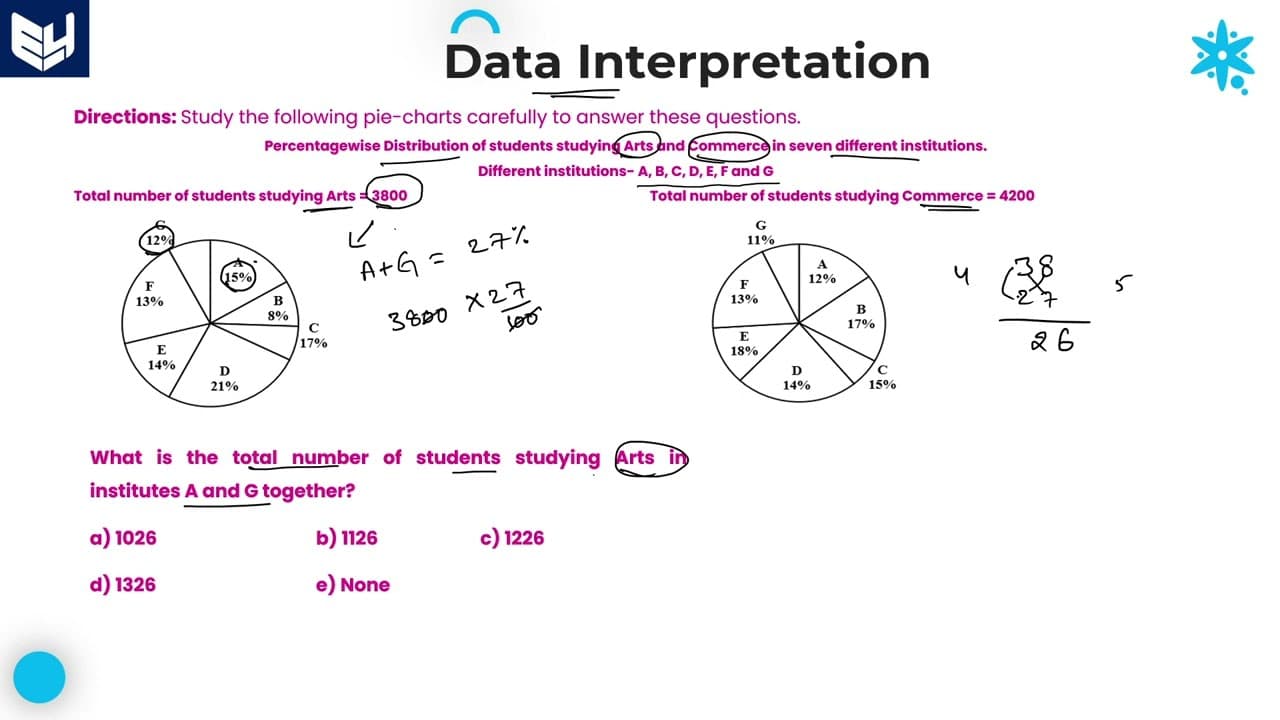
The session explains solving pie chart problems for student distribution in different institutes.
Transcript
hi everyone welcome to the session in this session I am continuing a pie chart date and preparation first of all you need to read the information which is provided in this pie chart after that you need to solve the questions based on this sum here the information is about a percentage distribution of students studying in Arts and Commerce in seven ... Read More
Key Insights
- 🧑🎓 Pie charts are a visual tool for understanding the distribution of students across different fields of study, such as Arts and Commerce.
- 🎭 It is essential to gather percentage data accurately from charts before performing calculations required for answering questions.
- ℹ️ Combining percentages from multiple sources helps simplify calculations and yields quicker results.
- 😥 Data interpretation involves not just computation, but also logical reasoning and understanding of relationships between different data points.
- 😷 Students can often avoid unnecessary calculations by focusing only on what questions specifically ask for.
- 🧑🎓 Mastering data interpretation improves problem-solving efficiency and prepares students for a variety of examination scenarios.
- 🐎 Regular practice with pie chart problems enhances familiarity, improving speed and accuracy in real-time test situations.
Install to Summarize YouTube Videos and Get Transcripts
Explore YouTube Video Summarizer or Get YouTube Transcript Extractor
Questions & Answers
Q: What methodology should be used to approach the given pie charts?
First, viewers should thoroughly read and understand the information in the pie charts. This understanding is crucial before attempting to solve any related questions. The data interpretation method requires focusing on relevant information, making it easier to tackle examination questions efficiently.
Q: How do you calculate the number of students studying Arts from Institute A and G?
To find the total number of students studying Arts in Institutes A and G, first determine the combined percentage from the pie charts (15% + 12% = 27%). Then, calculate 27% of the total number of Arts students (3,800), leading to the required number of 1,026 students.
Q: What steps are involved in finding student distribution from Institute B?
Begin by determining the percentages of Arts and Commerce students in Institute B (8% for Arts and 17% for Commerce). Then, calculate these percentages from the total of 3,800 Arts students and 4,200 Commerce students, culminating in adding both values for an overall total from Institute B.
Q: Why is understanding averages, ratios, and percentages critical in data interpretation?
A solid grasp of averages, ratios, and percentages is essential because they form the foundation for interpreting and solving pie chart problems. Mastery of these areas boosts confidence and enables students to tackle various data interpretation challenges more effectively.
Summary & Key Takeaways
-
The session focuses on solving pie chart problems related to student enrollment in Arts and Commerce across seven institutes.
-
It emphasizes the importance of understanding the data before attempting to answer questions based on the charts presented.
-
Key calculations for determining student numbers from specific institutes are demonstrated, showing strategic shortcuts for efficiency.
Read in Other Languages (beta)
Share This Summary 📚
Summarize YouTube Videos and Get Video Transcripts with 1-Click
Try YouTube Summary with ChatGPT & Claude or YouTube Transcript Generator