How Does a Mach-Zehnder Interferometer Work?
TL;DR
A Mach-Zehnder interferometer uses beam splitters and mirrors to manipulate photon behavior during detection. When unblocked, all photons direct to one detector, but introducing a blockage alters detection probabilities, revealing counterintuitive outcomes where photons can now be detected at different locations.
Transcript
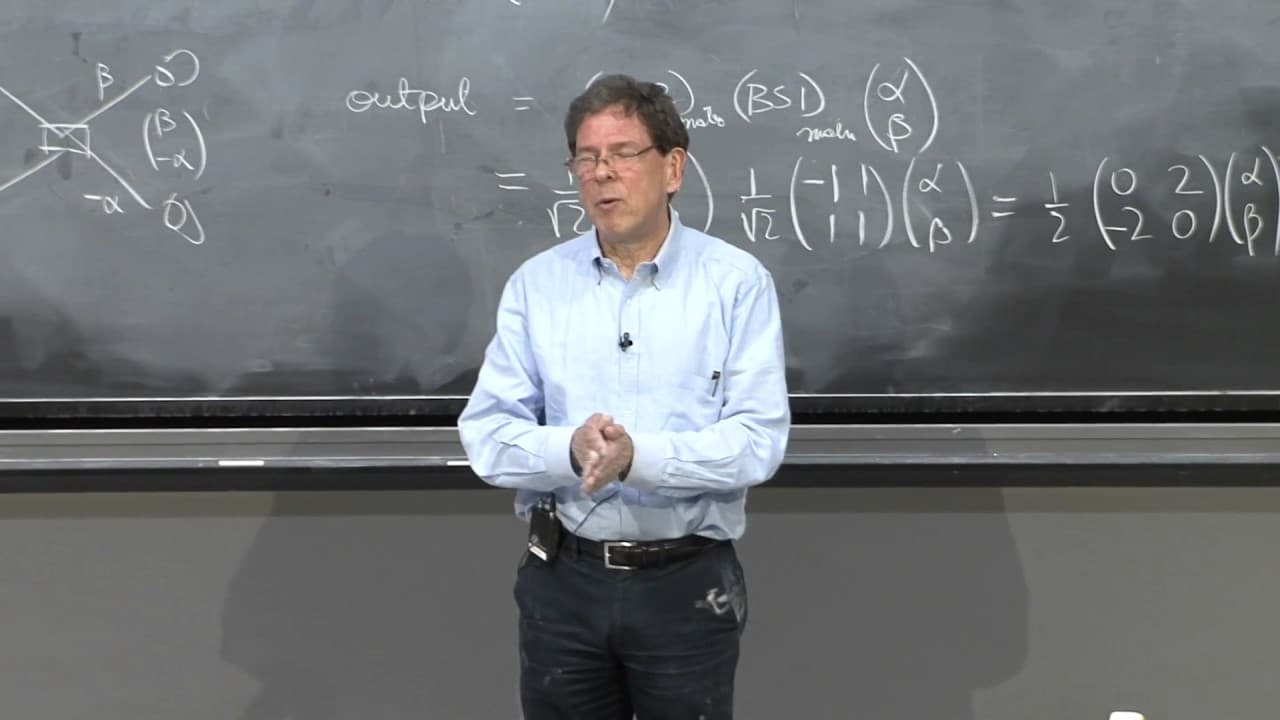
PROFESSOR: And let me I assume, for example, that I'll put the state alpha beta in. Alpha and beta. What do I get out? So you have this state, alpha beta. What do you get out? Well, state comes in and is acted by beam splitter 1. So you must put the beam splitter, 1 matrix. And then it comes the mirrors. And lets assume mirrors do nothing. In fact,... Read More
Key Insights
- 😁 Mach-Zehnder interferometers can manipulate the behavior of photons through the use of beam splitters, mirrors, and detectors.
- ❓ Interference occurs when the divided photons recombine, resulting in constructive or destructive interference.
- 💱 The introduction of a blockage in one path of the interferometer can change the probabilities of detection at different detectors.
- 🥺 Counterintuitively, blocking one path can lead to the detection of photons at previously unused detectors.
- 🦾 The behavior of photons in a Mach-Zehnder interferometer is intricately linked to quantum mechanical calculations and probability amplitudes.
- 🏛️ The results highlight the non-classical nature of quantum interference and the need to consider counterintuitive effects in quantum systems.
- 🦾 The outcomes of these experiments demonstrate the importance of understanding quantum mechanics for accurately predicting the behavior of particles.
Install to Summarize YouTube Videos and Get Transcripts
Explore YouTube Video Summarizer or Get YouTube Transcript Extractor
Questions & Answers
Q: What is the purpose of a beam splitter in a Mach-Zehnder interferometer?
Beam splitters divide the incoming photons into two paths, creating interference and allowing for the measurement of various properties.
Q: How does interference occur in the Mach-Zehnder interferometer?
Interference arises when the two paths of the divided photons recombine, resulting in constructive or destructive interference, leading to different probabilities of detection.
Q: What happens when a blockage is placed in one path of the interferometer?
Blocking one path changes the probabilities of detection at the detectors, allowing for the detection at previously unused detectors.
Q: Why does the introduction of a blockage lead to counterintuitive results?
The counterintuitive results arise because blocking one path seems like it should decrease the number of detections, but in reality, it can redistribute the probabilities of detection.
Summary & Key Takeaways
-
A Mach-Zehnder interferometer consists of beam splitters, mirrors, and detectors, which can manipulate and measure the behavior of photons.
-
When a photon is sent through the interferometer without any blockage, it undergoes interference, resulting in all photons being detected at one specific detector.
-
However, when a blockage is introduced in one path of the interferometer, the probabilities of detection at different detectors change, with some photons now being detected at the previously unused detector.
Read in Other Languages (beta)
Share This Summary 📚
Summarize YouTube Videos and Get Video Transcripts with 1-Click
Try YouTube Summary with ChatGPT & Claude or YouTube Transcript Generator
Explore More Summaries from MIT OpenCourseWare 📚


Summarize YouTube Videos and Get Video Transcripts with 1-Click
Try YouTube Summary with ChatGPT & Claude or YouTube Transcript Generator