Island Universes: Discovering Galaxies Beyond the Milky Way - Chris Lintott
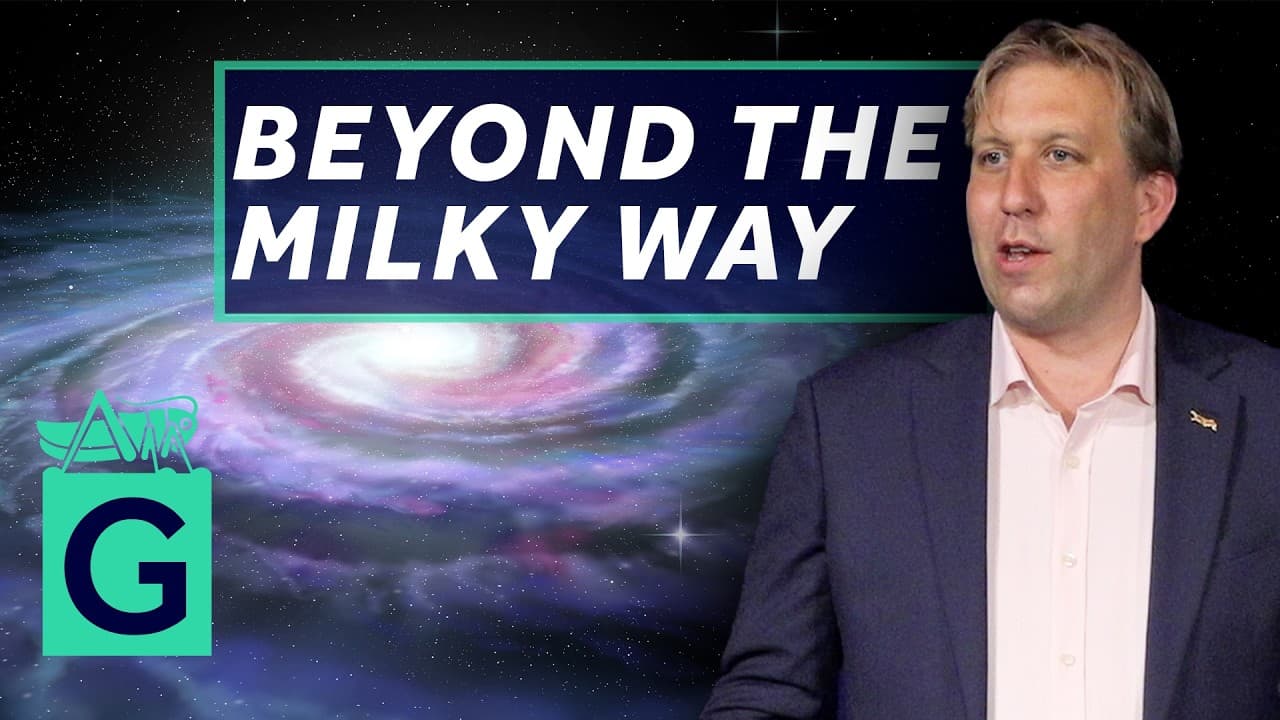
TL;DR
The universe is incredibly vast, with billions of galaxies and stars, and our understanding of its size and complexity continues to expand.
Transcript
foreign it's good practice as anyone who's taught knows to start with the thing that you want the audience to take away so I'm going to give away the ending of my three years of Gresham lectures the universe we're pretty sure is really big and if you remember nothing else from these lectures I want you to know that it's really really really big and... Read More
Key Insights
- 🤔 The universe is much larger than initially thought, with hundreds of billions of galaxies.
- 🤩 Galaxies collide and merge over billions of years, shaping their structure and triggering star formation.
- 🤩 Astronomers use various techniques, such as spectroscopy and parallax, to measure the distance to stars and galaxies.
- 💁 The early universe underwent a burst of star formation, with galaxies forming at an accelerated rate.
- ⏮️ The Hubble Deep Field image revealed a wealth of distant galaxies, challenging previous assumptions about the early universe.
- 👶 New telescopes, like the James Webb Space Telescope, continue to expand our knowledge of the universe.
Install to Summarize YouTube Videos and Get Transcripts
Explore YouTube Video Summarizer or Get YouTube Transcript Extractor
Questions & Answers
Q: How did astronomers measure the distance to stars and galaxies?
Astronomers used methods like parallax and spectroscopy to measure distances. Parallax involves observing the apparent shift in the position of a star as the Earth orbits the Sun. Spectroscopy analyzes the light emitted by stars and galaxies to determine properties like temperature, composition, and distance.
Q: Are there more stars in the observable universe than grains of sand on Earth?
It is often said that there are more stars in the observable universe than grains of sand on Earth, but the exact number is unknown. This comparison highlights the vastness of the universe and the countless stars it contains. However, the precise number of grains of sand on Earth is also uncertain.
Q: Why do galaxies collide and merge?
Galaxies collide and merge due to the gravitational interactions between them. Over billions of years, some galaxies come close to each other and their gravitational pull causes them to merge. These interactions can trigger bursts of star formation and create new structures within galaxies.
Q: How did the Hubble Deep Field image change our understanding of the universe?
The Hubble Deep Field image, which captured a seemingly empty patch of the sky, revealed a multitude of distant galaxies. It showed that the early universe was filled with galaxies undergoing rapid star formation. This challenged previous assumptions and expanded our understanding of the early stages of galaxy formation.
Summary & Key Takeaways
-
The universe is much larger than previously thought, with hundreds of billions of galaxies, each containing billions of stars.
-
Our Milky Way galaxy is just one of many galaxies in the universe, and it is considered ordinary in size and appearance.
-
Astronomers use various methods, such as parallax and spectroscopy, to measure distances to stars and galaxies.
-
The universe is not only vast, but also dynamic, with galaxies colliding and merging over billions of years.
Read in Other Languages (beta)
Share This Summary 📚
Summarize YouTube Videos and Get Video Transcripts with 1-Click
Try YouTube Summary with ChatGPT & Claude or YouTube Transcript Generator
Explore More Summaries from Gresham College 📚


Summarize YouTube Videos and Get Video Transcripts with 1-Click
Try YouTube Summary with ChatGPT & Claude or YouTube Transcript Generator