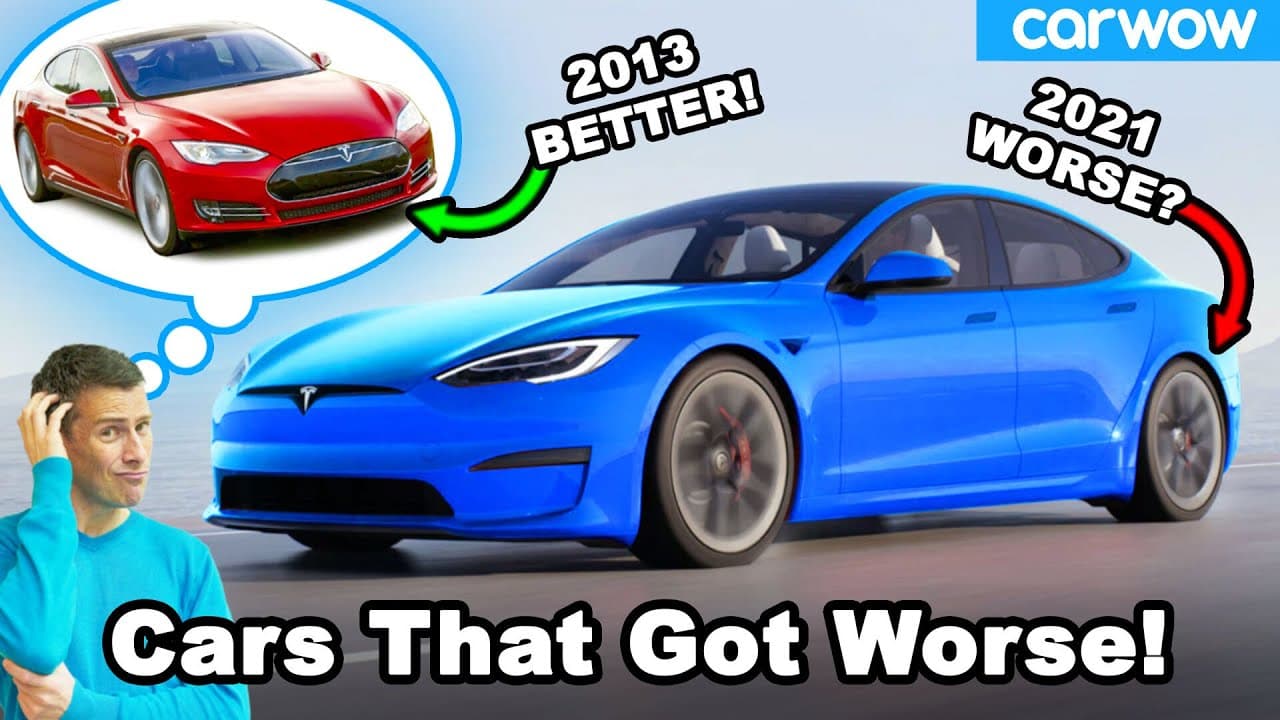
Why were these NEW cars WORSE than their predecessors?
TL;DR
Some newer cars were worse because added weight, weaker design choices, altered drivetrains, or less character undermined what made their predecessors special. The Honda Civic Type R FN2, for example, cost almost twenty thousand pounds, weighed nearly 100 kilos more than the EP3, and gained only one horsepower. Read on to compare the specific compromises made across eight notable successors.
Transcript
some new cars are actually worse than their predecessors in this video i'm going to tell you about certain models which weren't as good as those that they replaced actually there's been lots of models which weren't as good as those that they replaced over the years but here i'm going to tell you the 10 worst offenders i'm at watson and you're watch... Read More
Key Insights
- 😨 The success of a car model does not always guarantee a better replacement.
- 😨 Design changes can significantly impact a car's appeal and reception.
- 🎴 Factors such as weight, performance, and driving experience play crucial roles in determining a car's overall quality.
- 😨 Maintaining the essence and heritage of a popular car model is essential for its successor's success.
- 🥺 Changes in engine options, drivetrain systems, and added features can lead to varying levels of customer satisfaction.
Install to Summarize YouTube Videos and Get Transcripts
Explore YouTube Video Summarizer or Get YouTube Transcript Extractor
Questions & Answers
Q: Why was the Honda Civic Type R FN2 worse than the EP3?
The FN2 cost almost twenty thousand pounds, about four thousand pounds more than the EP3, and weighed nearly 100 kilos more. Its two-liter engine produced 201 horsepower, only one horsepower more, and its torsion-beam rear axle made it less fun to drive than the EP3 with multi-link independent rear suspension.
Q: Why did the BMW F10 M5 have less character than the E60 M5?
The F10 looked ordinary beside the futuristic, Bangle-designed E60. Its 4.4-liter twin-turbo V8 did not sound as good as the E60’s high-revving V10, and it was not available as an estate like the E61 M5.
Q: What made the Ford Mustang II disappointing?
The Mustang II had an unappealing design and arrived during the fuel crisis with a 2.3-liter four-cylinder engine. Producing only 90 horsepower, it lacked the performance expected from a muscle car.
Q: Why was the Mazda MX-5 Mark II considered worse than the Mark I?
The Mark II, also called the NB, lost the Mark I’s pop-up headlights and received a less appealing design. Extra chassis metal trapped water and caused rot, while also helping make the car 100 kilos heavier than the Mark I.
Q: Did the Mazda MX-5 Mark II have any advantage over the Mark I?
Its cabin was described as nicer and more comfortable. In the UK, the Mark II 1.8iS also came with a Torsen limited-slip differential as standard, which was the presenter’s main reason for choosing it.
Q: Why was the revived Lotus Elan worse than the original?
The original Elan was a light, front-engine, rear-wheel-drive convertible that weighed 680 kilos. The revived model switched to front-wheel drive, weighed about 300 kilos more, looked dumpier, and used an Isuzu engine.
Q: Why were the Porsche Boxster and Cayman 718 models less appealing than their predecessors?
The 718 models used turbocharged engines. According to the summary, those engines lacked the character and instant throttle response of the predecessors.
Q: Why did the third-generation Mitsubishi Eclipse fail to match earlier versions?
The third-generation Eclipse adopted a heavy V6 engine and front-wheel drive. According to the summary, these changes meant it failed to live up to the earlier rally-inspired versions.
Summary & Key Takeaways
-
The Honda Civic Type R fn2, which succeeded the popular ep3 model, was not as good in terms of price, weight, performance, and driving experience.
-
The BMW E60 M5, although an impressive high-performance saloon, lacked the character and unique design of its predecessor, the E60 M5.
-
The Ford Mustang II from the 70s had a lackluster design, underpowered engine, and failed to capture the essence of a muscle car like its successful predecessor.
-
The Mazda MX-5 Mark II (NB model) had design changes, including headlights and additional weight, which decreased its appeal compared to the Mark I.
-
The Lotus Elan, when revived in 1989, lost its classic design and rear-wheel-drive layout, compromising its driving experience.
-
The Porsche Boxster and Cayman 718 models, with their turbocharged engines, lacked the character and instant throttle response of their predecessors.
-
The Toyota Celica's replacement in 1999 lacked rally heritage, had lower horsepower, and changed to a front-wheel-drive system, diminishing its performance.
-
The Mitsubishi Eclipse's third-generation model, featuring a heavy V6 engine and front-wheel drive, failed to live up to its previous rally-inspired versions.
-
The Volkswagen Golf GTI Mark IV disappointed with its diesel engine option, low horsepower, and unremarkable appearance compared to earlier GTI models.
-
The original Tesla Model S offered free lifetime charging at superchargers, a perk that was no longer available in newer versions.
Read in Other Languages (beta)
Share This Summary 📚
Summarize YouTube Videos and Get Video Transcripts with 1-Click
Try YouTube Summary with ChatGPT & Claude or YouTube Transcript Generator
Explore More Summaries from carwow 📚




Summarize YouTube Videos and Get Video Transcripts with 1-Click
Try YouTube Summary with ChatGPT & Claude or YouTube Transcript Generator