How Will Global Connectivity Reshape Society?
TL;DR
Universal internet access will reshape identity, community, governance, rights, and the social contract more profoundly than narrowly defined security threats. Political leaders should place terrorism and similar dangers in perspective while preparing for paradigm risk: the possibility that institutions and assumptions inherited from a geographically organized past will fail in a world of global, digitally connected communities.
Transcript
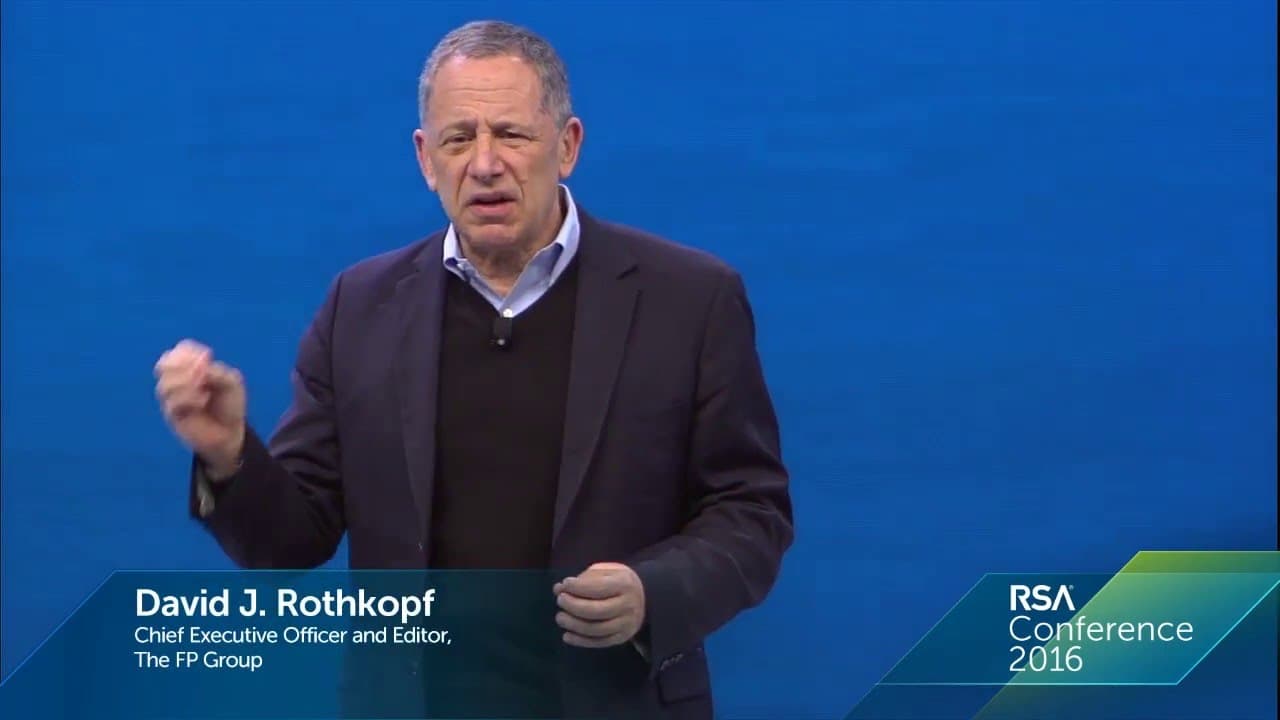
Ladies and gentlemen, please welcome Chief Executive Officer and Editor, the FP Group, publishers of Foreign Policy Magazine, David Rothkopf. Good afternoon, everybody. I see thousands of you streaming for the exit. I'm not gonna take it personally. I've listened to some of the speeches that you've been hearing here today, and they're a little frig... Read More
Key Insights
- Fear has shaped American political psychology since September 11, directing attention toward terrorism, hacking, refugees, immigrants, and people perceived as different. Rothkopf argues that this pattern turns specific dangers into generalized suspicion and prevents society from evaluating risks in proportion to their actual scale.
- The September 11 attacks were psychologically devastating despite Al-Qaeda having about one hundred people at the time, according to the Central Intelligence Agency figure cited by Rothkopf. The response treated a limited organization as though it presented the kind of existential danger associated with much larger historical threats.
- Small risks can produce sweeping policies when authorities generalize from what one attacker might theoretically accomplish. Rothkopf uses airport shoe removal to illustrate how a single attempted method can cause everyone sharing an ordinary characteristic to be treated as a continuing risk, even when that specific threat does not recur.
- ISIS was dangerous but not an existential threat in Rothkopf's assessment. He describes it as an organization of perhaps thirty thousand people that operated almost like a country in Iraq and Syria, displaced refugees, and conducted attacks, while warning that intense focus on one group can obscure surrounding dangers.
- Historical crises can hide transformations that ultimately reorganize civilization. Rothkopf recalls his father's claim that the plague killed one hundred million people in fourteenth-century Europe and was followed by the Renaissance, using the story to argue that visible catastrophe may distract observers from epochal political, economic, social, philosophical, and artistic change.
- Paradigm risk is the possibility that familiar frameworks no longer match current facts. Rothkopf argues that foreign policy, domestic policy, economics, social policy, and fundamental philosophies remain based on the past and may be inadequate for addressing the conditions created by a new technological era.
- Universal connectivity is presented as a watershed in which every human could participate in a man-made internet system. Rothkopf predicts that smartphones or nearby smartphones will effectively reach the entire planet, enabling an idea from any person in any location to affect people everywhere else.
- Identity and governance may change when affinity is no longer determined primarily by geographic proximity. Online networks let people form healthy support communities or harmful extremist groups, while the arrival of previously disconnected and unequal populations could create opportunity, alienation, political expression, and pressure for new forms of participation.
Install to Summarize YouTube Videos and Get Transcripts
Explore YouTube Video Summarizer or Get YouTube Transcript Extractor
Questions & Answers
Q: Why should terrorism risks be kept in perspective?
Terrorism risks should be kept in perspective because psychological shock can make a relatively small organization appear existential. Rothkopf notes that Al-Qaeda had about one hundred people when the September 11 attacks occurred, yet the United States responded as if it faced a threat comparable to historically existential attacks. Proportionate analysis can address genuine danger without turning every person or ordinary behavior into a presumed risk.
Q: What is paradigm risk in politics and society?
Paradigm risk is the danger that established ways of understanding and managing society no longer fit the facts of a changing era. Rothkopf applies the concept to foreign policy, domestic policy, economics, social policy, governance, and fundamental philosophy. If these frameworks remain rooted in past conditions, they may misidentify important problems and fail to guide decisions about the transformations produced by global digital connectivity.
Q: How can universal internet access change personal identity?
Universal internet access can change identity by allowing individuals to define themselves through relationships with people who share their interests, experiences, or beliefs rather than through geographic neighbors. For most of civilization, nearby communities largely determined association and belonging. Digital networks weaken that constraint, making virtual communities, including both supportive groups and extremist networks, increasingly important sources of purpose, solidarity, and self-definition.
Q: How might online communities affect national governance?
Online communities may weaken the assumption that geography is the natural basis of political organization. When people feel greater affinity with distant, like-minded groups than with nearby residents, their relationship to national communities and public authorities can change. Rothkopf suggests that this development raises questions about electronic referenda, political participation, accountability, and whether geographic proximity will remain the best way to define a nation.
Q: Why can focusing on one security threat create new risks?
Focusing intensely on one security threat can narrow institutional attention and cause surrounding dangers to be overlooked. Rothkopf uses the rise of ISIS to illustrate this problem, arguing that concentrated concern about a particular terrorist risk did not prevent another organization from operating almost as a country in Iraq and Syria, displacing refugees, destabilizing societies, and carrying out attacks in Paris, Brussels, and elsewhere.
Q: Who are the next populations expected to join the internet?
The next populations expected to enter the internet are described as people who have remained off the grid, experienced inequality, and differed substantially from established online communities. Rothkopf says they may treat connectivity as an avenue to opportunity, but some may also use it to express alienation or grievances in destabilizing ways. Their participation could therefore alter both the composition and political character of digital society.
Q: What does the Renaissance analogy say about future change?
The Renaissance analogy suggests that people absorbed by immediate crises may fail to recognize a much larger transformation developing around them. Rothkopf recounts his father's comparison between fears of nuclear war and the plague in fourteenth-century Europe, which was followed by the Renaissance. His broader point is that today's visible threats may pale beside technological changes capable of reorganizing economics, politics, society, philosophy, and art.
Q: How could global connectivity alter the social contract?
Global connectivity could alter the social contract by changing the communities through which people understand belonging, mutual obligation, and authority. The traditional contract assumes that individuals are better off inside a geographically organized society than outside it. If identity and affinity increasingly arise from borderless virtual groups, people may reconsider which community represents them, whom they accept as governing authorities, and why existing institutions deserve their participation.
Summary & Key Takeaways
-
Fear has dominated American politics since the September 11 attacks, encouraging governments and citizens to magnify limited dangers into seemingly existential threats. Terrorism, hacking, refugees, and immigrants have consequently occupied disproportionate attention. Rothkopf argues that real risks must still be addressed, but their scale and likelihood require careful perspective rather than generalized suspicion.
-
Rothkopf compares the present moment to periods when immediate disasters obscured larger historical transformations. His central concern is paradigm risk, the danger that established approaches to foreign policy, economics, domestic governance, social policy, and philosophy rely on outdated conditions. Technological change may therefore invalidate assumptions that previously organized institutions and public decisions.
-
Near-universal internet connectivity could transform the basic fabric of civilization by allowing ideas and relationships to cross every geographic boundary. Identity may increasingly come from dispersed, like-minded online communities rather than nearby populations or nations. This change could alter social belonging, political authority, electronic participation, national organization, and the reasons individuals accept society's social contract.
Read in Other Languages (beta)
Share This Summary 📚
Summarize YouTube Videos and Get Video Transcripts with 1-Click
Try YouTube Summary with ChatGPT & Claude or YouTube Transcript Generator
Explore More Summaries from RSAC Cybersecurity 📚
Summarize YouTube Videos and Get Video Transcripts with 1-Click
Try YouTube Summary with ChatGPT & Claude or YouTube Transcript Generator