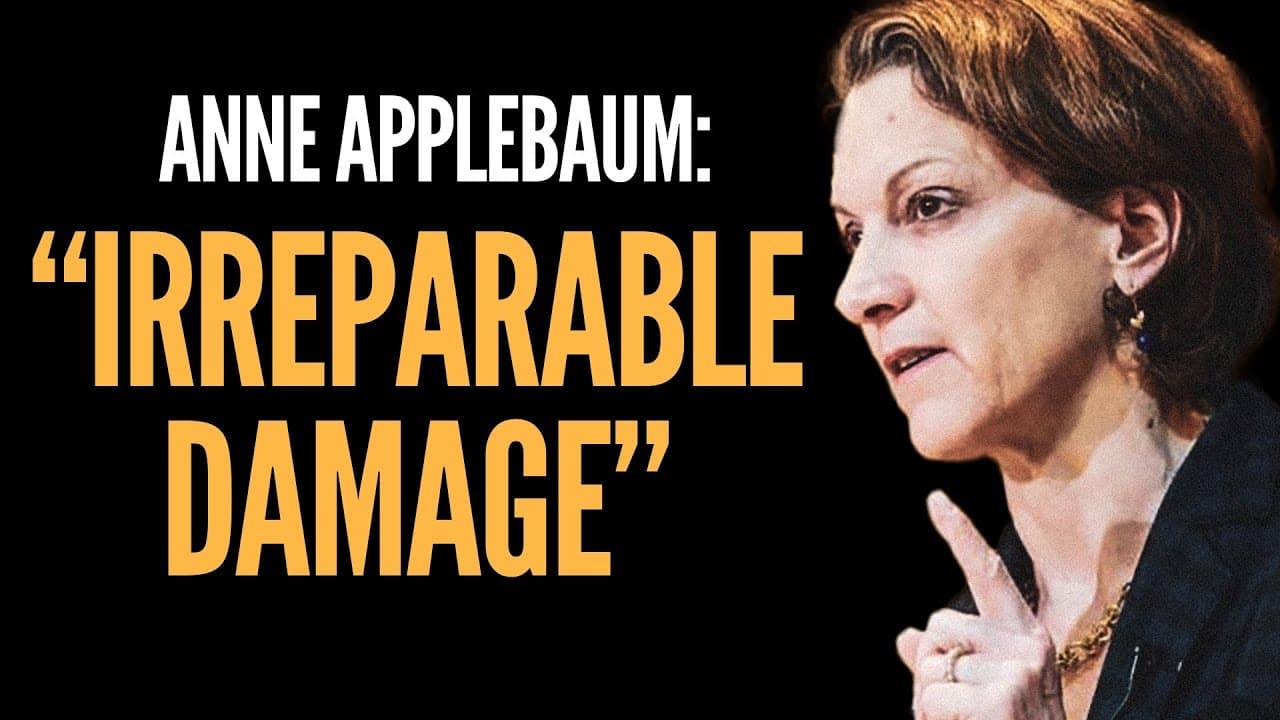
Anne Applebaum: Second Trump Term Would Be a Global Catastrophe | Bulwark Podcast Clip
TL;DR
A second Trump term could undermine NATO and American world leadership by casting doubt on whether the United States would defend its allies. Anne Applebaum argues that NATO’s Article Five deters attacks through the expectation of collective defense; Trump could weaken that expectation simply by saying he would not honor it. The resulting uncertainty could destabilize Europe and Asia, making it worth reading on for the specific risks to allies and US influence.
Transcript
I think a lot of people have not thought through exactly what it would mean uh if Trump were to be reelected for the NATO alliance and not just for the NATO alliance but for American world leadership in general so you quoted um you quoted him in this piece saying I don't give a about NATO uh and that was uh conveyed to you by uh uh John Bolton who ... Read More
Key Insights
- 🍉 Trump's transactional approach to alliances reflects a disregard for the long-term benefits of collective defense and American leadership.
- ❓ The psychological impact of Trump's skepticism towards NATO and potential withdrawal could undermine trust in the US as a reliable partner.
- 🥺 The loss of confidence in US security guarantees could lead to recalibration and shifts in alliances, potentially causing instability in Europe and Asia.
- 👨💼 Economic consequences could result from damaged business relationships between the US and its allies, impacting American influence and stability.
Install to Summarize YouTube Videos and Get Transcripts
Explore YouTube Video Summarizer or Get YouTube Transcript Extractor
Questions & Answers
Q: Why does Anne Applebaum say a second Trump term would be a global catastrophe?
Applebaum argues that Trump could irreparably damage NATO and American world leadership by making allies and adversaries doubt that the United States would honor its security commitments. She says this uncertainty could destabilize Europe and Asia and increase the possibility of larger-scale wars in both regions.
Q: What is Trump’s attitude toward NATO and other alliances?
Applebaum describes Trump’s approach to alliances as transactional, isolationist, and focused on what benefits him personally rather than what serves America over the long term. She says he does not value how alliances expand American influence or help American companies operate in friendly countries.
Q: What does NATO’s Article Five require?
Article Five says NATO members are obliged to aid another member if it is attacked. It does not specify exactly what that aid must involve, but it creates the expectation of collective defense.
Q: How could Trump weaken NATO without formally withdrawing from it?
Applebaum says Trump could eliminate the expectation of collective defense simply by declaring that he would not come to an ally’s aid. Even if the treaty remained ratified and political institutions opposed withdrawal, his stated intent could create damaging doubt among allies and adversaries.
Q: Why is the psychological credibility of NATO important?
NATO’s deterrent effect depends on the assumption that the United States and other members will defend an ally under attack. Once adversaries doubt that response, the alliance is undermined even if its treaty remains legally in place.
Q: Which countries could be affected if US security guarantees became unreliable?
Applebaum specifically identifies Poland, the Baltic states, Germany, Taiwan, South Korea, and Japan as potentially affected. She says every country relying on the United States as a backup security guarantee would immediately face greater trouble.
Q: How has collective defense deterred attacks in Europe?
Applebaum says the Soviet Union did not invade West Germany during the Cold War because it expected the United States and other NATO members to respond. She also argues that Poland’s presumed NATO protection deters an invasion today, even as weapons pass through Poland to Ukraine.
Q: How might US allies respond if they no longer trusted American protection?
Countries could conclude that the United States is unreliable and seek accommodations with China, Russia, Iran, or another major power. Applebaum says such recalibration could weaken American influence and make international instability more likely.
Summary & Key Takeaways
-
Trump's view on alliances is transactional and driven by personal interest, rather than long-term benefits for America.
-
His attitude towards NATO reflects a deep isolationist stance and a disregard for the importance of alliances in maintaining American leadership and economic prosperity.
-
The psychological impact of Trump's skepticism towards collective defense and his potential withdrawal from NATO could undermine trust and lead to a loss of confidence in the US as a reliable partner, potentially causing instability in Europe and Asia.
Read in Other Languages (beta)
Share This Summary 📚
Summarize YouTube Videos and Get Video Transcripts with 1-Click
Try YouTube Summary with ChatGPT & Claude or YouTube Transcript Generator