What Is String Theory and Its Role in Physics?

TL;DR
String theory posits that the universe is made up of 1-dimensional strings rather than point-like particles, requiring 10 dimensions to function—six of which are compactified to create our familiar 4D spacetime. This theory unifies various superstring types and connects quantum mechanics with gravity, offering a potential framework for a 'theory of everything.'
Transcript
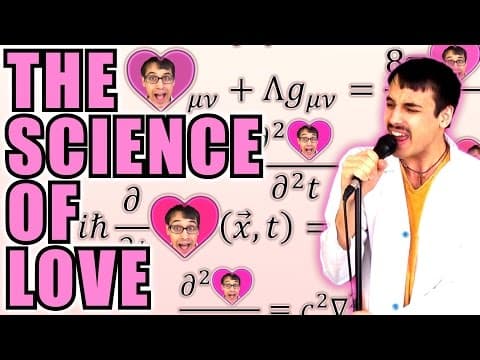
is string theory right? is it just fantasy? Caught in the landscape Out of touch with reality? Compactified on S5 or t*S3 Space is a pure void Why should it be stringy? Because it's quantum not classical; nonrenormalizable any way you quantize you encounter infinity y ou see... Quanta must interact via paths we understand using Feynman diagrams Of... Read More
Key Insights
- 😥 String theory proposes that the universe is composed of 1-dimensional strings rather than point-like particles.
- ♾️ Renormalization is a technique used in string theory to address infinities that arise in quantum calculations.
- ❓ String theory requires 10 dimensions, with 6 of them being compactified to match our observed 4-dimensional spacetime.
- 😘 The ADS/CFT holography in string theory connects gravitational phenomena in higher dimensions to non-gravitational phenomena in lower dimensions.
- 😀 String theory unifies various types of superstrings and has connections to supersymmetry, M-theory, and holography.
- ❓ Ed Witten and Juan Maldacena have made significant contributions to the development of string theory.
- 🦾 String theory has the potential to provide a unified theory of everything, combining quantum mechanics and general relativity.
Install to Summarize YouTube Videos and Get Transcripts
Explore YouTube Video Summarizer or Get YouTube Transcript Extractor
Questions & Answers
Q: What is string theory and why is it important?
String theory is a theoretical framework in physics that posits that the fundamental particles of the universe are not point-like but rather 1-dimensional strings. It is important because it aims to unite quantum mechanics and general relativity, providing a theory of everything.
Q: How are infinities addressed in string theory?
Infinities arise when trying to calculate certain quantum processes. String theory offers a possible solution through renormalization, a technique that cancels out infinities by adjusting fundamental constants.
Q: How many dimensions does string theory require?
String theory requires 10 dimensions, including time, to be consistent. The additional 6 dimensions are compactified, meaning they are "curled up" at microscopic scales, resulting in our familiar 4-dimensional spacetime.
Q: What is the ADS/CFT holography in string theory?
The ADS/CFT holography is a duality proposed by Juan Maldacena that relates gravitational phenomena in a particular higher-dimensional space (ADS) to non-gravitational phenomena in a lower-dimensional space (CFT). It has provided insights into understanding the nature of quantum gravity.
Summary & Key Takeaways
-
String theory is a quantum theory that explains the fundamental building blocks of the universe as extended 1-D objects.
-
The theory requires 10 dimensions, with 6 being compactified to yield our familiar 4-dimensional spacetime.
-
String theory unifies various types of superstrings and has connections to supersymmetry, M-theory, and holography.
Read in Other Languages (beta)
Share This Summary 📚
Summarize YouTube Videos and Get Video Transcripts with 1-Click
Try YouTube Summary with ChatGPT & Claude or YouTube Transcript Generator
Explore More Summaries from acapellascience 📚





Summarize YouTube Videos and Get Video Transcripts with 1-Click
Try YouTube Summary with ChatGPT & Claude or YouTube Transcript Generator