What Is the Photoelectric Effect and Einstein's Contribution?
TL;DR
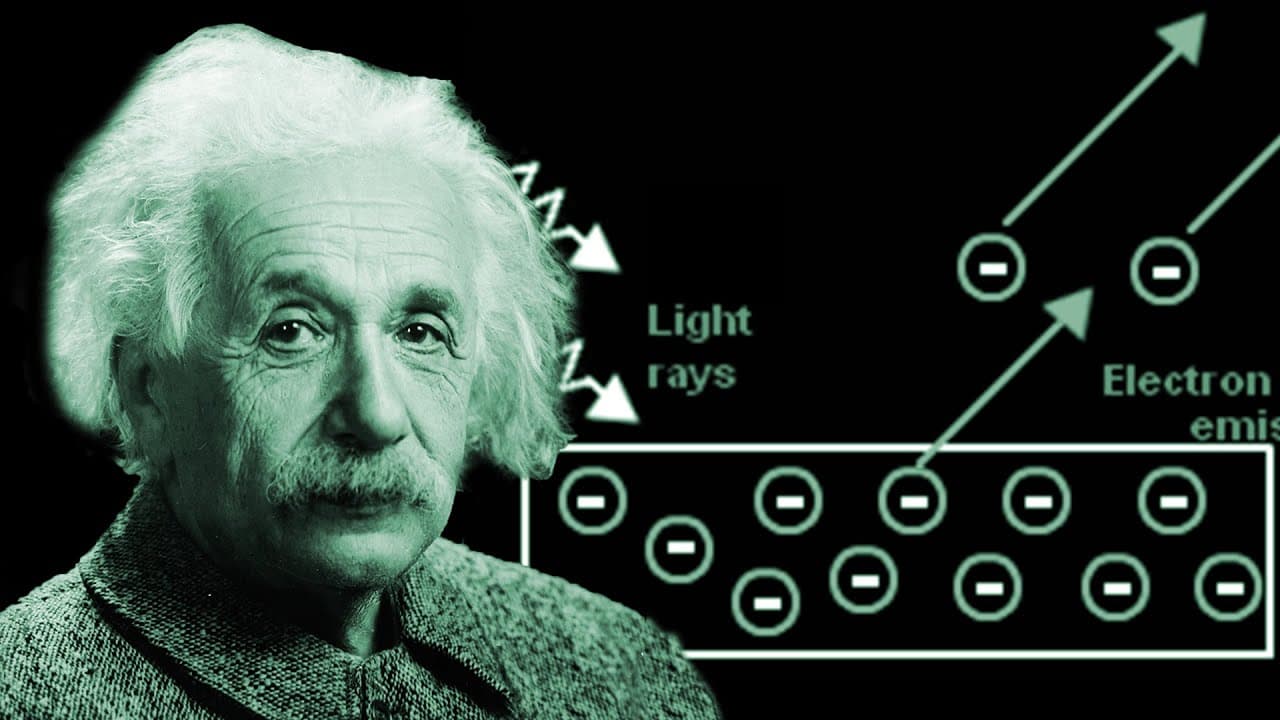
The photoelectric effect demonstrates that light consists of energy quanta called photons, which resolve two key puzzles: increasing frequency boosts electron energy but not quantity, while increased intensity raises the number of ejected electrons without boosting their energy. Einstein's insight into photons led to the wave-particle duality concept, fundamentally changing our understanding of light.
Transcript
The crucial thing was that it was Einstein who realized that the quanta were not a characteristic of the atoms the Quant were a characteristic of light itself so it wasn't that the atom could only release light in this particular way is that that light comprised of something that only only consisted of quanta and he used this insight to explain ano... Read More
Key Insights
- 🙂 Einstein realized that the quanta or photons were not just a characteristic of atoms but a characteristic of light itself.
- 🙂 The photoelectric effect presented puzzles that challenged the wave theory of light.
- 🙂 Einstein's resolution proposed that light consisted of energy quanta or photons, explaining the puzzles and leading to the concept of wave-particle duality.
Install to Summarize YouTube Videos and Get Transcripts
Explore YouTube Video Summarizer or Get YouTube Transcript Extractor
Questions & Answers
Q: What were the two puzzles that the photoelectric effect presented?
The two puzzles were that increasing the frequency of light increased the energy but not the number of ejected electrons, and increasing the intensity of light increased the number but not the energy of ejected electrons.
Q: How did Einstein resolve the puzzles of the photoelectric effect?
Einstein proposed that light consisted of energy quanta or photons, with energy proportional to their frequency. This explained why increasing frequency increased energy but not the number of ejected electrons, and why increasing intensity increased the number but not the energy of ejected electrons.
Q: Did people initially believe Einstein's photon-based explanation of light?
Initially, many believed Einstein's approach, similar to Max Planck's, was merely a mathematical device without physical reality. However, subsequent experiments confirmed the existence of photons and the wave-particle duality of light.
Q: What impact did Einstein's breakthrough have on scientific understanding?
Einstein's breakthrough paved the way for the development of quantum mechanics in the 1920s, which revolutionized our understanding of the atomic and subatomic world by incorporating the wave-particle duality of light.
Summary & Key Takeaways
-
Einstein discovered that light was not just a characteristic of atoms, but a characteristic of light itself, consisting of energy quanta or photons.
-
The photoelectric effect, where certain materials emit electrons when exposed to light, presented two puzzles: increasing the frequency of light increased the energy of ejected electrons but not their number, and increasing the intensity of light increased the number of ejected electrons but not their energy.
-
Einstein's revolutionary resolution was to propose that light consisted of photons with energy proportional to their frequency, which explained the puzzles and led to the understanding of light as both waves and particles.
Read in Other Languages (beta)
Share This Summary 📚
Summarize YouTube Videos and Get Video Transcripts with 1-Click
Try YouTube Summary with ChatGPT & Claude or YouTube Transcript Generator
Explore More Summaries from Gresham College 📚


Summarize YouTube Videos and Get Video Transcripts with 1-Click
Try YouTube Summary with ChatGPT & Claude or YouTube Transcript Generator