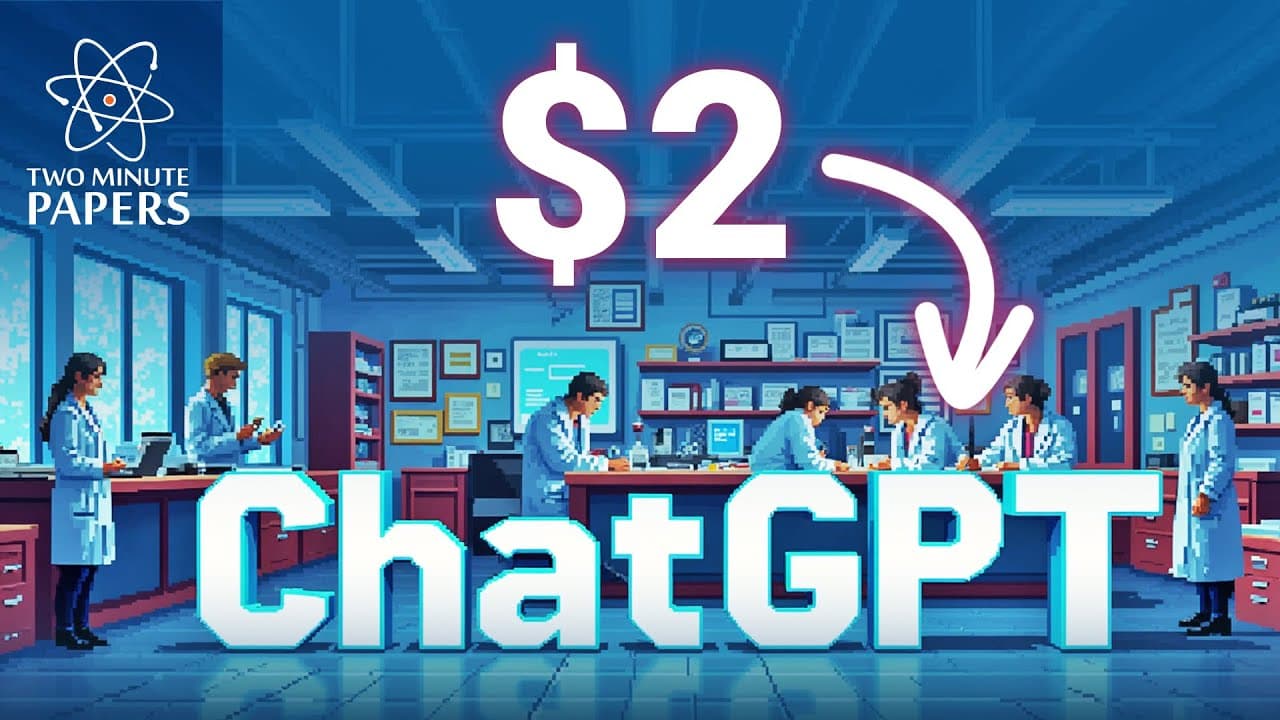
How Does ChatGPT Run a Research Lab for About $2?
TL;DR
ChatGPT can simulate a research lab by assigning separate AI agents to roles such as PhD student, postdoc researcher, and software engineer while a human supplies the initial idea. The basic workflow costs $2.33 and takes 20 minutes; using more advanced reasoning AIs costs about $13 and takes 1.5 hours. Read on to see how the agents divide the work, perform against previous techniques, and still depend on human judgment.
Transcript
Here is a crazy idea: Let’s slice up a brain into small pieces. Okay, let’s rewind a little. First, let’s not just use ChatGPT, but use it to create a full research lab. Now, wait a second. That is of course, impossible. A research lab requires the work of several people. How would we do that with just ChatGPT? Well, here is an even crazie... Read More
Key Insights
- 👨🔬 The utilization of AI models like ChatGPT can simulate collaborative research environments, enhancing problem-solving capabilities.
- 👨🔬 Cost-effective research leveraging AI shows significant potential, with projects completed quickly and affordably compared to traditional methods.
- 🌍 While AI can generate creative ideas, human insight remains essential for practical applications and real-world implementation.
- ✊ Innovative AI methods outperform previous benchmarks, highlighting the transformative power of AI in academic research.
- 👨🔬 Multi-agent simulations showcase how distinct roles in research can be effectively managed using AI technologies.
- 🤔 The collaboration between humans and AI in research can help to relieve researchers from tedious tasks, allowing more time for creative thinking.
- 🤗 Open science principles facilitate greater accessibility to research findings, fostering a more inclusive academic environment.
Install to Summarize YouTube Videos and Get Transcripts
Explore YouTube Video Summarizer or Get YouTube Transcript Extractor
Questions & Answers
Q: How does ChatGPT simulate a research lab?
Several copies of ChatGPT take on distinct research roles, including a PhD student, an experienced postdoc researcher, and two agents that write code. A human provides the initial research idea, after which the agents check prior work, create a plan, and implement the project.
Q: How much does the ChatGPT research-lab workflow cost?
The basic workflow costs $2.33 and completes its work in 20 minutes. Using more advanced reasoning AIs costs about $13 and takes 1.5 hours for research that includes an implementation, experiments, and other work.
Q: What does each AI agent do in the simulated research lab?
The ChatGPT agent acting as a PhD student checks whether the proposed idea has already been solved. A postdoc agent develops a research plan, and two additional AI agents code the implementation.
Q: What role does the human have in the AI research process?
The process begins with a human submitting the research idea, such as asking whether biases affect language-model performance on benchmarks. The human remains in charge while the AI handles time-intensive, repetitive work.
Q: How well does the multi-agent research approach perform?
The approach outperforms previous techniques across a variety of tasks and wins medals, according to the transcript. One stated limitation is that it performs poorly on tasks involving Russian.
Q: Can the AI agents invent fundamentally new research ideas?
Their ideas were evaluated as more novel and exciting than human ideas, but also less feasible. The conclusion is that AI does not produce fundamentally new, practical work without human brilliance.
Q: What changes when more advanced reasoning AIs are used?
The more advanced reasoning AIs perform the literature review better. That improvement requires more time and money, increasing the run to about $13 and 1.5 hours.
Q: Is the code and paper for the AI research lab publicly available?
Yes, the full code and paper are available free to everyone. The paper also contains a more detailed user study, with its link provided in the video description.
Summary & Key Takeaways
-
An innovative approach was taken by using multiple ChatGPT agents to simulate roles in a research lab for solving complex queries.
-
The results from this experimental setup were astonishing, with the simulated research outperforming traditional methods and achieving exceptional results for minimal costs.
-
While AI can generate novel ideas, the need for human ingenuity is crucial for practical implementations, demonstrating a collaborative future between AI and humans.
Read in Other Languages (beta)
Share This Summary 📚
Summarize YouTube Videos and Get Video Transcripts with 1-Click
Try YouTube Summary with ChatGPT & Claude or YouTube Transcript Generator
Explore More Summaries from Two Minute Papers 📚



Summarize YouTube Videos and Get Video Transcripts with 1-Click
Try YouTube Summary with ChatGPT & Claude or YouTube Transcript Generator