Agents in AI | Part-1/2 | AI | Artificial Intelligence | Lec - 04 | Bhanu Priya
TL;DR
Artificial intelligence agents perceive and act upon their environment using sensors and actuators.
Transcript
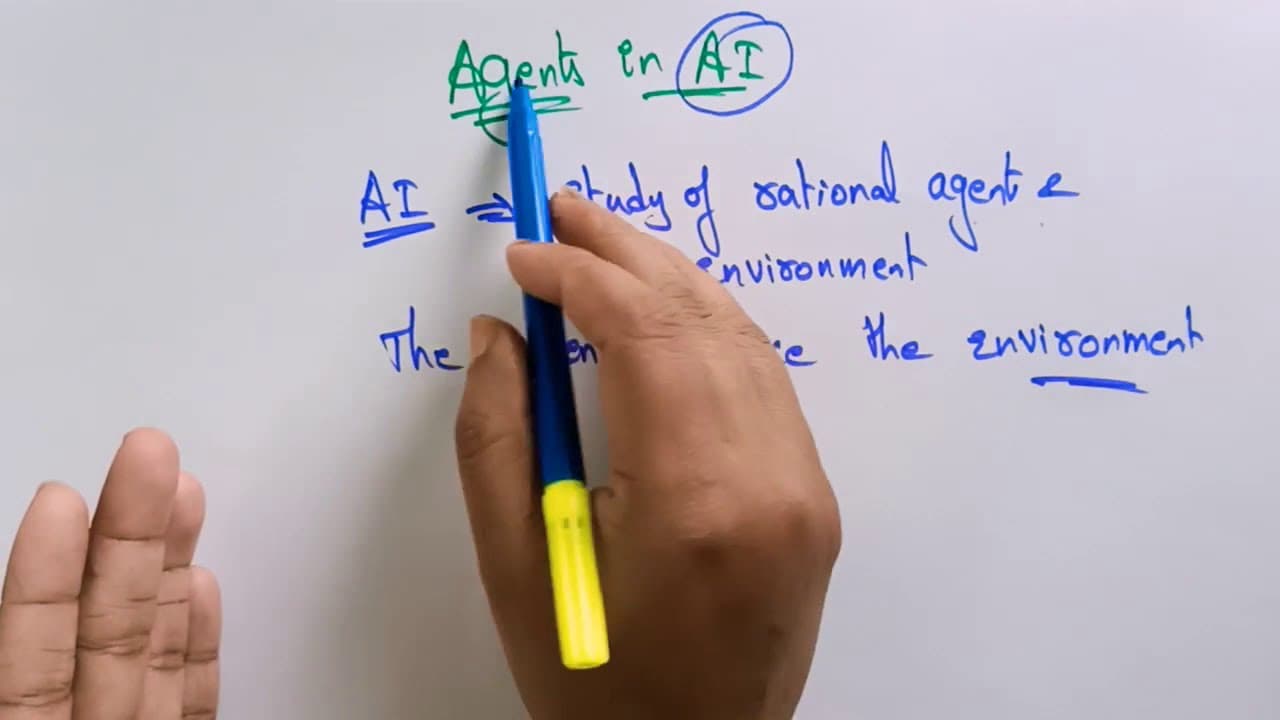
hi students welcome back coming to the next topic in the subject artificial intelligences agents in artificial intelligence so far we have discussed about AI artificial intelligence what is the definition of artificial intelligence okay so now coming to this the agents that are in artificial intelligence an artificial intelligence system is defined... Read More
Key Insights
- 🛰️ An agent in artificial intelligence defines the role of entities that sense and interact with their environment.
- 💨 The environment encompasses everything an agent perceives and responds to, shaping the way it operates.
- 😍 Human agents use their sensory organs, like eyes and ears, to perceive their surroundings, with actuators like limbs enabling interaction.
- 🧡 Robotic agents are designed with advanced sensors, such as cameras and range finders, to navigate and perform tasks autonomously.
- 👤 Software agents, such as a program responding to user inputs, serve as a different type of agent relying solely on digital interactions.
- 🌍 The relationship between agents, sensors, and actuators is crucial for the functionality of autonomous systems in real-world scenarios.
- 😨 The integration of sensors and actuators in various devices, from cars to cell phones, exemplifies the prevalence of agents in everyday life.
Install to Summarize YouTube Videos and Get Transcripts
Explore YouTube Video Summarizer or Get YouTube Transcript Extractor
Questions & Answers
Q: What is an artificial intelligence agent, and how does it work?
An artificial intelligence agent is defined as a system designed to perceive its environment, process that information, and act upon it. It uses sensors to gather data about the environment and actuators to execute actions based on that information. This cycle of perceiving, thinking, and acting enables the agent to interact effectively with its surroundings.
Q: Can you provide examples of different types of agents?
There are three primary types of agents: human agents, which are individuals like us using sensory organs to interact with the environment; robotic agents, which utilize cameras and motors for sensing and action; and software agents, which operate by processing input through keystrokes to generate outputs on a screen.
Q: How do sensors and actuators function in artificial intelligence agents?
Sensors are devices that gather information from the environment, while actuators are mechanisms that enable the agent to perform actions. For example, a self-driving car uses sensors to detect traffic and surroundings and actuators to steer, accelerate, or brake based on that sensed information, thereby navigating safely.
Q: What mental properties do artificial intelligence agents possess?
Artificial intelligence agents can embody mental properties such as knowledge, beliefs, and intentions. These attributes allow agents to make informed decisions, exhibit adaptability in varying environments, and perform tasks that mimic human cognitive functions, thereby enhancing their effectiveness in real-world applications.
Summary & Key Takeaways
-
Artificial intelligence agents are defined as entities that sense and interact with their environments, using sensors for perception and actuators for action.
-
The human body serves as an example of an agent, utilizing sensory organs for perception and body parts as actuators to interact with the environment.
-
There are three types of agents: human agents, robotic agents equipped with sensors and motors, and software agents that process input to produce output.
Read in Other Languages (beta)
Share This Summary 📚
Summarize YouTube Videos and Get Video Transcripts with 1-Click
Try YouTube Summary with ChatGPT & Claude or YouTube Transcript Generator