Landscape with St George and the Dragon - Professor Simon Thurley CBE
TL;DR
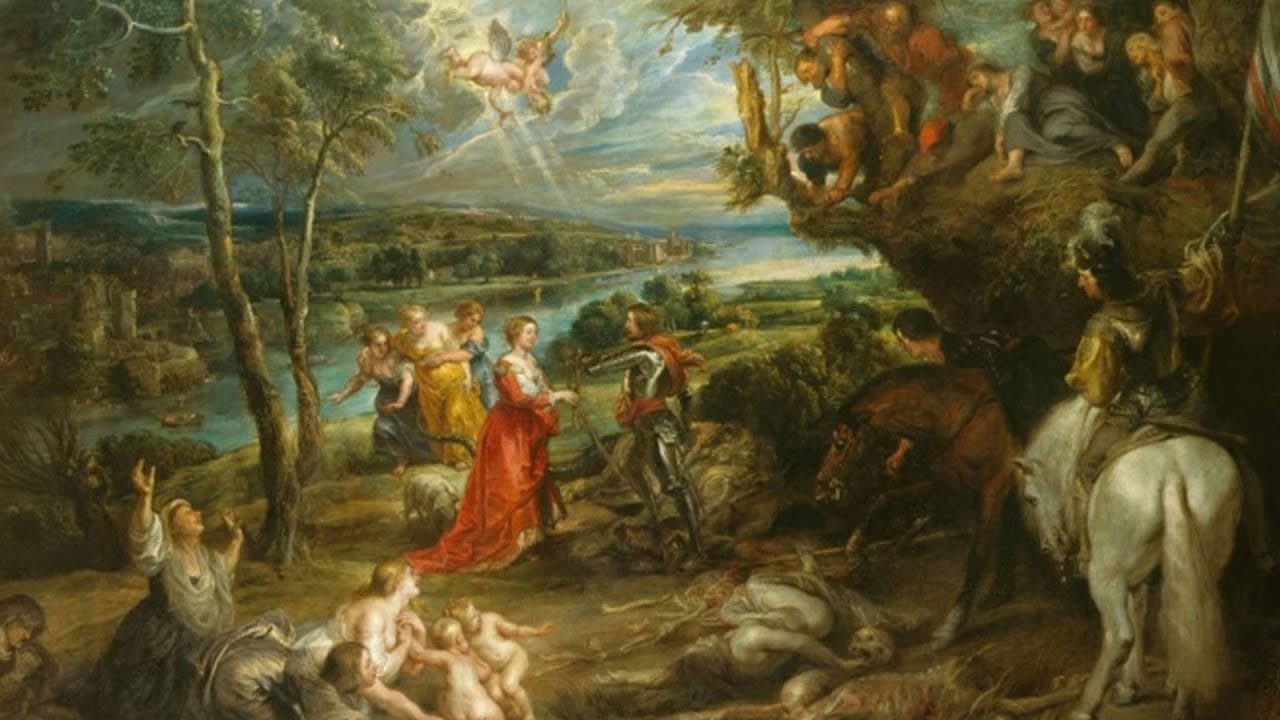
Rubens' painting of St George and the Dragon, now housed at Windsor Castle, serves as a souvenir of his time in London.
Transcript
but another painting which Rubin did while he was in London is the one that really fascinates me this now hangs at Windsor Castle it's in the Royal collection but it wasn't uh in fact a present to the king rather interestingly this painting uh was uh done in London and taken by Rubin back to antp as his own souvenir of London much better than a t-s... Read More
Key Insights
- 🗽 Rubens created the painting St George and the Dragon as a souvenir of his time in London.
- 🛀 The original composition shows a smaller central moment, with additional elements being added later.
- 📁 The painting is not a direct allegory but reflects Rubens' admiration for England and its countryside.
- 🥰 Rubens appreciated England's beauty and its great works of art.
- 🫵 The painting may have been inspired by the view from York House, with notable landmarks potentially depicted in the artwork.
- 🗽 The figure of St George in the painting resembles Charles I.
- 🕰️ The painting is not a presentation piece, but something Rubens created for himself.
Install to Summarize YouTube Videos and Get Transcripts
Explore YouTube Video Summarizer or Get YouTube Transcript Extractor
Questions & Answers
Q: Why did Rubens paint St George and the Dragon while in London?
Rubens painted it as a personal souvenir of his time in London, expressing his appreciation for England's beauty and art.
Q: Why were additional elements added to the painting after Rubens sold it to Charles I?
Rubens and his advisor likely wanted to enhance the painting's significance, adding the mounted standard and grizzly remains to make it a more substantial piece.
Q: What is the symbolism behind St George slaying the dragon?
While some have suggested it represents Rubens' diplomatic mission, it is more likely to be an English idol and tribute to England's patron saint, St George.
Q: Are the figures in the painting meant to depict Charles I and Henrietta Maria?
The figure of St George bears a resemblance to Charles I, but the lady does not resemble Henrietta Maria, making it unlikely that they were meant to be depicted as such.
Summary & Key Takeaways
-
Rubens painted St George and the Dragon while in London and later took it back to Antwerp as a personal souvenir.
-
The painting underwent changes after Rubens sold it to Charles I, with additional elements being added.
-
The artwork is not a direct allegory related to Rubens' diplomatic mission but likely represents his admiration for England and its countryside.
Read in Other Languages (beta)
Share This Summary 📚
Summarize YouTube Videos and Get Video Transcripts with 1-Click
Try YouTube Summary with ChatGPT & Claude or YouTube Transcript Generator
Explore More Summaries from Gresham College 📚

Summarize YouTube Videos and Get Video Transcripts with 1-Click
Try YouTube Summary with ChatGPT & Claude or YouTube Transcript Generator