How to Build Sustainable, Purposeful Productivity
TL;DR
Productivity improves when effort is directed toward a meaningful, clearly defined result rather than toward staying busy. Sustainable progress also requires rest, recovery, long-term thinking, careful prioritization, and simple tools, because elaborate systems and constant action can consume energy without advancing the goals that matter most.
Transcript
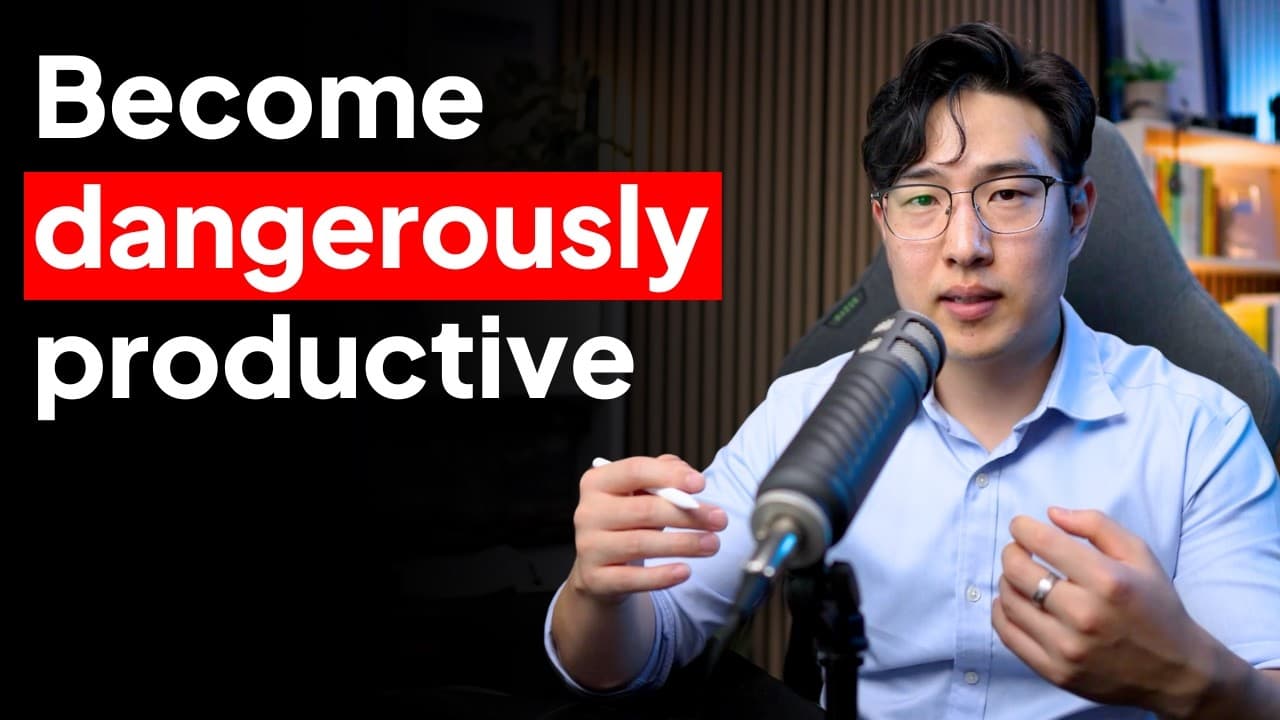
In this video, I'm going to share with you three powerful productivity principles that allow you to get so much work done compared to everyone else that it makes you dangerous. These are principles that I use to finish medical school and work as a doctor while running a business full-time and the same principles that I coach to my thousands of stud... Read More
Key Insights
- Productivity is the efficiency with which your activities create an intended product. That product might be passing an exam, earning a promotion, following a career path, or living intentionally, so productivity cannot be evaluated meaningfully until the desired result has been defined.
- Busyness is not evidence of meaningful progress. A busy person can expend substantial energy across many directions, while a productive person may perform fewer activities that consistently advance personally meaningful goals with less effort and greater purpose.
- Rest is an integral component of sustainable achievement. Sleep, breaks, planning, relationships, and enjoyable experiences preserve energy, improve the value gained from effort, and help a person remain capable of pursuing increasingly difficult goals over longer periods.
- The performance paradox is that getting more valuable output often requires doing less. Removing low-impact execution creates space for recovery and for the smaller set of actions that genuinely influence the intended result.
- Short-term success can conceal a damaging productivity strategy. Many approaches may achieve a goal within six months or one year, but habits built around constant bursts can increase burnout risk and make later, harder goals more difficult to reach.
- Self-care is a responsibility when a goal matters deeply. The person pursuing a goal is simultaneously the driver, vehicle, and fuel, so damaging personal capacity also damages the system needed to reach the destination.
- The obvious target trap is the tendency to invest effort in a visible problem simply because an obvious solution is available. Improving apps, templates, or workflows can feel productive while diverting attention from priorities that would create substantially more progress.
- Simplicity is often sufficient for managing work. A calendar, a phone notes app, and physical sticky notes can replace a fragile ecosystem of connected tools, reducing maintenance while keeping tasks and schedules accessible.
- Proper prioritization resolves most of the productivity problems identified in the transcript. New apps and time-blocking techniques cannot compensate for spending time on activities that do not meaningfully advance the intended product.
Install to Summarize YouTube Videos and Get Transcripts
Explore YouTube Video Summarizer or Get YouTube Transcript Extractor
Questions & Answers
Q: How can productivity be measured meaningfully?
Productivity can be measured by how efficiently an activity contributes to an intended product. The product must first be identified, whether it is passing an exam, getting a job, earning a promotion, developing a career, or living intentionally. Once the outcome is clear, activities can be judged by whether they create meaningful progress rather than merely filling time or generating visible effort.
Q: What is the difference between being busy and being productive?
Being busy means spending time and energy doing many things, often in several directions. Being productive means choosing activities that meaningfully contribute to a desired result. A productive person may therefore appear less active than a busy person while making more consistent progress, because each selected action has a clear purpose connected to the outcome that matters.
Q: What is the performance paradox in productivity?
The performance paradox is the idea that producing more valuable results can require doing less. Constant execution is not useful when the selected activities have little effect on the intended outcome. Reducing low-impact work preserves energy for important actions, rest, recovery, relationships, and planning, which can improve both efficiency and the ability to continue pursuing difficult goals over time.
Q: Why is rest part of productive work?
Rest supports the person whose energy and judgment are required to achieve the goal. Sleep, breaks, and recovery help maintain performance, improve the return gained from effort, and reduce the risk of burning out before later objectives are reached. Because people are not machines, a strategy that ignores maintenance may deliver a short-term result while weakening long-term capacity.
Q: Why should productivity goals include a long-term perspective?
A short-term objective may be reachable through many imperfect methods, including intense approaches that cannot be sustained. Longer and more difficult goals allow fewer workable paths. Extending the time horizon reveals whether current habits preserve energy and capability or create burnout, making it easier to choose systems that support both the immediate result and the goals that follow it.
Q: What is the obvious target trap?
The obvious target trap occurs when someone notices a visible problem, identifies an apparent solution, and invests time or resources in fixing it without first deciding whether the problem deserves priority. Productivity apps and elaborate templates can become such targets. They may create a sense of optimization while consuming attention that could be directed toward work with a stronger connection to the intended result.
Q: Why can a complicated productivity system become counterproductive?
A complicated system can require several connected tools, repeated maintenance, and detailed knowledge of how every component works. If one app changes and breaks a connection, the full system may become difficult to use. Tasks and schedules can then become trapped in a backlog that must be manually moved elsewhere. The organizational system becomes another demanding project instead of supporting meaningful work.
Q: What simple tools can support personal productivity?
The simple system described in the transcript consists of a calendar app, the notes app on a phone, and physical sticky notes. These tools handle schedules, stored information, and immediately visible reminders without requiring an elaborate connected ecosystem. The broader principle is to use only what is needed, because additional features and integrations do not automatically create more meaningful progress.
Q: How does prioritization improve productivity?
Prioritization improves productivity by identifying which actions meaningfully influence the desired outcome and which merely appear useful. It prevents visible but low-value problems from absorbing time and reduces dependence on new applications, templates, or scheduling techniques. When priorities are clear, effort can be concentrated on purposeful work, while unnecessary execution can be removed to preserve energy and attention.
Summary & Key Takeaways
-
Productivity should be measured by how efficiently actions create an intended result, such as passing an exam, advancing a career, or living intentionally. Busy people may direct energy toward many activities, while productive people choose purposeful actions. Defining the desired product makes it easier to distinguish meaningful progress from motion that only appears useful.
-
The performance paradox is that producing more over time can require doing less. Sleep, breaks, planning, relationships, and recovery may not resemble conventional work, but they preserve the person responsible for reaching the goal. Short-term methods that cause burnout can undermine harder long-term objectives, so sustainable performance requires treating self-care as part of execution.
-
The obvious target trap occurs when a visible problem attracts an obvious but low-value solution. Elaborate combinations of productivity apps can feel efficient yet become fragile, complicated, and costly to maintain. Strong prioritization solves many problems more directly, while a simple calendar, phone notes, and physical sticky notes may provide all the organization actually required.
Read in Other Languages (beta)
Share This Summary 📚
Summarize YouTube Videos and Get Video Transcripts with 1-Click
Try YouTube Summary with ChatGPT & Claude or YouTube Transcript Generator
Explore More Summaries from Justin Sung 📚


Summarize YouTube Videos and Get Video Transcripts with 1-Click
Try YouTube Summary with ChatGPT & Claude or YouTube Transcript Generator