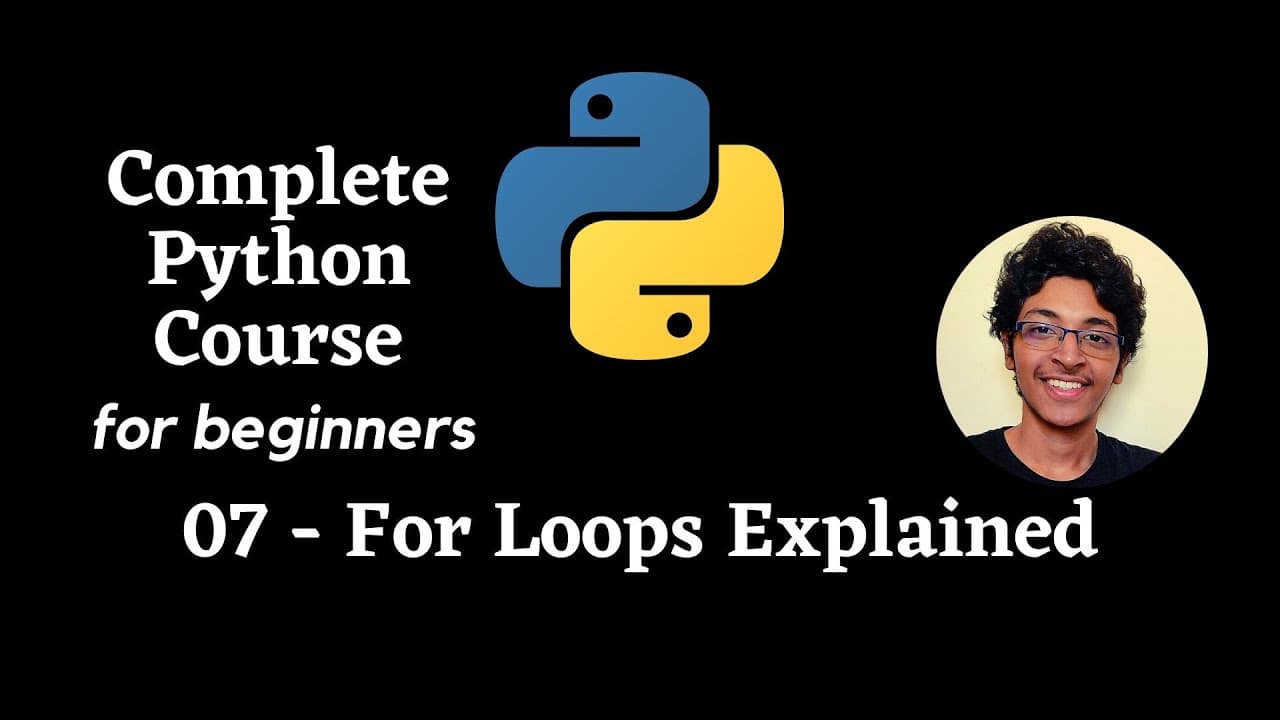
For Loops Explained in Python | Python Tutorial for Absolute Beginners 2020
TL;DR
This tutorial provides an overview of the Python for loop, explaining its syntax and providing examples of how to use it.
Transcript
welcome everyone I wish Amma had in this tutorial of the Python programming language will be learning about what loops are how does the far loop work we'll be talking about the syntax of the for loop and then we'll also be solving some problems okay we'll we have some examples that I want to show you so that you can get a clearer perspective of for... Read More
Key Insights
- 😫 Loops in programming are used to repeat a set of instructions.
- 😒 The for loop in Python uses the "in" keyword to iterate over a sequence of elements.
- 🧡 The range function in Python generates a sequence of integers based on the provided arguments.
- 🧡 The start argument of the range function is inclusive, while the stop argument is exclusive.
- 🧡 The step argument of the range function determines the increment value between each iteration.
- 🎭 The for loop can be combined with if statements to perform conditional actions.
- ⚾ Project Euler provides math-based programming problems to solve, which can be solved using for loops in Python.
Install to Summarize YouTube Videos and Get Transcripts
Explore YouTube Video Summarizer or Get YouTube Transcript Extractor
Questions & Answers
Q: What is a for loop in Python?
A for loop in Python is a control flow statement that repeatedly executes a block of code for each item in a sequence.
Q: How is the syntax of a for loop in Python structured?
The syntax of a for loop in Python is "for i in range(start, stop, step):", where "i" is a placeholder for the value in each iteration.
Q: What is the purpose of the range function in Python?
The range function generates a sequence of integers. It takes three arguments: start (inclusive), stop (exclusive), and step (optional).
Q: How can you check if a number is divisible by another number in Python?
To check divisibility, you can use the modulo operator (%). If the result is equal to zero, the number is divisible.
Summary & Key Takeaways
-
Loops in programming allow for repetitive actions. The for loop in Python iterates over a sequence of elements.
-
The syntax of a for loop in Python is: "for i in range(start, stop, step):", where "i" is a placeholder for the value in each iteration.
-
The range function in Python generates a sequence of integers. It takes three arguments: start (inclusive), stop (exclusive), and step (optional).
Read in Other Languages (beta)
Share This Summary 📚
Summarize YouTube Videos and Get Video Transcripts with 1-Click
Try YouTube Summary with ChatGPT & Claude or YouTube Transcript Generator
Explore More Summaries from Ishan Sharma 📚


Summarize YouTube Videos and Get Video Transcripts with 1-Click
Try YouTube Summary with ChatGPT & Claude or YouTube Transcript Generator