What Are Jonny Thomson’s 3 Philosophical Pillars of Happiness?
TL;DR
Jonny Thomson’s three pillars of happiness are looking beyond pleasure toward flourishing, practicing moderation, and cultivating goodness and virtue. Drawing on 2,500 years of philosophy, he distinguishes hedonia from eudaimonia, presents Daoism’s middle path and the Swedish concept of lagom, and identifies five enduring virtue-vice pairs. Read on to see how these ideas apply to desires, parenting, diets, and social life.
Transcript
- So in his "Nicomachean Ethics," Aristotle argues that everything we do in life is for some further purpose. So I go to school to get an education, I get an education to get a job, and I get a job so that I get money to buy nice things, and so on and so on. But the question Aristotle asks is what is the end point of all this? What lies at the top ... Read More
Key Insights
- Happiness, for Aristotle in the 'Nicomachean Ethics,' is the end point of all human action. Every action serves a further purpose until you reach the top of the ladder, which is happiness itself.
- Eudaimonia, often translated as 'flourishing,' differs from simple pleasure (hedonia) because it is understood in reverse. Raising young kids or school feels hard at the time, yet you look back and recognize deep happiness.
- Pleasure cannot equal happiness because it is an unwinnable game. Buddhism defines pleasure as a desire satisfier, and since we have millions of desires daily, chasing them is like a game of whack-a-mole.
- Fetishizing suffering is a logical fallacy. Just because pleasure does not equal happiness does not mean suffering does; equating masochistic misery with flourishing is a real risk to avoid.
- Moderation is the second pillar, central to Daoism's middle path between yin and yang. The Swedish concept lagom, meaning 'just the right amount,' captures both fair usage and the idea that less is more.
- Happiness is an emergent state of goodness: you cannot be truly happy unless you are also virtuous. Across cultures and eras, certain traits have consistently been named virtues and others vices.
- Five enduring virtue-vice pairs recur across philosophy: altruism versus egoism, kindness versus cruelty, justice versus injustice, wisdom versus ignorance, and humility versus arrogance.
- Robin Dunbar's study of gossip found it works as social culling. People talk about cheaters, liars, and thieves to shun them, while the kind and friendly are welcomed into society.
Install to Summarize YouTube Videos and Get Transcripts
Explore YouTube Video Summarizer or Get YouTube Transcript Extractor
Questions & Answers
Q: What are Jonny Thomson’s three philosophical pillars of happiness?
The first pillar is that happiness is not measured by pleasure, because flourishing goes beyond satisfying immediate desires. The second is moderation, or finding a middle way, and the third is that meaningful happiness emerges from goodness and virtue.
Q: What is the difference between hedonia and eudaimonia?
Hedonia is the ancient Greek term for simple pleasure, such as a night out with friends or drinking herbal tea on the sofa. Eudaimonia is often translated as “flourishing” and may be recognized in retrospect when a difficult experience, such as school or raising young children, is remembered as deeply happy.
Q: Why does pleasure not equal happiness?
Buddhism describes pleasure as the satisfaction of a desire, such as wanting water and then drinking it. Because people have millions and millions of desires every day and cannot satisfy them all, chasing pleasure becomes an unwinnable game like whack-a-mole; happiness must therefore extend beyond hedonia.
Q: Does rejecting pleasure mean that suffering creates happiness?
No. Thomson calls it a logical fallacy to conclude that suffering must equal happiness simply because pleasure does not, and he warns against fetishizing suffering or treating masochistic misery as necessary for flourishing.
Q: How does parenting illustrate eudaimonia?
Raising young children can feel difficult while it is happening, just as school can. Yet people may look back on those experiences and recognize them as times when they were deeply and supremely happy, showing how flourishing differs from momentary pleasure.
Q: What does moderation mean in Daoism?
Daoism presents life as neither black nor white but as a confusing mixture in which everything is gray. Its middle path walks between yin, associated with darkness, mystery, water, and fluidity, and yang, associated with excitement, passion, loudness, sunlight, and truth.
Q: What is lagom, and how does it relate to happiness?
Lagom is a Swedish lifestyle concept meaning “just the right amount,” and it expresses the pillar of moderation. One element is fair usage: taking every cookie from the jar leaves none for anyone else, so personal choices also affect other people.
Q: Which virtues and vices are connected to happiness?
The five recurring virtue-vice pairs are altruism versus egoism, kindness versus cruelty, justice versus injustice, wisdom versus ignorance, and humility versus arrogance. Thomson’s third pillar holds that a person cannot be truly and meaningfully happy without also being virtuous.
Summary & Key Takeaways
-
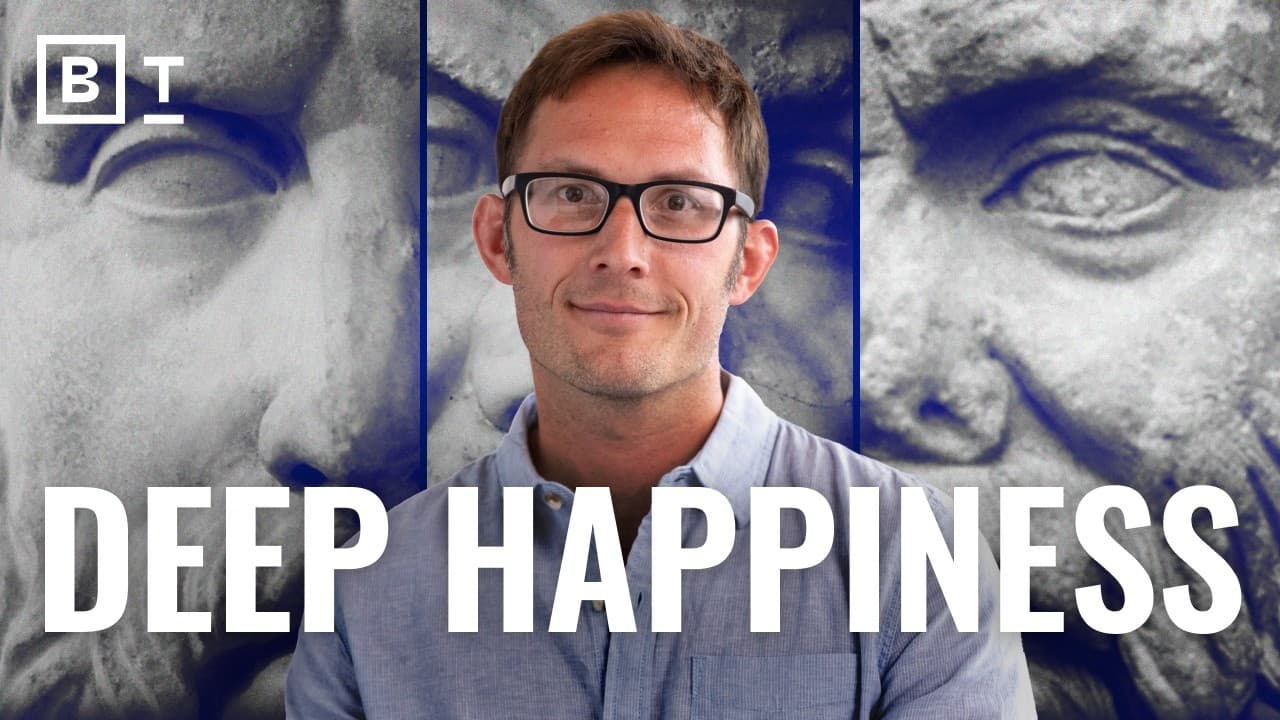
Aristotle argued in the 'Nicomachean Ethics' that everything we do serves a further purpose, with happiness at the top of the ladder. Jonny Thomson, Big Think staff writer and author of 'Mini Philosophy,' says happiness is elusive because it is confused with a smiling face rather than a smiling soul.
-
Surveying philosophical schools like epicureanism, cynicism, stoicism, and skepticism, Thomson identifies three pillars of happiness. The first is that happiness is not measured by pleasure; the Greek hedonia is simple pleasure, while eudaimonia, or flourishing, is often understood only in reverse, as with parenting.
-
The second pillar is moderation, the middle way seen in Daoism's yin and yang and the Swedish concept of lagom. The third is that happiness requires goodness and virtue, expressed through five enduring virtue-vice pairs, applied to everyday examples like parenting, dieting, and social behavior.
Read in Other Languages (beta)
Share This Summary 📚
Summarize YouTube Videos and Get Video Transcripts with 1-Click
Try YouTube Summary with ChatGPT & Claude or YouTube Transcript Generator
Explore More Summaries from Big Think 📚


Summarize YouTube Videos and Get Video Transcripts with 1-Click
Try YouTube Summary with ChatGPT & Claude or YouTube Transcript Generator