Physics: Are we forever trapped in the arrow of time? | Sabine Hossenfelder
TL;DR
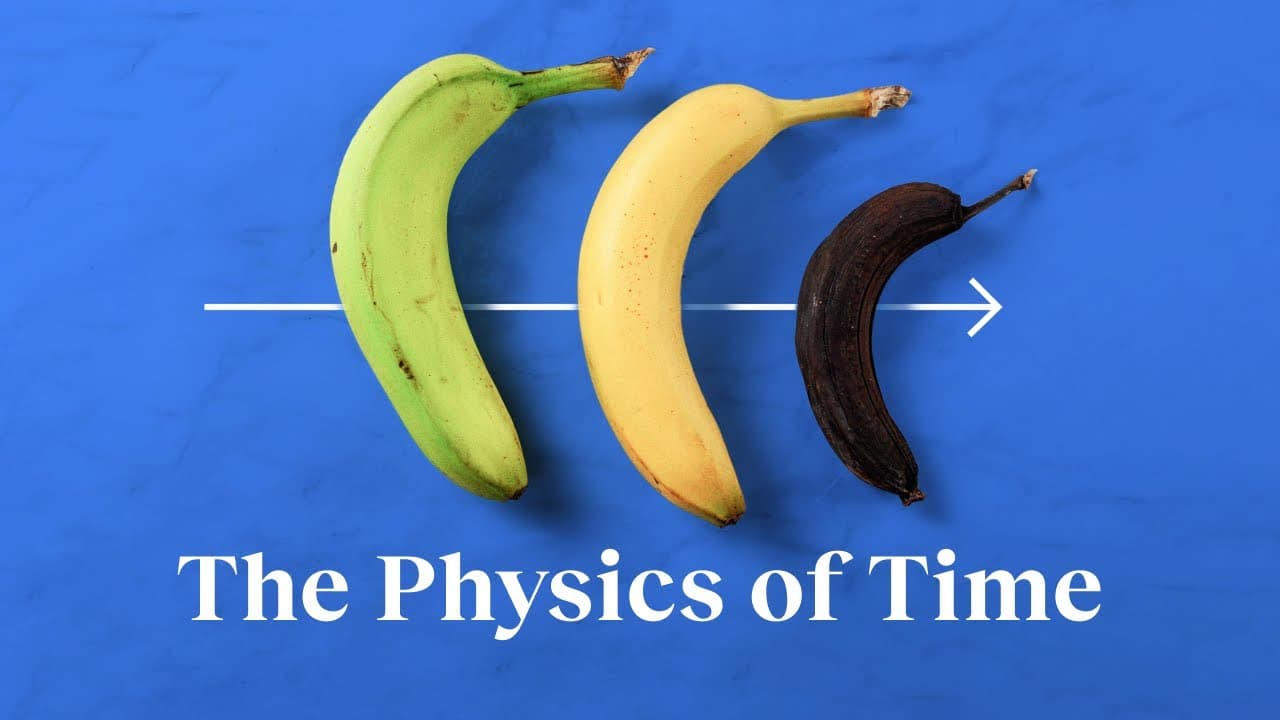
We experience an arrow of time because particle arrangements change toward higher entropy, even though microscopic laws work the same forward and backward. Entropy could increase only if it began very low, and it can be held down temporarily in one part of a system only by increasing it elsewhere. Read on to see how this connects aging, the universe’s beginning, and its unknown end.
Transcript
- We need some way to explain why people only get older and not younger. But we have this big mystery in the foundations of physics because if we look at the laws for the microscopic constituents, like elementary particles, they work the same way forward in time as they do backward in time. But the problem is we think that everything around us, us,... Read More
Key Insights
- ⏳ The laws of physics remain the same whether time flows forward or backward.
- ⌛ Our experience of time's directionality stems from the arrangement of particles and the increase in entropy.
- 🤕 Aging is a result of entropy increase in biological systems, which cannot be halted entirely.
- ❤️🩹 Entropy increase poses a challenge in explaining the beginning and end of the universe.
- 🐢 Slowing down aging in certain systems is possible, but not for the entire universe.
- 👈 The fate of the universe remains unknown, with the increase in entropy pointing towards a state of maximum disorder.
- ❤️🩹 Science fiction explores different possibilities for the universe's end, but reality is still uncertain.
Install to Summarize YouTube Videos and Get Transcripts
Explore YouTube Video Summarizer or Get YouTube Transcript Extractor
Questions & Answers
Q: Why does time appear to move only forward?
The microscopic laws governing elementary particles work the same forward and backward in time. Our experience differs because the arrangement of particles changes as entropy increases, creating what physicists call the arrow of time.
Q: What is the arrow of time in physics?
The arrow of time is our experience that forward and backward in time are different. Eggs break but do not unbreak, pebbles create outward splashes rather than reversed ones, and people grow older rather than younger.
Q: What is entropy?
Entropy measures the number of microstates associated with each macrostate. In the explanation presented, increasing entropy means that things become progressively more disorderly over time.
Q: How does entropy explain the difference between the past and future?
Entropy increases in one direction of time, so events look different when their sequence is reversed. Although the equations can run a movie backward mathematically, the reversed events do not resemble ordinary experience.
Q: Why must the early universe have had low entropy?
Entropy can continue increasing only if it was small initially. The transcript says the universe’s entropy must have been very small at its beginning, otherwise we would not be here today.
Q: Can entropy increase be delayed?
Entropy increase can be held off temporarily within a particular part of a system. This happens at the expense of increasing entropy elsewhere, and some species are better at maintaining low local entropy than others.
Q: Could humans ever slow down aging?
Cell processes determine aging, and those processes are described as extremely complicated. The transcript suggests that aging might someday be slowed enough for lives lasting 100,000 years or perhaps a billion years, but it does not claim this will happen.
Q: Does entropy reveal how the universe will end?
Entropy will eventually increase because it cannot be suppressed across the entire universe. However, Sabine Hossenfelder’s answer about how the universe will end is that we do not really know.
Summary & Key Takeaways
-
Definition: The arrow of time is our experience that forward and backward in time are different.
-
Definition: Entropy measures the number of microstates within each macrostate.
-
Compare: Microscopic laws work identically forward and backward, while everyday events do not.
-
Compare: Eggs break but do not unbreak, illustrating the asymmetry of ordinary experience.
-
Step 1: Individual particles begin in a particular arrangement.
-
Step 2: Entropy increases as arrangements become progressively more disorderly.
-
Step 3: Increasing entropy makes the future look different from the past.
-
When: Entropy can remain low temporarily in one region by increasing elsewhere.
-
Number: Future lifespans might reach 100,000 years or perhaps a billion years.
-
Who: Isaac Asimov explored reversing universal entropy in his short story, "The Last Question."
-
When: The universe’s entropy must have been very small at its beginning.
-
Who: Sabine Hossenfelder says we do not really know how the universe will end.
Read in Other Languages (beta)
Share This Summary 📚
Summarize YouTube Videos and Get Video Transcripts with 1-Click
Try YouTube Summary with ChatGPT & Claude or YouTube Transcript Generator
Explore More Summaries from Big Think 📚

Summarize YouTube Videos and Get Video Transcripts with 1-Click
Try YouTube Summary with ChatGPT & Claude or YouTube Transcript Generator