What Is Critical Race Theory Trying to Solve?
TL;DR
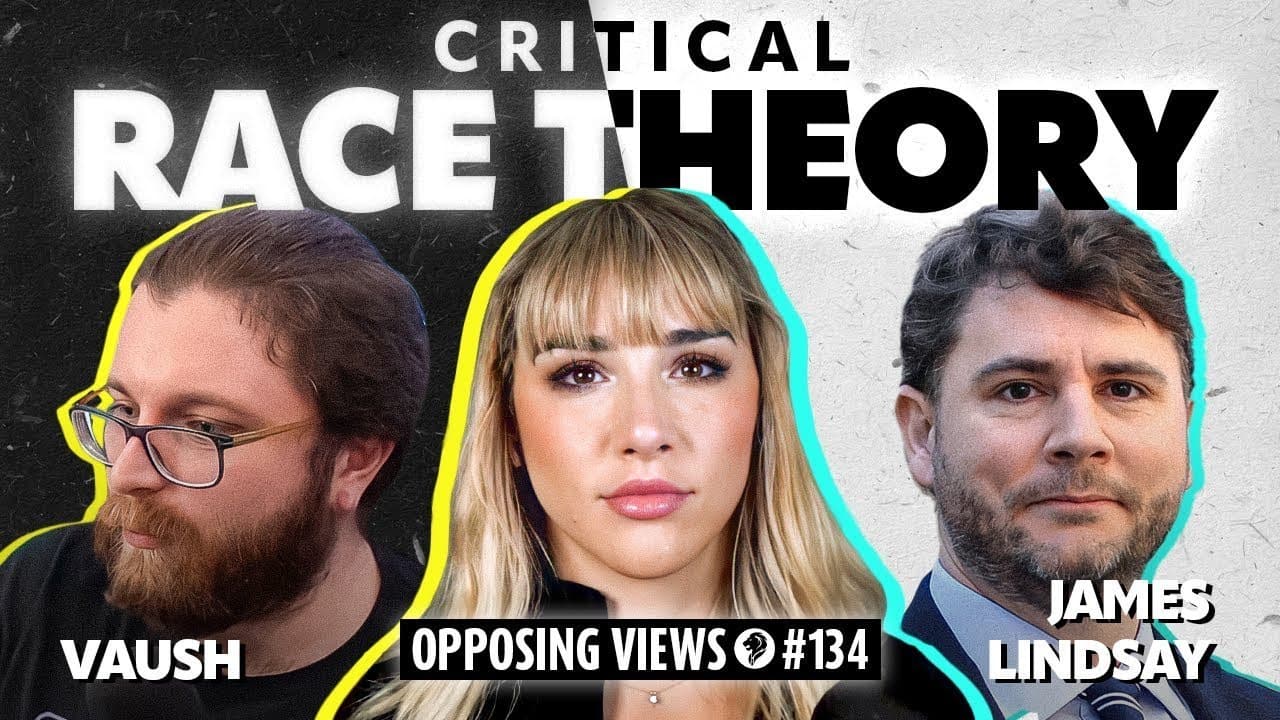
Critical race theory seeks to expose racial inequality that its proponents view as systemic, structural, and concealed by claims of neutrality. James Lindsay rejects that framework, characterizing CRT as a race-centered adaptation of Marxism that treats apparent progress as racism becoming harder to see and challenges the legitimacy of existing social systems.
Transcript
what is critical race theory critical race theory is calling everything that you want to control racist until you control it a collegiate theory which centers the idea that modern discussions around race relations impose a kind of false neutrality that there's an assumption of racial neutrality that we've overcome systemic issues when we really hav... Read More
Key Insights
- Critical race theory is presented as a framework that places race at the center of explanations for inequality, rather than treating racial problems solely as individual prejudice or isolated institutional misconduct.
- James Lindsay's central claim is that CRT adapts Marxist and critical-theory ideas by replacing economic class with race as the main category used to analyze power, inequality, and social organization.
- CRT proponents are described as challenging claims of racial neutrality because they believe apparently neutral systems can preserve inequalities inherited from a society historically shaped by slavery and white supremacy.
- Systemic racism is described as operating beyond conscious intentions, meaning people may participate in or benefit from a racial structure without recognizing their role in maintaining it.
- Critical analysis is presented by proponents as a method for making subtle or hidden forms of racial oppression visible when conventional approaches focus only on explicit prejudice or discriminatory conduct.
- Apparent racial progress can be interpreted within the framework as racism becoming less visible, according to Lindsay, because an established power structure may adapt and preserve itself through increasingly subtle mechanisms.
- Lindsay's criticism is that CRT grants its practitioners privileged authority to identify racism, while portraying other approaches to fighting racism as inadequate or as unintentionally helping the system conceal itself.
- The debate encompasses more than CRT's definition, including its presence in education, its underlying ideology, social bias, anti-capitalism, whiteness, the current emphasis on race, and what responses may be appropriate.
Install to Summarize YouTube Videos and Get Transcripts
Explore YouTube Video Summarizer or Get YouTube Transcript Extractor
Questions & Answers
Q: What is critical race theory trying to solve?
Critical race theory is presented as trying to identify and address racial inequality that persists through systems and structures, including inequality that may remain hidden behind claims of neutrality. Proponents, as described by Lindsay, believe focusing only on individual intentions or isolated institutions misses the broader mechanisms through which racial advantages and disadvantages can reproduce themselves.
Q: How does James Lindsay define critical race theory?
James Lindsay defines critical race theory as a critical theory that centers race as the principal category for understanding inequality. He characterizes it more critically as an adaptation of Marxism in which race replaces economic class as the primary object of analysis. His shortest formulation is that it calls desired targets racist until control over them is achieved.
Q: Why do CRT proponents question racial neutrality?
CRT proponents are described as questioning racial neutrality because they believe declarations of equal treatment can obscure continuing systemic problems. In Lindsay's account, their position is that a society formed under slavery and white supremacy may continue reproducing racial inequality through its structures, even when participants believe they are neutral and do not consciously intend to discriminate.
Q: How does critical race theory describe systemic racism?
Systemic racism is described as a broad organizing structure rather than merely a collection of openly prejudiced individuals. According to Lindsay's explanation of the proponents' view, the structure can sustain advantages for white people while remaining difficult for participants to recognize. People may therefore help perpetuate it without consciously knowing that they are doing so.
Q: How does James Lindsay connect CRT to Marxism?
Lindsay connects CRT to Marxism through the concept of a self-preserving power structure. He says twentieth-century critical theory adapted Marxist analysis after capitalism stabilized the working class, while CRT subsequently centered race instead of economic class. In his interpretation, racial categories become the means for analyzing how power creates and maintains social conditions that benefit dominant groups.
Q: Who is credited with developing the name critical race theory?
Lindsay credits Kimberlé Crenshaw with developing the name critical race theory. He says Crenshaw identified her mentor, Harvard law scholar Derrick Bell, as a co-founder of the underlying ideas. Lindsay presents Crenshaw's description as combining critical theorists interested in racial justice advocacy with racial justice advocates who were practicing critical theory.
Q: Why does Lindsay criticize critical race theory?
Lindsay criticizes CRT because he believes it interprets racism as the fundamental organizing principle of society and assumes that existing systems perpetuate white advantage. He argues that its practitioners position themselves as uniquely able to perceive hidden racism, while treating apparent progress and competing anti-racist methods as ways in which racism becomes more subtle or better concealed.
Q: What topics are included in the CRT debate?
The discussion is framed around CRT's meaning, the problems it is intended to address, where it is taught, its underlying ideology, and what responses might be possible. It also covers related questions concerning social biases, anti-capitalism, whiteness, and whether contemporary society focuses excessively or reasonably on race. The supplied excerpt primarily records Lindsay's opening perspective.
Summary & Key Takeaways
-
Critical race theory is presented as a disputed framework for interpreting racial inequality. James Lindsay describes it as critical theory that replaces economic class with race as its central concern. Proponents, according to his explanation, argue that apparently neutral systems can preserve racial inequality even when individuals do not consciously intend discriminatory outcomes.
-
Lindsay traces the term to Kimberlé Crenshaw and identifies Harvard law scholar Derrick Bell as an important intellectual influence credited by Crenshaw. He also cites education theorist Gloria Ladson-Billings to support his view that CRT makes race a central construct for understanding inequality, particularly when examining institutions and social structures.
-
The broader discussion is framed as an exchange between opposing perspectives represented by Lindsay and Vaush. Its stated subjects include where CRT is taught, its ideology, social bias, anti-capitalism, whiteness, the contemporary focus on race, and possible responses. The supplied transcript excerpt primarily contains Lindsay's interpretation rather than Vaush's detailed response.
Read in Other Languages (beta)
Share This Summary 📚
Summarize YouTube Videos and Get Video Transcripts with 1-Click
Try YouTube Summary with ChatGPT & Claude or YouTube Transcript Generator
Explore More Summaries from Mikhaila Peterson 📚




Summarize YouTube Videos and Get Video Transcripts with 1-Click
Try YouTube Summary with ChatGPT & Claude or YouTube Transcript Generator