Why $RACE Stock Has the Biggest MOAT | Ferrari Stock Analysis
TL;DR
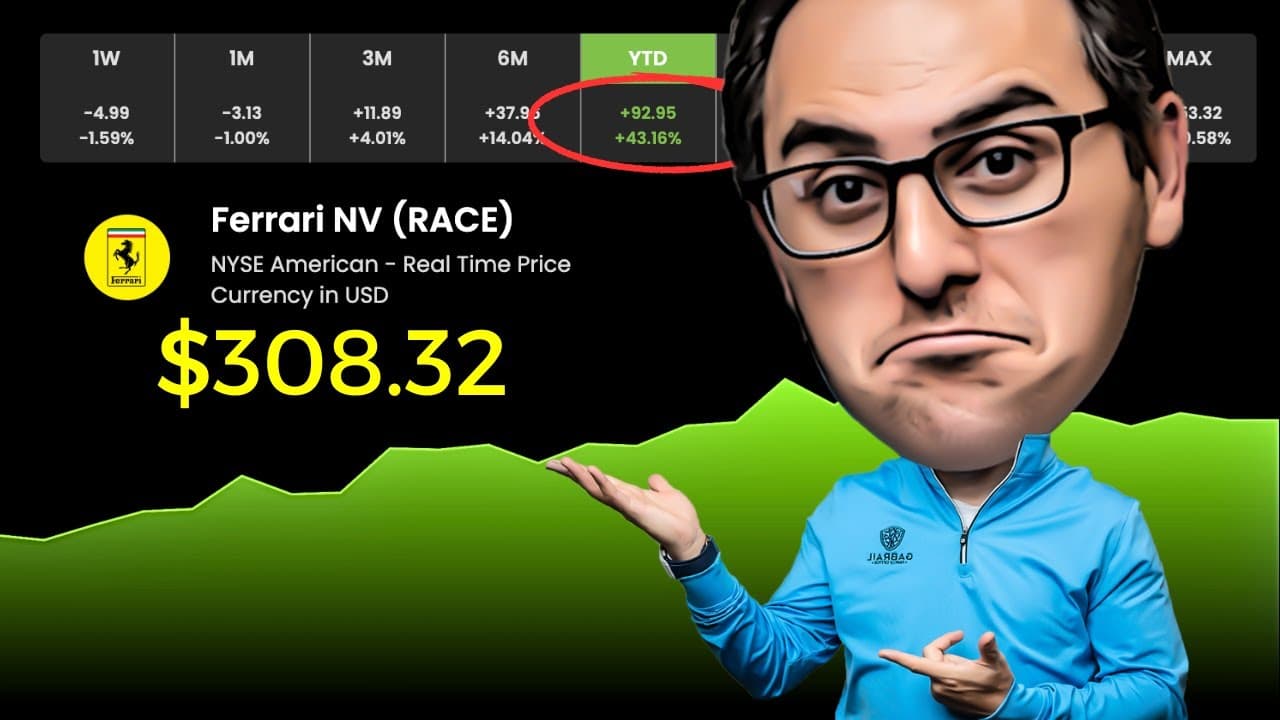
Ferrari is presented as an exceptionally strong moat company because limited supply, intense demand, pricing power, and elite branding support unusually high margins. Its gross margin is 49%, its bottom-line profit margin is about 20%, and annual sales have reached 13,000 cars. However, free cash flow trails net income and the stock commands high valuation multiples, so read on to understand both the bull case and the risks.
Transcript
the ultimate moat Ferrari that is my opinion to me I believe that the ultimate moat company is Ferrari limited Supply amazing demand the world's getting richer expanding its Market of who wants to buy this car Africa is their fastest growing Market it is an incredible company in this video we're going to look at the high level metrics we're going t... Read More
Key Insights
- 🥺 Ferrari operates with limited supply and high demand, leading to potential pricing power.
- 💪 The company's financial metrics, such as market cap, enterprise value, and net income, indicate a strong moat and financial stability.
- 💐 Concerns about lower free cash flow compared to net income raise questions about potential financial management issues.
- 😨 Ferrari's high margins set it apart from other car companies, demonstrating its unique positioning in the luxury car market.
- ❓ Analysts foresee modest growth in earnings per share and revenue for Ferrari, reflecting a steady but not aggressive expansion.
- 🍉 The brand's exclusivity and younger consumer base contribute to its long-term growth potential.
- ✋ Repurchasing shares at a time when the stock already has high valuations may not be financially prudent.
Install to Summarize YouTube Videos and Get Transcripts
Explore YouTube Video Summarizer or Get YouTube Transcript Extractor
Questions & Answers
Q: Why does Ferrari stock have such a strong moat?
Ferrari combines limited supply with strong demand, elite branding, and the ability to raise prices while continuing to sell cars. The analysis also points to a growing pool of potential buyers as the world gets richer, with Africa identified as Ferrari’s fastest-growing market.
Q: What demonstrates Ferrari’s pricing power and customer demand?
The speaker describes customers ordering their next Ferrari when collecting a new one, then trading the earlier car when the replacement arrives. One dealership example involved a car bought for about $500,000 and potentially traded for $700,000 two years later, illustrating the brand’s perceived scarcity and demand.
Q: How many cars does Ferrari sell annually?
The transcript says Ferrari’s annual sales have risen to 13,000 cars. The key question for investors is how much further that volume can grow while the company preserves limited supply and exclusivity.
Q: How profitable is Ferrari compared with the average car company?
Ferrari has a 49% gross margin and an approximately 20% bottom-line profit margin. The speaker says an average car company has a 15% to 20% gross margin, meaning Ferrari’s after-tax margin is around the level many carmakers achieve before their remaining expenses.
Q: Why is Ferrari’s free cash flow lower than its net income a concern?
Ferrari’s one-year net income is $1.1 billion versus $700 million in free cash flow, while its five-year averages are $900 million and $500 million, respectively. The speaker considers cash flow harder to manipulate than net income and finds the persistent gap concerning, although he says he does not know its cause.
Q: What do Ferrari’s market cap, enterprise value, and debt indicate?
Ferrari has a market capitalization of $56.5 billion and an enterprise value of $61 billion. The speaker treats the roughly $5 billion difference as debt and notes that it equals about ten years of the company’s $500 million average annual free cash flow, while arguing that Ferrari’s moat may support higher debt levels.
Q: What is Ferrari’s return on invested capital?
Ferrari’s five-year return on invested capital is 16%. The speaker characterizes that as very high for a car company and argues that Ferrari behaves more like a branding company because of its unusually strong margins.
Q: Is Ferrari stock’s valuation justified?
Ferrari trades at 62 times five-year earnings and 110 times five-year free cash flow in the analysis. The speaker believes the company deserves a premium because it is a great business with a strong moat, but says the difficult question is how large that premium should be.
Summary & Key Takeaways
-
Ferrari has established itself as an elite car company with limited supply and high demand, particularly in emerging markets like Africa.
-
The company has seen significant growth in sales and has implemented a strategy of raising prices while still maintaining strong sales.
-
Financial metrics such as market cap, enterprise value, net income, and free cash flow are analyzed, revealing a large moat and consistent profitability.
Read in Other Languages (beta)
Share This Summary 📚
Summarize YouTube Videos and Get Video Transcripts with 1-Click
Try YouTube Summary with ChatGPT & Claude or YouTube Transcript Generator