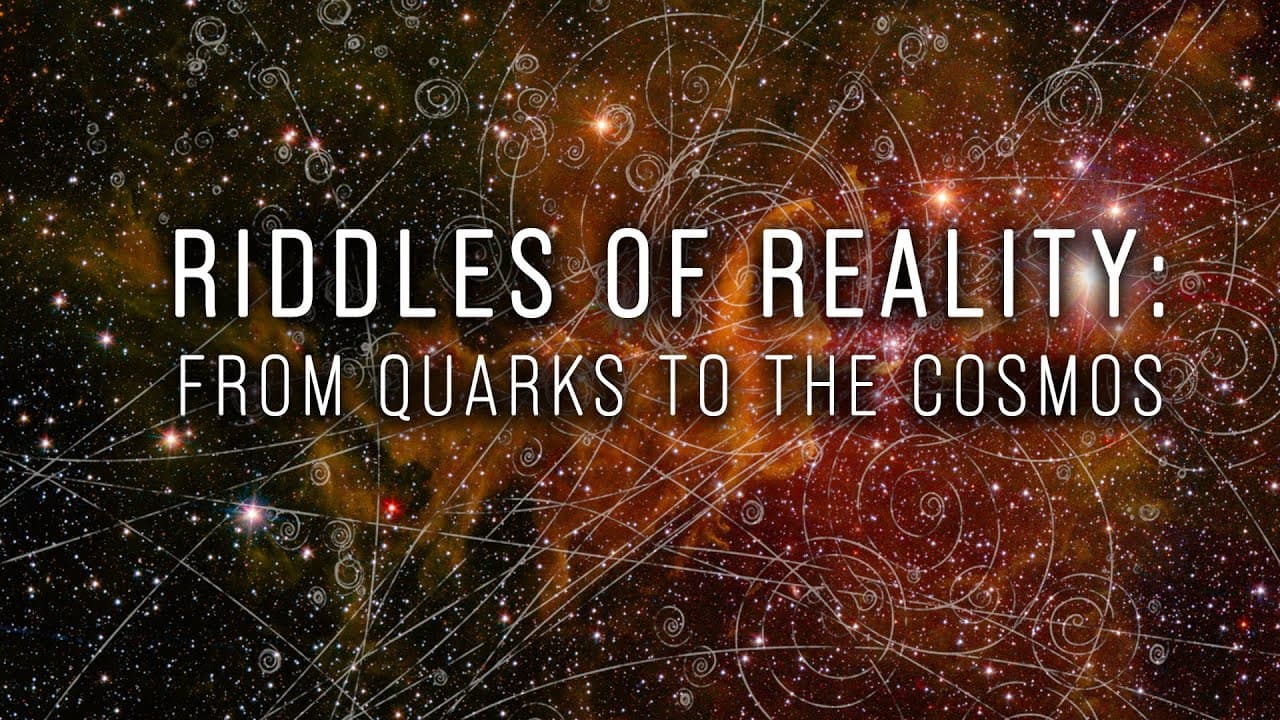
Riddles of Reality: From Quarks to the Cosmos
TL;DR
Frank Wilczek discusses the power of mathematics in describing the world, the possibility of a mathematical universe, and the importance of open-mindedness in scientific exploration.
Transcript
frank wilcheck is the hermann feshbach professor of physics at the massachusetts institute of technology and the co-recipient with david gross and david politzer of the 2004 nobel prize in physics for insights into the strong nuclear interactions among many additional honors including the sakurai prize and the dirac medal wilcheck has recently been... Read More
Key Insights
- 👮 Mathematics' effectiveness in describing the physical world is contingent on the laws of physics and their properties.
- 👮 While mathematics is a powerful tool, it may not be as applicable in domains outside of fundamental physics or in simulated worlds with different laws.
- 🤯 There are mathematical truths independent of the human mind, but human creativity shapes the mathematics relevant to us.
- 👨🔬 Physics has made significant progress by searching for more compact and reduced descriptions, but other important questions and opportunities exist in fields like astrophysics and dark matter.
- 💪 The discovery of the strong nuclear force and the existence of axions are examples of how mathematical models can revolutionize our understanding of the world.
- ⁉️ Physics can provide insights into philosophical and theological questions, such as the concept of complementarity and the nature of scientific communities.
Install to Summarize YouTube Videos and Get Transcripts
Explore YouTube Video Summarizer or Get YouTube Transcript Extractor
Questions & Answers
Q: Why is mathematics so effective in describing the physical world?
Mathematics accurately describes the world because the laws we have discovered have properties such as locality and symmetry that allow for accurate analysis and deduction. However, this may not be the case in all domains of science.
Q: Is it possible that the fundamental laws of our universe are not mathematical?
It is difficult to imagine a non-mathematical fundamental substrate for our universe, as it would require a complex and verbose program that cannot be easily explained. The mathematical nature of our universe is a remarkable and miraculous thing.
Q: Does math exist independently of the human mind?
There are mathematical truths that exist independently of how we arrive at them, such as Fermat's Last Theorem. However, human creativity shapes the mathematics relevant to us, and different intelligences may prioritize different mathematical questions.
Q: Is the search for more compact and reduced descriptions still important in physics?
While it has been the main line of progress in modern physics, it may not be the most important goal in the future. Understanding phenomena such as the origin of life or dark matter may be more significant at this point.
Summary & Key Takeaways
-
Mathematics has been phenomenally effective in describing the laws of physics, thanks to the way fundamental laws work and the symmetry they possess.
-
There are domains outside of fundamental physics where the application of mathematics is limited, and in simulated worlds with different laws, mathematical analysis may not be as applicable.
-
Mathematical truths exist independently of the human mind, but human creativity shapes the mathematics relevant to us.
-
Insights from mathematical models have revolutionized our understanding of the world, and the search for more compact and reduced descriptions is a main focus of modern physics.
Read in Other Languages (beta)
Share This Summary 📚
Summarize YouTube Videos and Get Video Transcripts with 1-Click
Try YouTube Summary with ChatGPT & Claude or YouTube Transcript Generator
Explore More Summaries from World Science Festival 📚
Summarize YouTube Videos and Get Video Transcripts with 1-Click
Try YouTube Summary with ChatGPT & Claude or YouTube Transcript Generator