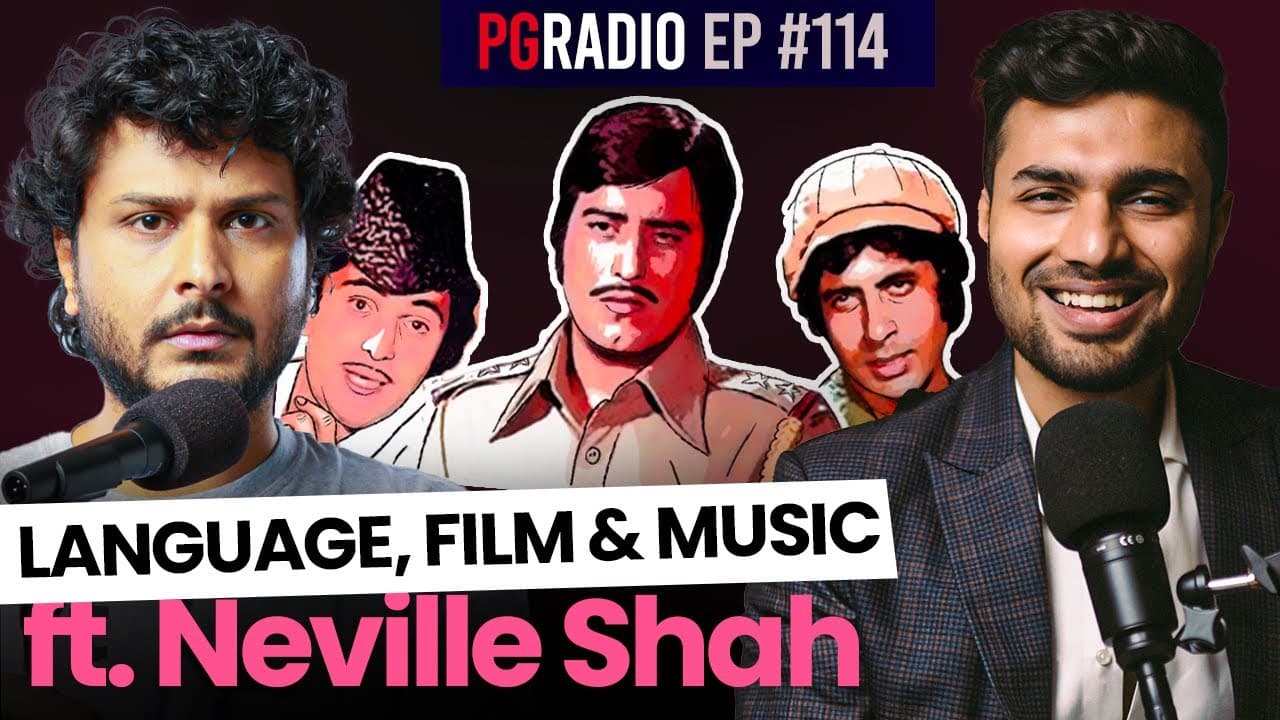
@neville_shah is Always WRONG | PG Radio Ep 114
TL;DR
Comedian and writer Neville Shah explains that even when writing in Hindi he thinks predominantly in English, so his old process was to think in English, translate to Hindi, then type it back in Roman script, never truly thinking in Hindi. To fix this he started writing loose Hindi "word clouds" of disconnected words. He notes most of his Hindi comes from song lyrics rather than dialogue, and that he read Premchand in translation. A candid look at how language, sound, and thought shape a writer's craft.
Transcript
thank you guys are always wondering how is it that we produce and edit our awesome podcast episodes and that is because we use filmora filmora is an editing software that has an amazing range of features that makes editing quick and efficient it has instant mode through which you can instantly add templates and use them Auto beat sync to quickly sy... Read More
Key Insights
- 🧡 Filmora is an editing software that provides a range of features to enhance efficiency and speed in video editing.
- 🤔 Language learning is a nuanced process that involves aligning thought processes with the language being written or spoken.
- 🦻 Music can aid in language comprehension by evoking familiarity and helping in understanding the emotions and meanings behind words.
- 🖐️ Language plays a crucial role in humor and storytelling, with comedians employing techniques like wordplay and timing to engage their audience.
Install to Summarize YouTube Videos and Get Transcripts
Explore YouTube Video Summarizer or Get YouTube Transcript Extractor
Questions & Answers
Q: How does Neville Shah write in Hindi when he thinks in English?
He says his thought process is aligned to English, so his early method was to think in English, translate into Hindi, and then type it in Roman script rather than Devanagari. Because of that he was never truly thinking in Hindi at any point. To break the habit he began sitting down and writing loose Hindi words, almost a word cloud rather than full sentences.
Q: Where does Neville Shah's Hindi vocabulary come from?
He says most of his Hindi comes from lyrics rather than dialogue. He gives the example of the word "dehleez," which entered his lexicon only through Hindi movies. He describes being in love with the sound and oral quality of language.
Q: Can you pick up a language just from songs without understanding it?
He says yes to a degree, explaining he can sing two or three songs in Tamil despite not knowing what the words mean, simply because he has heard them so many times that they stuck. He frames this as being drawn to the oral, sonic quality of language rather than its literal meaning.
Q: Did Neville Shah read Premchand in the original Hindi?
No. He says he read Premchand in translation, not in Devanagari. He explains that reading it in the original script would have taken him ten times longer, and he calls it one of his regrets, blaming his convent schooling and English-speaking upbringing in Bombay.
Q: What does the Sorkin idea about browsing the internet mean?
He references Aaron Sorkin's point that we don't really browse anymore, because browsing online requires you to already know what you are looking for. True browsing, by contrast, is like walking into a library, picking up an encyclopedia, and going from page to page reading whatever you find.
Q: What was StumbleUpon and why did he lose interest in it?
He describes StumbleUpon as a Chrome plugin that he initially thought delivered true browsing. He decided it wasn't, because it still did the typical internet thing of asking what you like, which makes the results a curated version of what gets shown. As a result you never discover something you didn't already expect to find.
Q: Why does Neville Shah want to shift his content to English?
He says he wants his content to be in English so he can reach more people. Currently his work is mostly in Hindi, which forces him to give a diluted answer when people ask what he makes and prevents him from passing it on to interested audiences.
Summary & Key Takeaways
-
The content discusses the use of editing software Filmora and its various features, highlighting the importance of efficiency and time-saving in video editing.
-
The conversation delves into the significance of language and the challenges of writing in different languages, emphasizing the need to align one's thought process with the language being used.
-
The speaker shares insights on language learning, the impact of music and lyrics on language comprehension, and the richness of languages in conveying emotions and nuances.
-
The discussion touches on the role of language in humor and storytelling, exploring how words and comedic timing can engage and captivate an audience.
Read in Other Languages (beta)
Share This Summary 📚
Summarize YouTube Videos and Get Video Transcripts with 1-Click
Try YouTube Summary with ChatGPT & Claude or YouTube Transcript Generator
Explore More Summaries from Prakhar ke Pravachan 📚

Summarize YouTube Videos and Get Video Transcripts with 1-Click
Try YouTube Summary with ChatGPT & Claude or YouTube Transcript Generator