What Caused the Israel-Palestine Conflict?
TL;DR
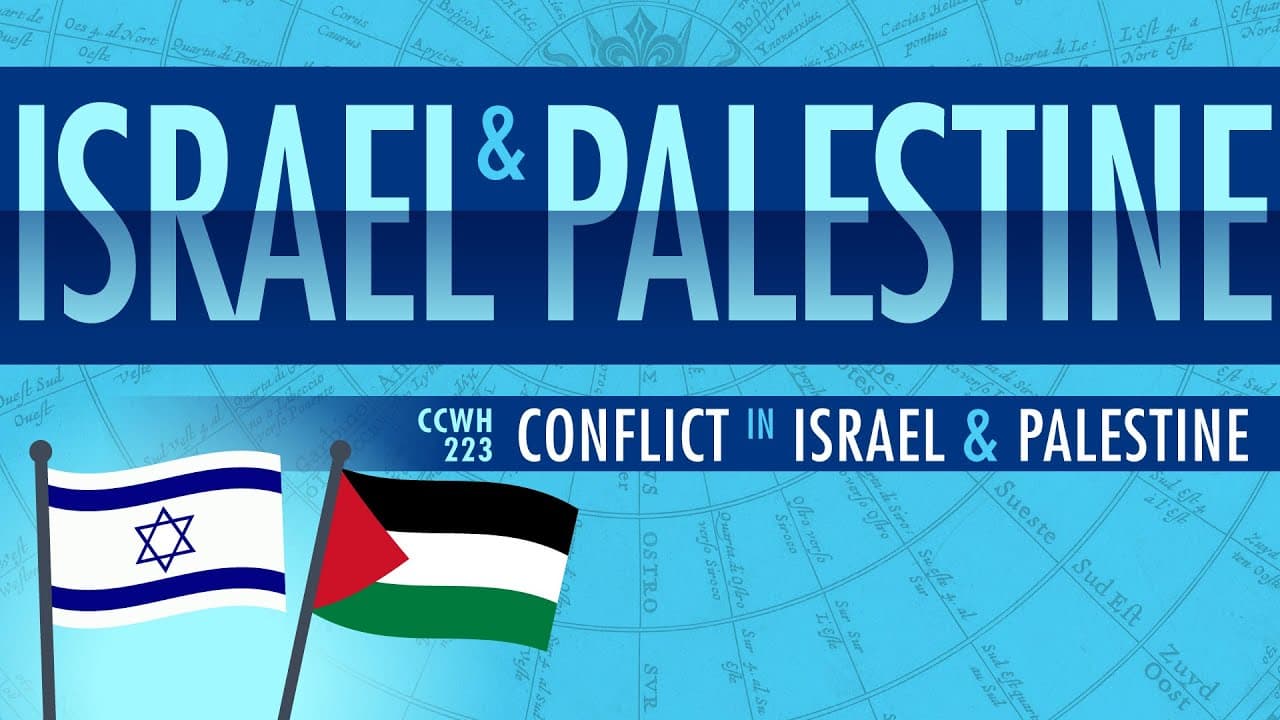
The Israel-Palestine conflict is mainly about land and emerged from competing nationalist movements in the late 19th century, primarily triggered by the rise of Zionism and British promises during World War I. The 1947 UN partition plan and subsequent events led to widespread violence and territorial disputes, complicating efforts for peace.
Transcript
Hi, I'm John Green, this is Crash Course World History, and today, we're going to talk about Israel and Palestine, hopefully, without a flame war. Yeah, yeah big ask, Mr. Green, I mean, that fight goes back thousands and thousands of years. Except, thousands of years ago... there wasn't an Islam yet, so, yeah, no. Also, let me submit that very litt... Read More
Key Insights
- 💔 The Israel-Palestine conflict is primarily about land, not religion or theology.
- 💫 In the late 19th century, Palestine was a place where people of different religious backgrounds lived together peacefully.
- 🔑 The concept of Jewish nationalism, known as Zionism, emerged in the late 19th century.
- 🗝️ The Balfour Declaration in 1917 promised a national home for Jewish people in Palestine, even though it was still under Ottoman rule.
- 💼 The British made conflicting promises to different groups regarding the control of Palestine during World War I.
- 🌍 After World War II, the United Nations proposed the partition of Palestine into separate Palestinian and Jewish states.
- 🔔 The 1948 Arab-Israeli War resulted in Israel occupying more land than originally proposed by the UN.
- 🌍 UN Resolution 242 outlined a framework for peace, but many unresolved issues, including land disputes and refugee rights, remained.
Install to Summarize YouTube Videos and Get Transcripts
Explore YouTube Video Summarizer or Get YouTube Transcript Extractor
Questions & Answers
Q: How did the late 19th century nationalism movements contribute to the conflict between Israel and Palestine?
The rise of nationalism during the late 19th century fueled the desire for self-determination among different groups in Palestine, including Jewish Zionists who sought a state for Jews. This desire for a homeland led to clashes with Palestinian Arabs and set the stage for the later conflict.
Q: What were the main factors that led to the partition of Palestine?
The Balfour Declaration promised a national home for the Jewish people in Palestine, but conflicting promises made to other groups, such as the French and the Arab states, complicated the situation. The increasing Jewish immigration and settlement, along with tensions between different religious and ethnic groups, led to the decision to partition Palestine.
Q: How did the Six-Day War in 1967 impact the conflict?
Israel's victory in the Six-Day War resulted in the occupation of the West Bank, Gaza Strip, Sinai Peninsula, and Golan Heights. This further escalated tensions and complicated peace efforts, as Israel gained control over territories that were meant to be part of a future Palestinian state.
Q: What are some of the key challenges to achieving peace between Israel and Palestine?
One of the main challenges is the competing historical narratives and the lack of recognition and understanding of each other's legitimacy. Other factors include the status of Jerusalem, Jewish settlements in occupied territories, the right of return for Palestinian refugees, and the ongoing violence and security concerns for both parties.
Summary & Key Takeaways
-
In the late 19th century, the Ottoman Empire ruled over Palestine, with a diverse population of Muslims, Christians, and Jews living peacefully together.
-
The concept of Jewish nationalism, known as Zionism, emerged during this time and gained support among secular Jews who believed in establishing a state for Jews.
-
After World War I, the British attempted to fulfill conflicting promises to different groups, leading to tensions, immigration, violence, and the eventual partition of Palestine.
Read in Other Languages (beta)
Share This Summary 📚
Summarize YouTube Videos and Get Video Transcripts with 1-Click
Try YouTube Summary with ChatGPT & Claude or YouTube Transcript Generator
Explore More Summaries from CrashCourse 📚
Summarize YouTube Videos and Get Video Transcripts with 1-Click
Try YouTube Summary with ChatGPT & Claude or YouTube Transcript Generator