Sony RX10 V Review: Huge Zoom With Key Trade-Offs
TL;DR
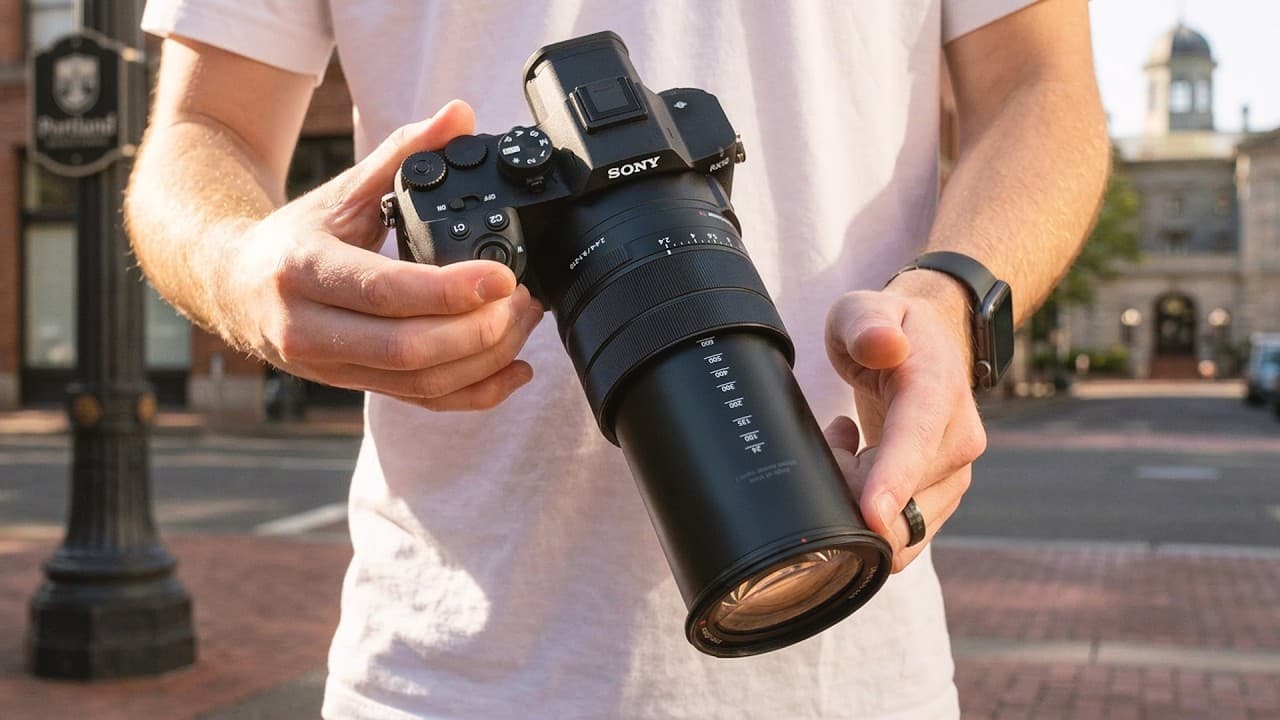
The Sony RX10 V is a strong all-in-one travel camera for wildlife, birding, sports, and buyers who want no lens decisions, thanks to its 24–600mm equivalent zoom, fast autofocus, and 30 fps shooting. Its biggest compromises are the lack of a flip screen and built-in ND filter, an SD card slot inside the battery compartment, one card slot, and micro HDMI.
Transcript
This is the brand new Sony RX10 Mark V. It's the fifth iteration of the RX10 series and the last time that Sony actually updated this camera line was over 9 years ago. Honestly, I don't think anybody saw this coming from Sony right now, but after spending the last couple of weeks with it, I'm actually way more excited about this camera than I even ... Read More
Key Insights
- The 24–600mm equivalent lens is the RX10 V's defining advantage, covering wide travel scenes, everyday shooting, sports, birds, and distant wildlife without an interchangeable-lens kit. The lens retracts into the body, making extreme telephoto reach considerably easier to carry while traveling.
- The camera delivers sharp and vibrant JPEG photographs that resemble results from other Sony cameras. Its 30 fps blackout-free continuous shooting retains autofocus and auto exposure, while the large viewfinder provides a clear and comfortable way to follow moving wildlife or sports subjects.
- The video system records 4K at up to 120 fps with a small crop that the reviewer estimates at roughly 1.1 times. It also captures uncropped 4K at 60 fps through a full pixel readout, oversampling from 5.4K for sharper and more detailed footage.
- S-Log 3 recording has a base sensitivity of ISO 1000 on this camera, which makes controlling bright-light exposure more difficult. Because the RX10 V lacks a built-in ND filter, filmmakers using S-Log 3 may need to attach an external ND filter to the lens.
- Handheld telephoto video is supported by optical image stabilization in the lens and active digital stabilization in the camera. Some shake remains noticeable at 600mm, but careful breathing, a steady stance, and post-production correction can still produce usable handheld footage at maximum reach.
- The non-flip screen is the most serious limitation for solo creators because it prevents them from directly checking composition, focus tracking, and exposure while recording themselves. A phone can act as a monitor through the Sony Creators app, but the Monitor and Control app is not supported.
- The fixed lens offers a minimum focusing distance of 1.18 inches at 24mm, enabling extremely close detail photographs. Its variable aperture changes quickly, reaching F3.5 near 60mm and F4 at 100mm, then remaining at F4 through the rest of the zoom range.
- The RX10 V is best suited to travel creators, wildlife and bird photographers, parents photographing sports, and buyers who want one permanent lens. Its practical drawbacks include one SD card slot inside the battery door, awkward tripod access, micro HDMI, and a grip that may feel large in smaller hands.
Install to Summarize YouTube Videos and Get Transcripts
Explore YouTube Video Summarizer or Get YouTube Transcript Extractor
Questions & Answers
Q: Is the Sony RX10 V a good camera for travel?
The Sony RX10 V is a strong travel option for people who want one camera to cover many subjects without changing lenses. Its fixed 24–600mm equivalent lens handles wide scenes, ordinary moments, distant wildlife, birds, sports, and close details. The lens retracts into the body, and the overall size and weight feel comparable to a Sony A1 paired with a 24–105mm lens.
Q: How good is the Sony RX10 V for wildlife and bird photography?
The Sony RX10 V is particularly well suited to wildlife and bird photography because its optical zoom reaches a 600mm equivalent focal length while preserving substantial detail. It can shoot at 30 fps without viewfinder blackout and retains autofocus and auto exposure during bursts. Its dedicated AI chip also improves subject detection and recognition, supporting the tracking demands of moving animals and birds.
Q: What video modes does the Sony RX10 V support?
The Sony RX10 V can record 4K video at up to 120 fps, although that mode applies a small crop that the reviewer estimates at about 1.1 times. Its 4K 60 fps mode has no crop and uses a full pixel readout. That mode oversamples from 5.4K, producing footage described as sharper and more detailed than standard 4K capture.
Q: Can the Sony RX10 V record usable handheld video at 600mm?
The Sony RX10 V can produce usable handheld footage at its 600mm equivalent maximum, although some visible shake may remain. The lens supplies optical image stabilization, and the camera adds an active digital stabilization mode for additional correction. The reviewer found that steady breathing and minimal body movement helped, while residual motion could also be corrected later in post-production software.
Q: Is the Sony RX10 V suitable for vlogging and self-recording?
The Sony RX10 V is not an ideal choice for solo vlogging because its tilting screen cannot flip forward. A person recording alone cannot directly confirm framing, focus tracking, or exposure from in front of the camera. The Sony Creators app can turn a phone into a monitor, but that adds a workaround, and the camera is not currently compatible with Sony's Monitor and Control app.
Q: How does the Sony RX10 V lens aperture change while zooming?
The fixed zoom lens begins at F2.4 on the wide end but loses light relatively quickly as the focal length increases. It reaches approximately F3.5 around 60mm and F4 by 100mm, then maintains F4 through 600mm. Photographers who are comfortable working at F4 can set that aperture from the start to prevent exposure from changing throughout the zoom range.
Q: What are the main hardware drawbacks of the Sony RX10 V?
The Sony RX10 V has one SD card slot, so it cannot create an in-camera backup across two cards. That slot sits inside the battery compartment on the bottom, which may be difficult to reach when the camera is mounted on a tripod. It also uses micro HDMI rather than a more robust full-size connector, potentially requiring specialty cables or adapters for monitors and switchers.
Q: Who should buy the Sony RX10 V, and who should avoid it?
The Sony RX10 V makes the most sense for travel creators, wildlife and bird photographers, parents photographing children's sports, and anyone who wants broad focal coverage without choosing or changing lenses. Solo creators who regularly film themselves should consider avoiding it because the screen does not face forward. Buyers requiring dual-card backup, easy tripod-mounted card access, or built-in ND filtration should also weigh its limitations carefully.
Summary & Key Takeaways
-
The Sony RX10 V combines a fixed 24–600mm equivalent lens with sharp, vibrant photography, fast subject tracking, and 30 fps blackout-free shooting. Its unusually broad focal range makes distant wildlife, birds, sports, travel scenes, and close details accessible without carrying or changing multiple lenses, which is the camera's central practical advantage.
-
Video capabilities include 4K recording at up to 120 fps with a small crop and 4K at 60 fps without a crop. The 60 fps mode uses a full pixel readout and oversamples from 5.4K. Optical lens stabilization and active digital stabilization can produce usable handheld footage even at 600mm.
-
The RX10 V feels like a current Sony Alpha camera, with a substantial grip, modern menus, customizable controls, and a dedicated AI chip for subject recognition. However, the fixed lens reaches F4 by 100mm, the screen cannot face forward, and the single SD card shares the bottom battery compartment.
Read in Other Languages (beta)
Share This Summary 📚
Summarize YouTube Videos and Get Video Transcripts with 1-Click
Try YouTube Summary with ChatGPT & Claude or YouTube Transcript Generator
Explore More Summaries from Think Media 📚





Summarize YouTube Videos and Get Video Transcripts with 1-Click
Try YouTube Summary with ChatGPT & Claude or YouTube Transcript Generator