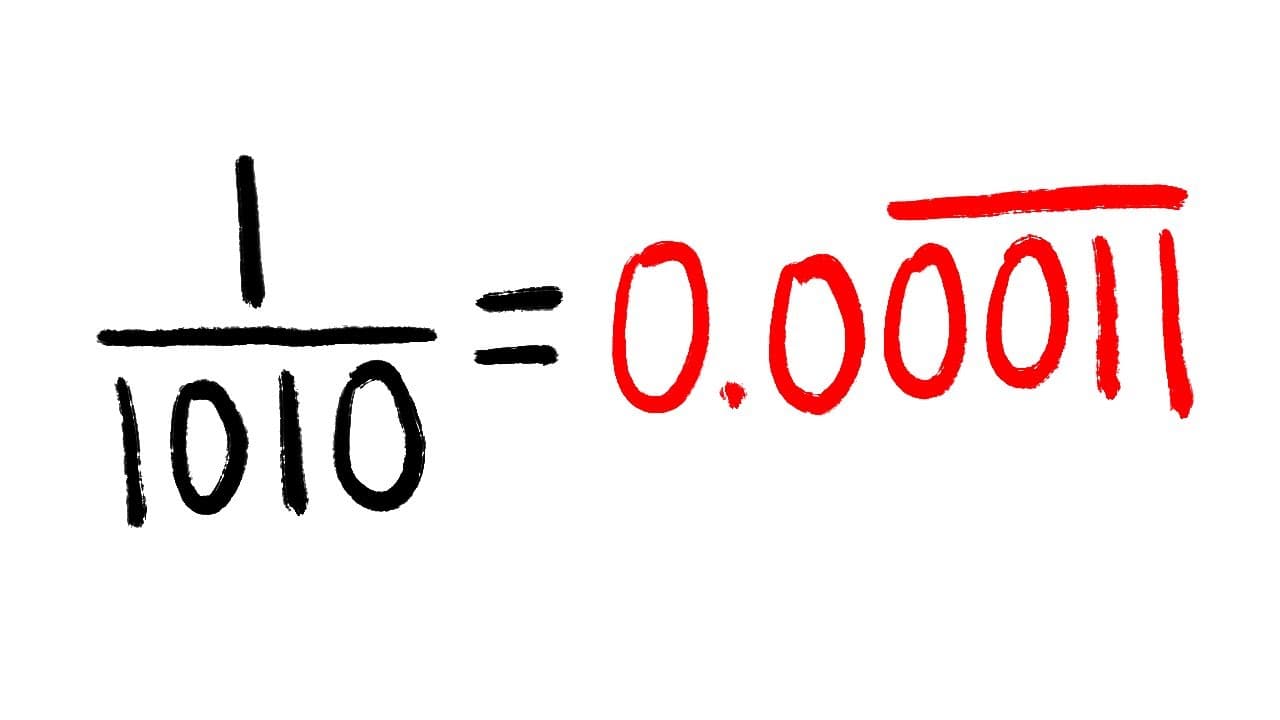
how to convert fractions to binary point
TL;DR
Learn how to convert fractions into binary using only zeroes and ones.
Transcript
put a zero here be where you put us right here but you you right here but we're actually okay we're gonna see how to do fraction in the world of only zeros and ones and the main parts that we'll see how to convert a fraction to a binary point you'll see what I mean by that and first of all this right here's one over one zero which is the same as sa... Read More
Key Insights
- 🪘 Converting fractions to binary involves using long division to obtain the binary representation.
- 😥 Binary numbers require a binary point instead of a decimal point to separate the integer and fractional parts.
- 🔁 Fractions with repeating patterns in the decimal representation will also have repeating patterns in the binary representation.
- 🤢 The bar notation is used to indicate the repeating portion of the binary representation.
- 💻 Understanding binary conversion is essential for applications in computer science and digital systems.
- 🤑 Converting fractions to binary using only zeroes and ones allows for a clear representation of fractional values.
- 🪘 Long division is a common method for converting fractions to different number systems.
Install to Summarize YouTube Videos and Get Transcripts
Explore YouTube Video Summarizer or Get YouTube Transcript Extractor
Questions & Answers
Q: How do you convert fractions into binary using only zeroes and ones?
To convert fractions into binary, you can use long division. By placing the fraction inside and the divisor outside, you divide and write the remainders as binary digits. The repeating pattern indicates the binary representation of the fraction.
Q: Why is a binary point used instead of a decimal point?
A binary point is used because binary numbers only have two digits (zero and one), unlike decimal numbers that have ten digits. The binary point indicates the separation between the integer and fractional parts of a binary number.
Q: How do you convert 1/1011 into binary?
To convert 1/1011 into binary, use long division. As the division progresses, the pattern "0.0011" repeats indefinitely, indicating the binary representation as 0.0011 with a bar over the repeating part.
Q: What is the significance of the repeating part in the binary representation?
The repeating part in the binary representation signifies an infinite repeating pattern in the binary number. It is denoted by placing a bar over the repeating part, indicating that the pattern continues indefinitely.
Summary & Key Takeaways
-
The content demonstrates how to convert fractions into binary using long division.
-
A binary point is used instead of a decimal point to indicate the fraction's value in binary form.
-
The process is shown step-by-step for fractions such as 1/10, 1/11, and 1/1010.
Read in Other Languages (beta)
Share This Summary 📚
Summarize YouTube Videos and Get Video Transcripts with 1-Click
Try YouTube Summary with ChatGPT & Claude or YouTube Transcript Generator
Explore More Summaries from blackpenredpen 📚
Summarize YouTube Videos and Get Video Transcripts with 1-Click
Try YouTube Summary with ChatGPT & Claude or YouTube Transcript Generator