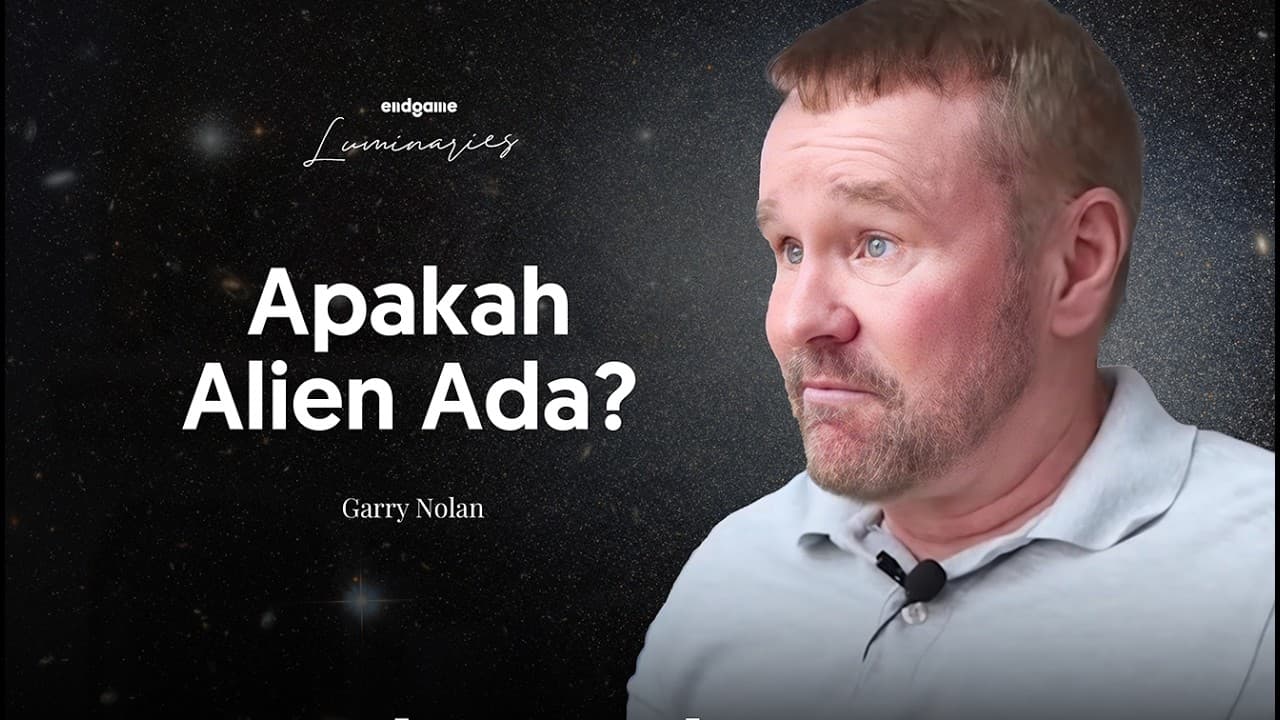
Alien & UFO: The Critical Question Nobody's Asking - Garry Nolan | Endgame #209 (Luminaries)
TL;DR
The critical question is not simply whether UFOs are extraterrestrial, but what range of explanations can account for unexplained experiences without reaching a premature conclusion. Garry Nolan describes recurring childhood visions and a silent object with five or six lights that passed over him around 1972 or 1973. He connects scientific openness, anomalies, non-human intelligence, and AI-driven research. Read on for his evidence-minded approach to extraordinary possibilities.
Transcript
GITA WIRJAWAN: Hi friends, today we're honored to have Professor Garry Nolan, who is a professor at the Department of Pathology at the School of Medicine at Stanford University. Garry, thank you so much for gracing our show. GARRY NOLAN: Well, I really appreciate it and I'm looking forward to speaking to you and then through you to your listeners. ... Read More
Key Insights
- Garry Nolan shares childhood experiences with unexplained phenomena, sparking his lifelong curiosity about UFOs and non-human intelligence.
- Nolan emphasizes the importance of questioning anomalies in scientific data, as they can lead to groundbreaking discoveries.
- He discusses the potential of AI to aid scientific research and solve complex problems, particularly in the field of immunology.
- Nolan argues that non-human intelligence might not be hostile, as they have no need to compete for resources with humans.
- He suggests that non-human intelligence could be interdimensional or time-traveling entities, challenging traditional views of extraterrestrial life.
- The conversation highlights the role of AI in advancing human knowledge and addressing global challenges, including education and leadership.
- Nolan advocates for open-mindedness and interdisciplinary approaches in scientific research, encouraging young scientists to pursue unconventional ideas.
- He believes that humanity is on the brink of significant discoveries, with AI playing a crucial role in shaping the future of science and society.
Install to Summarize YouTube Videos and Get Transcripts
Explore YouTube Video Summarizer or Get YouTube Transcript Extractor
Questions & Answers
Q: What is the critical question Garry Nolan thinks people should ask about UFOs and aliens?
Nolan focuses on what the phenomenon could be rather than assuming it is extraterrestrial. He keeps several possibilities open: a physical manifestation, an ordinary mistake or dream, or a hallucination placed in the mind.
Q: What sparked Garry Nolan's interest in UFOs and non-human intelligence?
As a child, Nolan repeatedly woke to what he described as little figures in his room, although he acknowledges they could have been dreams. Years later, he saw a silent object pass slowly above the trees, and reading Whitley Strieber's Communion as a Stanford graduate student brought those memories back and intensified his interest.
Q: What did Garry Nolan see while delivering newspapers?
Around 1972 or 1973, Nolan noticed his shadow moving while he walked through the woods early in the morning. Looking up, he saw a slow, silent object near treetop level with five or six lights strong enough to cast a shadow.
Q: Does Garry Nolan claim his childhood experiences prove that UFOs are real?
No. He says the object might have been a UFO, while the figures in his room might have been dreams, physical beings, or visions placed in his mind. His scientific position is to keep multiple explanations available instead of declaring a conclusion.
Q: How does Garry Nolan approach unexplained anomalies as a scientist?
Nolan argues that scientists should question anomalies and remain open to several possible explanations. He treats even ordinary mistakes, dreams, and hallucinations as possibilities that must stay on the table until evidence distinguishes among them.
Q: How does Garry Nolan view AI's role in scientific research?
Nolan sees AI as a transformative research tool, particularly in immunology. He believes it can organize ideas, generate hypotheses, process large amounts of data, and help scientists investigate complex problems beyond the limits of unaided human cognition.
Q: Why does Nolan think non-human intelligence might not be hostile?
Nolan suggests that advanced non-human intelligence may have no need to compete with humanity for resources. If such intelligence can access energy and resources beyond human capabilities, the resource pressures that produce conflict could be absent.
Q: How does Nolan encourage young scientists to pursue unconventional research?
He encourages them to remain open-minded, draw knowledge from different fields, and investigate anomalies instead of dismissing them. He also stresses testing ideas experimentally, persisting despite critics, and combining older ideas in new ways.
Summary & Key Takeaways
-
Garry Nolan shares his childhood encounters with unexplained phenomena, which fueled his interest in UFOs and non-human intelligence. He emphasizes the importance of questioning scientific anomalies and exploring unconventional ideas.
-
Nolan discusses the potential of AI to revolutionize scientific research, particularly in immunology, and its role in addressing global challenges. He suggests that AI could help create a scarcity-free society, reducing conflict over resources.
-
The conversation explores the possibility of non-human intelligence being interdimensional or time-traveling entities. Nolan encourages young scientists to pursue innovative ideas and remain open-minded in their research endeavors.
Read in Other Languages (beta)
Share This Summary 📚
Summarize YouTube Videos and Get Video Transcripts with 1-Click
Try YouTube Summary with ChatGPT & Claude or YouTube Transcript Generator
Explore More Summaries from Gita Wirjawan 📚



Summarize YouTube Videos and Get Video Transcripts with 1-Click
Try YouTube Summary with ChatGPT & Claude or YouTube Transcript Generator