Which country does the most good for the world? | Simon Anholt
TL;DR
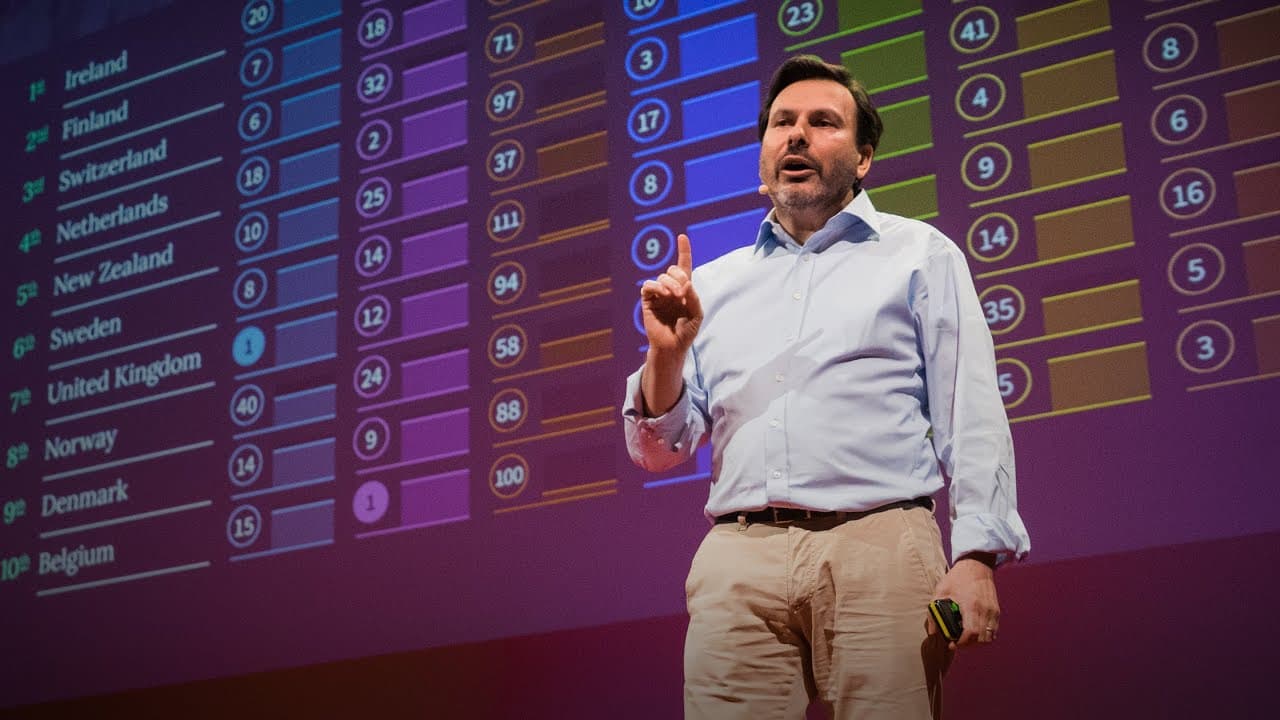
According to the Good Country Index, Ireland ranks as the most 'good' country, meaning it contributes positively to the world relative to its population. This index highlights that a nation's greatness is not solely based on wealth but on its global impact and collaborative spirit, emphasizing the need for countries to work together to address global challenges.
Transcript
I've been thinking a lot about the world recently and how it's changed over the last 20, 30, 40 years. Twenty or 30 years ago, if a chicken caught a cold and sneezed and died in a remote village in East Asia, it would have been a tragedy for the chicken and its closest relatives, but I don't think there was much possibility of us fearing a global p... Read More
Key Insights
- 🌍 Globalization has brought both negative and positive impacts, and we need to respond more quickly to the challenges it presents, like climate change and terrorism.
- 🔍 The current organizational structure of nation-states, with inward-looking governments, is ineffective for addressing global problems and collaborating with other countries.
- 🤝 We need to ask our governments to think more outwardly and consider global problems, as their focus on domestic issues hinders progress on a global scale.
- 🌎 The Good Country Index reveals that countries that contribute positively to the world are admired, and this creates opportunities for economic growth and collaboration.
- 🌐 Attitude, culture, and imagination are key factors in becoming a good country, not just financial wealth.
- 🗳️ Using the word "good" and questioning whether government actions align with the principles of a good country can encourage positive change.
- 💡 The self-interest of countries can be aligned with the interests of the global community, leading to greater collaboration and progress in solving global challenges.
- 💪 Changing our mindset and embracing a focus on the common good can help us create a better world for everyone.
Install to Summarize YouTube Videos and Get Transcripts
Explore YouTube Video Summarizer or Get YouTube Transcript Extractor
Questions & Answers
Q: How has globalization changed over the last 20-30 years?
Globalization has become faster and cheaper, allowing for the transshipment of bodies, minds, words, pictures, ideas, teaching, and learning around the world. However, it has also brought about negative consequences, such as the global economic crisis and the fear of pandemics.
Q: Why have we been slow in responding to the challenges of globalization?
One reason is that we are still organized as a species in the same way we were organized 200 or 300 years ago, with nation-states and governments looking inward instead of considering global problems. Another reason is that we, and our leaders, tend to have minds that focus on our own countries rather than thinking globally.
Q: Why do governments tend to look inward rather than outward?
Governments look inward because that is what we, as the population, ask them to do. We elect them or tolerate their leadership with the expectation that they will deliver prosperity, growth, competitiveness, justice, and other benefits within our own country. This self-centered focus discourages them from considering global problems.
Q: How can countries be encouraged to work together more effectively?
Countries can be encouraged to collaborate by recognizing that being a "good" country, one that contributes to the world and makes it safer, better, richer, and fairer, can lead to greater success in terms of selling products, attracting investments, and ultimately becoming more competitive. By aligning their self-interest with global cooperation, countries can change their mindset.
Q: Which country is considered the "goodest" country in the world?
According to the Good Country Index, Ireland is the country that contributes the most to humanity per head of population and per dollar of GDP. Through their positive contributions to the world, Ireland stands out as a model for other countries to follow.
Summary
This video discusses the challenges and opportunities of globalization and the need for countries to work together to solve global problems. The speaker emphasizes the importance of thinking beyond national interests and focusing on the greater good for humanity. He introduces the concept of a "good country" and presents the Good Country Index, which measures a country's contribution to the world.
Questions & Answers
Q: How has globalization changed the world?
Globalization has enabled the faster and cheaper movement of people, ideas, and resources around the world. It has brought both positive and negative outcomes, such as economic crises and global pandemics.
Q: Why have we been slow in responding to the challenges of globalization?
One reason is that we are still organized as nation-states and our governments tend to focus on national interests rather than global issues. There is a lack of collaboration and a tendency to compete with one another.
Q: How can countries better work together to solve global problems?
We need to ask our governments to think beyond national interests and consider the global implications of their actions. By encouraging collaboration and looking at international contexts, we can more effectively address domestic policy issues.
Q: Why do our leaders still tend to look inward?
Our leaders look inward because that is what we ask them to do. As citizens, we often prioritize prosperity, growth, and competitiveness within our own countries. We need to shift our expectations and demand that our leaders consider global problems.
Q: What is the role of empathy in solving global problems?
Empathy is crucial for understanding and valuing the perspectives and experiences of others. Often, we are only empathetic to those who are similar to us, which hinders our ability to solve global problems. We must strive to see people from different cultures and backgrounds as individuals with rich and complex lives.
Q: Why do governments believe the domestic and international agendas are incompatible?
There is a misconception that domestic and international issues cannot be addressed simultaneously. However, many domestic policy issues can be resolved more effectively by treating them as international problems and considering the broader context and solutions implemented by other countries.
Q: Why is it often difficult to make people change?
Humans are inherently resistant to change, as it is a survival mechanism. We tend to stick to what we know because it has kept us alive thus far. However, if there is a self-interest involved, such as personal benefit or competitive advantage, people are more likely to be motivated to change.
Q: How can countries benefit from being a "good country"?
Being a good country, one that contributes to the well-being and betterment of humanity, brings numerous benefits. It enhances a country's reputation, attracts tourism and investment, and improves global competitiveness. Collaboration and contribution can lead to economic and social prosperity.
Q: How is the Good Country Index relevant?
The Good Country Index measures a country's contribution to the world, focusing on its impact beyond its own borders. It is an attempt to shift the discourse from competitive and prosperous countries to good countries that prioritize the common good. The index encourages governments and citizens to prioritize global issues and fosters a sense of responsibility.
Q: What can individuals do to promote the idea of a "good country"?
Individuals can start using the term "good" when discussing countries and their actions. They should evaluate whether a country's behavior aligns with the principles of a good country and demand that their politicians prioritize the common good over narrow national interests. By promoting the idea of a good country, individuals can bring about change.
Takeaways
The world is facing numerous global challenges, and the current organization of nation-states is ill-equipped to address them effectively. Globalization has brought both positive and negative outcomes, but our response to its challenges has been slow. To solve global problems, we need to think beyond national interests and encourage countries to work together. The concept of a "good country" that contributes positively to the world can guide us in this direction. By valuing empathy, demanding change from our leaders, and promoting the idea of a good country, we can shift the focus towards collaboration and the betterment of humanity.
Summary & Key Takeaways
-
Globalization has brought both positive and negative effects, such as the ability for information and ideas to be shared around the world more quickly, but also challenges like climate change and terrorism.
-
The current organization of nation-states and governments is not efficient in solving global problems, as they tend to focus on their own interests rather than working together.
-
The Good Country Index measures how much each country contributes to the world, and Ireland ranks the highest, showing that being a good country is not solely dependent on being rich.
Read in Other Languages (beta)
Share This Summary 📚
Summarize YouTube Videos and Get Video Transcripts with 1-Click
Try YouTube Summary with ChatGPT & Claude or YouTube Transcript Generator
Explore More Summaries from TED 📚



Summarize YouTube Videos and Get Video Transcripts with 1-Click
Try YouTube Summary with ChatGPT & Claude or YouTube Transcript Generator