Apollo 15: "Never Been on a Ride like this Before"
TL;DR
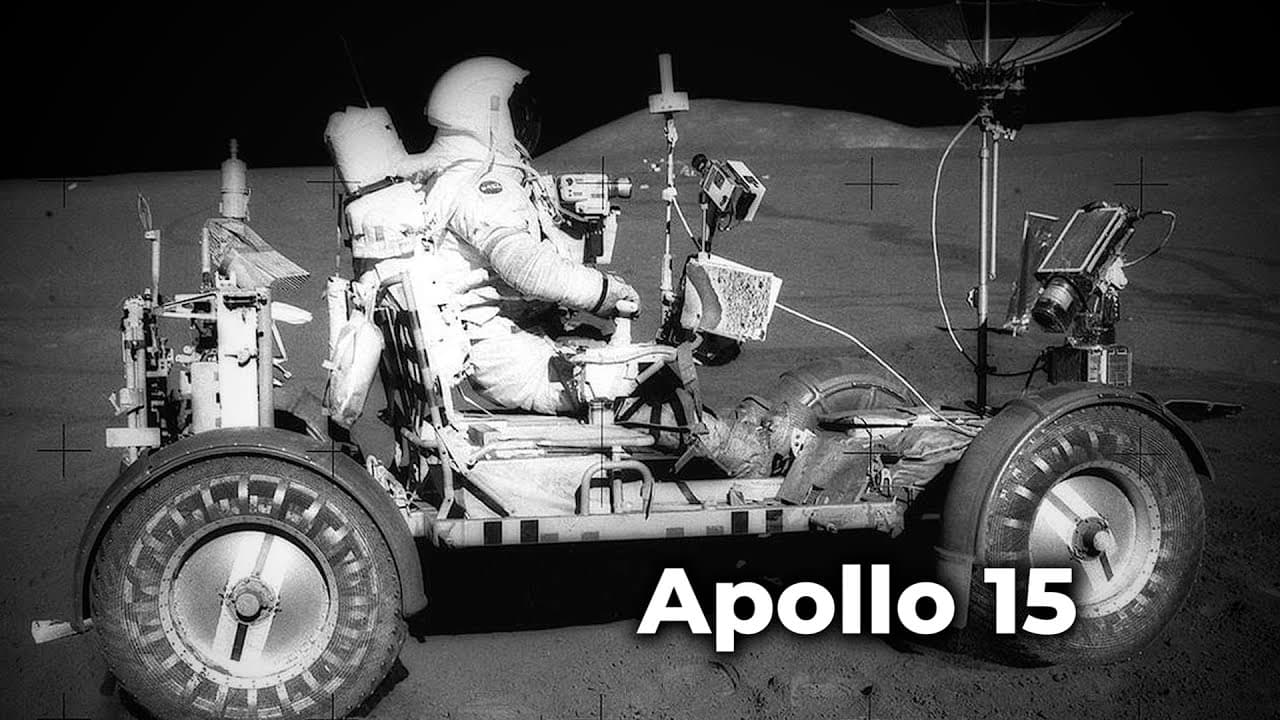
Apollo 15 advanced lunar science by combining the first Lunar Rover with a SIM bay of scientific instruments for surface and orbital research. David Scott and Jim Irwin explored the Apennine Hadley region, collected 170 pounds of lunar material, and found the over 4-billion-year-old Genesis Rock, while Al Worden gathered photographs and data from orbit. Read on for its experiments, records, deep-space EVA, and challenging return.
Transcript
- [Man] Guidance, internal. 13 12 11 10 9 8 Ignition sequence start. Engines on. 5 4 3 2 1 (orchestral music) - Apollo 15 that was launched 50 years ago on July the 26th, 1971. It was a relatively big step from the previous three missions. As president Nixon stated, it would be the most ambitious scientific exploration in space at that time. The th... Read More
Key Insights
- ❣️ Apollo 15 was notable for its heavy emphasis on scientific exploration and data gathering.
- 😒 The use of the Lunar Rover significantly expanded the astronauts' ability to explore the moon's surface.
- 🥮 The mission resulted in the discovery of the Genesis Rock, which provided valuable insights into the moon's geological history.
- 😫 The mission set multiple records, demonstrating advancements in space exploration technology and capabilities.
- 🥮 Apollo 15 contributed significantly to our understanding of the moon and collected a wealth of scientific data during its duration.
- 💁 The astronauts conducted experiments and deployed scientific instruments to gather information about the lunar environment.
- 🎑 The mission included both surface exploration and orbital activities, offering a comprehensive view of the moon.
Install to Summarize YouTube Videos and Get Transcripts
Explore YouTube Video Summarizer or Get YouTube Transcript Extractor
Questions & Answers
Q: What made Apollo 15 different from previous lunar missions?
Apollo 15 placed a heavier emphasis on scientific exploration than the previous three missions. Its Lunar Rover expanded surface exploration, while the command service module's SIM bay let Al Worden collect photographs and scientific data from lunar orbit.
Q: Who were the astronauts on Apollo 15?
The crew consisted of Commander David Scott, Command Module Pilot Al Worden, and Lunar Module Pilot Jim Irwin. Scott and Irwin explored the lunar surface while Worden conducted orbital observations.
Q: How did the Lunar Rover help Apollo 15 explore the Moon?
The electrically driven Lunar Rover allowed Scott and Irwin to travel much farther than astronauts on the previous three missions. It had a top speed of about eight miles per hour, and they used it while exploring the Apennine Hadley region for three days.
Q: What was the Genesis Rock found during Apollo 15?
The Genesis Rock was a single lunar rock found by Scott and Irwin during their geological studies. It was determined to be over 4 billion years old.
Q: What experiment did David Scott perform on the Moon?
Scott demonstrated Galileo's theory that two objects fall at the same rate in an airless environment. He dropped two objects together, and they reached the ground at the same time.
Q: How much lunar material did Apollo 15 collect?
Scott and Irwin gathered 170 pounds of lunar material to bring back to Earth. They spent over 18 hours on the Moon, the longest lunar-surface time of any Apollo mission at that point.
Q: Why did Al Worden perform a deep-space EVA?
During the return flight, Al Worden left the command module to retrieve cassettes containing data recorded during his lunar orbits. The EVA occurred 197,000 miles from Earth and was the first deep-space walk.
Q: What records did Apollo 15 set?
Apollo 15 recorded the first use of the Lunar Rover, the first deep-space walk, the heaviest payload in lunar orbit at 107,000 pounds, and the longest crewed lunar mission at 295 hours. The mission achieved all of its objectives and accumulated extensive scientific information.
Summary & Key Takeaways
-
Apollo 15, launched in 1971, was a significant mission that marked a milestone in scientific exploration in space.
-
The mission included three astronauts, who used the Lunar Rover to cover a greater distance on the moon and gather more lunar data.
-
The astronauts spent three days exploring the Apennine Hadley region, conducted experiments, discovered the Genesis Rock, and gathered 170 pounds of lunar material.
Read in Other Languages (beta)
Share This Summary 📚
Summarize YouTube Videos and Get Video Transcripts with 1-Click
Try YouTube Summary with ChatGPT & Claude or YouTube Transcript Generator
Explore More Summaries from NASA 📚

Summarize YouTube Videos and Get Video Transcripts with 1-Click
Try YouTube Summary with ChatGPT & Claude or YouTube Transcript Generator