What Are the Challenges of Simulating Deformable Objects?
TL;DR
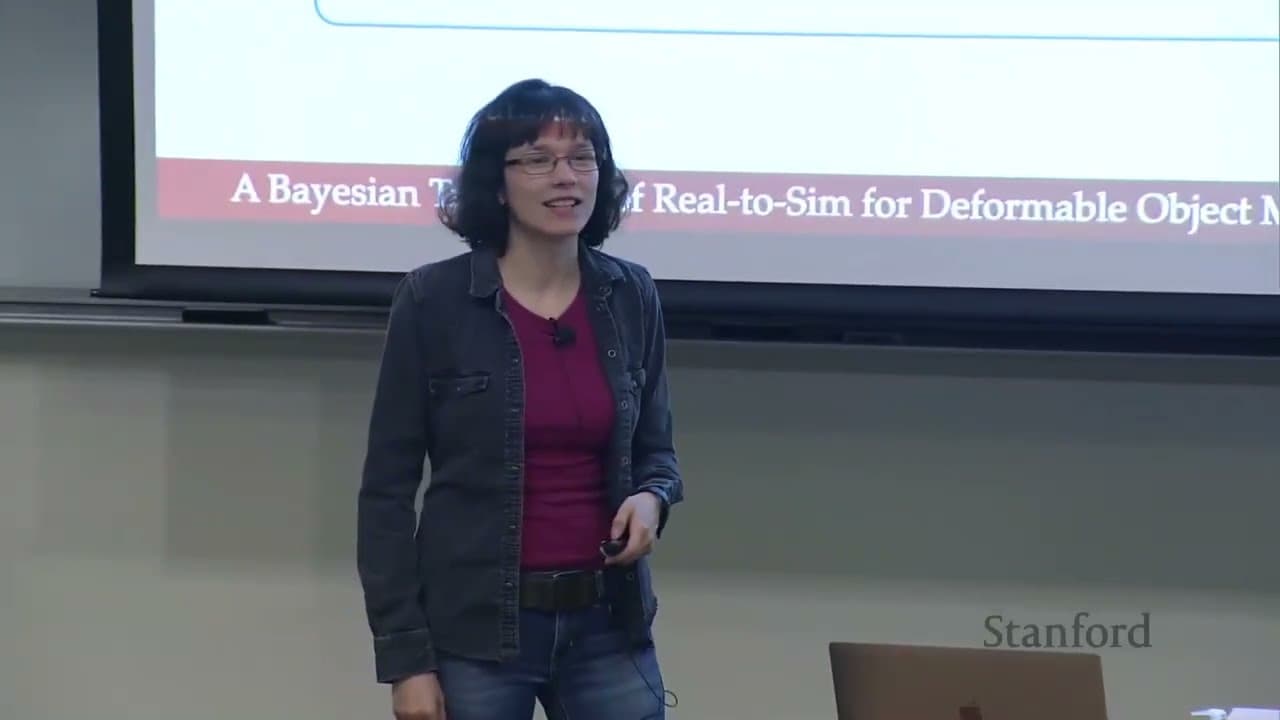
Simulating deformable objects poses challenges due to their infinite degrees of freedom and the difficulty of accurately annotating their states. Issues like occlusion and dimensionality reduction further complicate representation. Innovations in distributional embeddings and differentiable simulations offer promising solutions for better representation, enabling enhanced interaction with real-world environments.
Transcript
first i will give you an overview of what is challenging about deformables just to introduce kind of this topic why am i interested in it why we're generally interested in looking into that and then just to give you a brief uh preview of what's going to be in the talk i will talk about the distributional approach to representing the state of the de... Read More
Key Insights
- 🎁 Deformable objects present a challenge due to their infinite degrees of freedom and the difficulty of annotating their states.
- 💠 Occlusions make it hard to establish the shape and behavior of deformable objects.
- ❓ Reducing dimensionality in the representation of deformable objects does not eliminate the complexity of their dynamics.
- ❓ Distributional embedding and differentiable simulation offer potential solutions to overcome the challenges in representing and simulating deformable objects.
- 😒 The use of unsupervised methods and embedding probability distributions can provide a robust and permutation-invariant representation of deformable objects.
- 👻 Differentiable simulators allow for automatic adjustment of simulation parameters based on real observations, enabling simulation-to-reality transfer.
- 👨🔬 Creating comprehensive simulation environments for deformable objects can facilitate research and development in robotics and machine learning communities.
- ❓ The integration of deformable objects into existing frameworks, such as AI Habitat, can expand the capabilities for sim-to-real transfer and policy learning.
Install to Summarize YouTube Videos and Get Transcripts
Explore YouTube Video Summarizer or Get YouTube Transcript Extractor
Questions & Answers
Q: Why is it difficult to represent the state of deformable objects?
Deformable objects have an infinite number of degrees of freedom, unlike rigid objects with a fixed number of degrees of freedom. This poses a challenge in determining the state of a deformable object accurately.
Q: What are the challenges in annotating the states of deformable objects?
Annotating the states of deformable objects is expensive and challenging. Placing markers on the objects for tracking purposes is a meticulous process, and using expensive scanners is not always feasible.
Q: How do occlusions affect the representation of deformable objects?
Occlusions are challenging to handle in deformable objects, as their shape can change drastically within a short timeframe. Establishing the shape of an occluded deformable object becomes much more difficult due to this constant change.
Q: How does reducing dimensionality impact the representation of deformable objects?
Mapping the representation of a deformable object into a lower dimensional space, even by tracking key points, does not eliminate the complex dynamics of the object. In the lower dimensional space, the key points jump around seemingly randomly, making it difficult to interpret the object's actual behavior.
Summary & Key Takeaways
-
Deformable objects have an infinite number of degrees of freedom, making it challenging to represent their states accurately.
-
Annotation of deformable object states is expensive and difficult, requiring sophisticated scanning equipment.
-
Dealing with occlusions, reducing dimensionality, and handling noisy states are additional challenges in representing deformable objects.
Read in Other Languages (beta)
Share This Summary 📚
Summarize YouTube Videos and Get Video Transcripts with 1-Click
Try YouTube Summary with ChatGPT & Claude or YouTube Transcript Generator
Explore More Summaries from Stanford Online 📚





Summarize YouTube Videos and Get Video Transcripts with 1-Click
Try YouTube Summary with ChatGPT & Claude or YouTube Transcript Generator