Numerical on Kite - Boundary Layer Theory - Fluid Mechanics 2
TL;DR
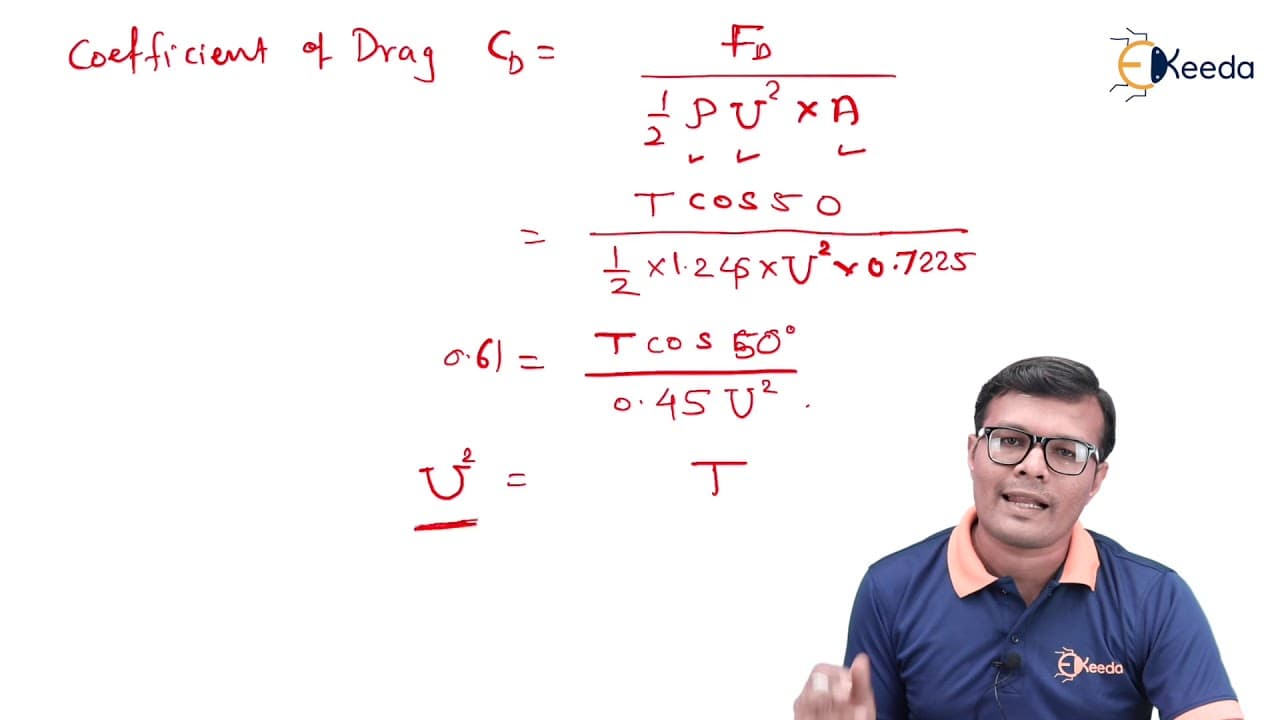
This video discusses the process of calculating the tension in a kite string and determining the wind speed based on given parameters.
Transcript
hello friends in this video we are going to solve a numerical in which we will calculate the tension in the string which is attached with a kite so let's move on to a video let's start with problem a kite of dimension a dimension of a kite is given to us and weighing seven point eight five Newton weight is also given to us in Newton which is our re... Read More
Key Insights
- 🐲 The tension in the string attached to a kite can be determined by resolving forces and using the drag force equation.
- 🧑🏭 The drag and lift coefficients are necessary to calculate the forces acting on the kite.
- 🖐️ The density of the air and the area of the kite also play a crucial role in the calculations.
- 💨 By rearranging equations and substituting known values, the tension and wind speed can be obtained.
- 🆘 Resolving forces helps separate the components of the forces and simplifies the calculations.
- 🏋️ The drag force is in the direction of velocity, while the lift force and weight contribute to the forces acting on the kite.
- 👨💼 The calculations involve trigonometric functions, such as cosine and sine, to consider the angles involved in the problem.
Install to Summarize YouTube Videos and Get Transcripts
Explore YouTube Video Summarizer or Get YouTube Transcript Extractor
Questions & Answers
Q: How can the tension in the string attached to a kite be calculated?
The tension in the string can be calculated by resolving forces and using the drag force equation, which considers the lift force and weight of the kite. By rearranging the equation and substituting known values, the tension can be determined.
Q: What are the drag and lift coefficients, and how do they affect the calculations?
The drag coefficient (CD) and lift coefficient (CL) determine the forces acting on the kite. The drag coefficient affects the drag force calculation, while the lift coefficient influences the lift force calculation. These coefficients are given and need to be used in the appropriate equations.
Q: How is the wind speed determined in this problem?
By rearranging equations and utilizing the tension value obtained in the previous calculations, the wind speed (U) can be calculated. The equation involves the tension value and other known parameters, such as the density of air and the area of the kite.
Q: What is the significance of resolving forces in this problem?
Resolving forces is essential to separate the components of the forces acting on the kite. By dividing the forces into their respective directions, the equations become more manageable and the tension and wind speed can be calculated accurately.
Summary & Key Takeaways
-
The video focuses on solving a mathematical problem involving a kite's dimensions, weight, and angles to calculate the tension in the string attached to the kite.
-
The drag and lift coefficients are provided, along with the density of the air, which are necessary for the calculations.
-
By using equations and resolving forces, the video explains how to obtain the tension in the string and the wind speed.
Read in Other Languages (beta)
Share This Summary 📚
Summarize YouTube Videos and Get Video Transcripts with 1-Click
Try YouTube Summary with ChatGPT & Claude or YouTube Transcript Generator
Explore More Summaries from Ekeeda 📚



Summarize YouTube Videos and Get Video Transcripts with 1-Click
Try YouTube Summary with ChatGPT & Claude or YouTube Transcript Generator