How to Derive a Six-Hour Unit Hydrograph from a Two-Hour Unit Hydrograph – Hydrology Numerical
TL;DR
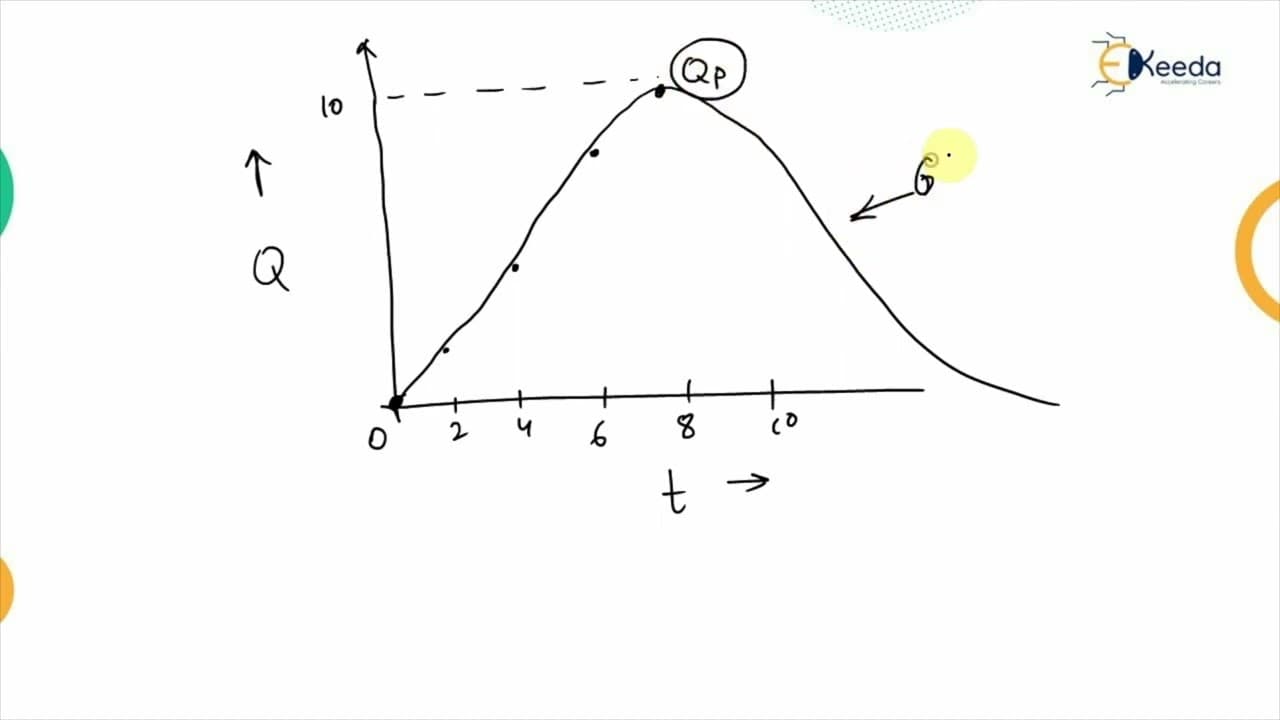
Convert the two-hour unit hydrograph to a six-hour unit hydrograph by adding three copies lagged at two-hour intervals, then dividing the summed ordinates by the total rainfall depth of 3 centimeters. For the given discharges, the summed direct-runoff ordinates are 0, 5, 13, 28, 30, 22, 7, and 0, producing a peak unit-hydrograph discharge of 10 cubic meters per second. Read on for the calculation sequence and resulting ordinates.
Transcript
hello everyone in this video we are going to solve numericals based upon the derivation of the unit hydrograph from the given unit hydrograph so let's start so the first problem it says that convert a two hour unit hydrograph to a six hour unit hydrograph for the given discharge values so at the different durations of the time the discharge values ... Read More
Key Insights
- 🇦🇪 Unit hydrographs are graphical representations of the relationship between rainfall and runoff.
- 🇦🇪 Converting unit hydrographs for different storm durations involves lagging the hydrographs and dividing the resulting ordinates by the total effective rainfall depth.
- 📁 Direct runoff hydrographs can be obtained by multiplying unit hydrograph ordinates by the effective rainfall depth.
- 📁 The resulting direct runoff hydrographs can be combined to calculate the direct runoff hydrograph for longer storm durations.
Install to Summarize YouTube Videos and Get Transcripts
Explore YouTube Video Summarizer or Get YouTube Transcript Extractor
Questions & Answers
Q: How do you derive a six-hour unit hydrograph from a two-hour unit hydrograph?
Use three copies of the two-hour unit hydrograph because six hours equals 3 × 2 hours. Keep the first copy unchanged, lag the second by two hours, and lag the third by four hours; then add their ordinates and divide each sum by the total rainfall depth of 3 centimeters.
Q: What discharge values define the given two-hour unit hydrograph?
At 0, 2, 4, 6, 8, and 10 hours, the discharge ordinates are 0, 5, 8, 15, 7, and 0. Plotting discharge on the y-axis against time on the x-axis gives the original two-hour unit hydrograph.
Q: Why are three two-hour hydrographs used in the conversion?
The target duration of six hours is an integer multiple of the given two-hour duration: 6 = 3 × 2. The method therefore uses three successive two-hour rainfall events, each with a rainfall depth of 1 centimeter.
Q: How are the three two-hour unit hydrographs lagged?
The first hydrograph starts at 0 hours, the second is shifted by two hours, and the third is shifted by four hours from the first. This creates three successive two-hour hydrographs spanning the six-hour rainfall duration.
Q: What are the summed ordinates of the six-hour direct runoff hydrograph?
Adding the corresponding ordinates of the three lagged hydrographs gives 0, 5, 13, 28, 30, 22, 7, and 0. These values form a six-hour direct runoff hydrograph because the combined excess rainfall depth is 3 centimeters.
Q: Why must the summed hydrograph ordinates be divided by 3?
Each two-hour unit hydrograph represents 1 centimeter of rainfall depth, so three copies represent a total of 3 centimeters. A unit hydrograph must correspond to 1 centimeter, so every summed ordinate is divided by 3.
Q: What are the ordinates of the derived six-hour unit hydrograph?
The derived ordinates are 0, 5/3, 13/3, 28/3, 10, 22/3, 7/3, and 0. They are obtained by dividing the six-hour direct-runoff ordinates by the total rainfall depth of 3 centimeters.
Q: What is the peak discharge of the derived six-hour unit hydrograph?
The peak discharge is 10 cubic meters per second at 8 hours. It comes from dividing the maximum summed direct-runoff ordinate of 30 by the 3-centimeter rainfall depth.
Summary & Key Takeaways
-
The video explains how to convert a two-hour unit hydrograph to a six-hour unit hydrograph by assuming another two-hour rainfall event.
-
It demonstrates the process of obtaining direct runoff hydrographs and unit hydrographs for storms with rainfall excess values of 3 centimeters and 2 centimeters.
-
The video discusses the calculation and interpretation of discharge values for different storm durations and how to convert them into unit hydrographs.
Read in Other Languages (beta)
Share This Summary 📚
Summarize YouTube Videos and Get Video Transcripts with 1-Click
Try YouTube Summary with ChatGPT & Claude or YouTube Transcript Generator
Explore More Summaries from Ekeeda 📚




Summarize YouTube Videos and Get Video Transcripts with 1-Click
Try YouTube Summary with ChatGPT & Claude or YouTube Transcript Generator