Neptunium - Periodic Table of Videos
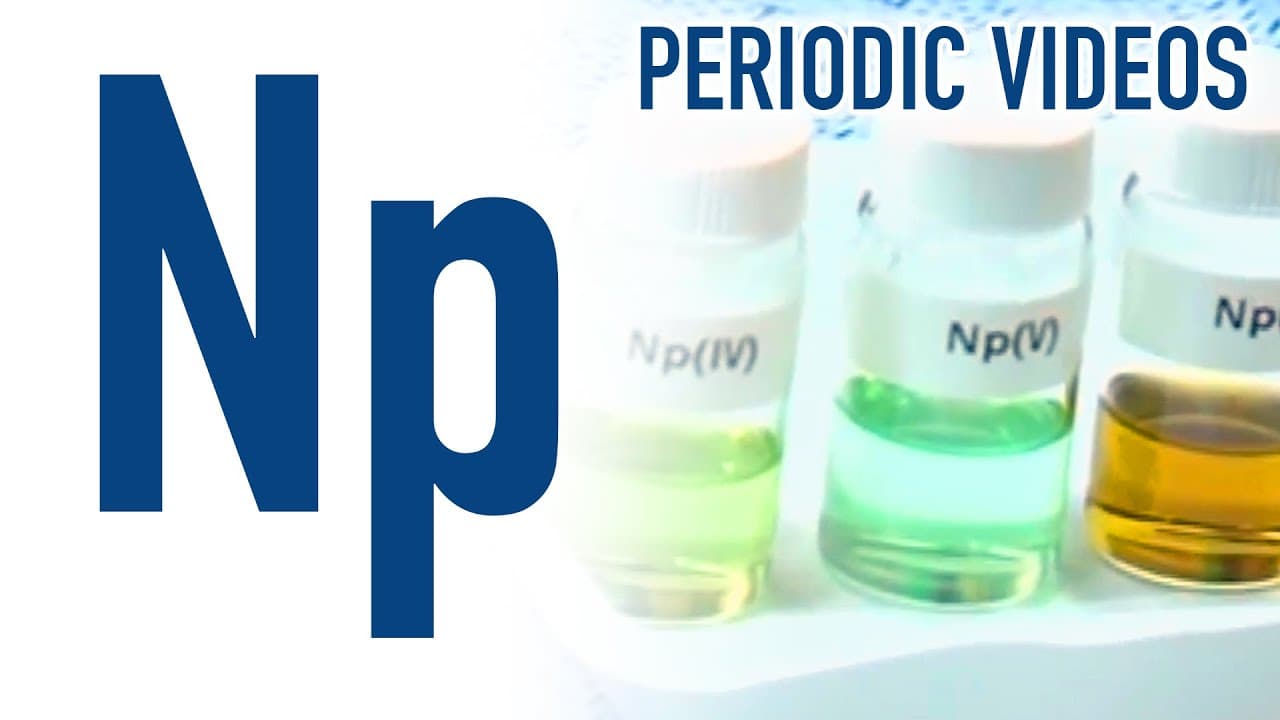
TL;DR
Neptunium, a byproduct of radiating nuclear fuel, has various oxidation states and a large liquid range. It is used in purifying waste from nuclear reactors and has minor applications in battery production.
Transcript
I've never seen any of these elements before and so it's really good because I now feel that I know them a little bit better I mean you never really know a chemical till you tried doing reactions yourself so it's like meeting somebody very quickly at a party rather than having dinner with them but still it is a start I know more about chemistry tha... Read More
Key Insights
- ⛽ Neptunium is a byproduct of radiating nuclear fuel and needs to be controlled and separated during waste purification.
- 🔶 It has the largest liquid range among all elements in the periodic table, requiring high temperatures for phase transition.
- 📶 Neptunium exists in multiple oxidation states, which can be manipulated by adjusting the strength of nitric acid during chemical processes.
- 👨🔬 The manipulation of neptunium's oxidation states is crucial in research on advanced waste processing.
- 🦻 Nitrous acid, produced through radiation chemistry, aids in stabilizing neptunium's oxidation state.
- 📛 Germanium was almost named neptunium, and if it had been, neptunium would have been given a different name.
- 🥺 Neptunium's chemistry and applications are not widely discussed or researched, leading to its relative obscurity compared to other elements.
Install to Summarize YouTube Videos and Get Transcripts
Explore YouTube Video Summarizer or Get YouTube Transcript Extractor
Questions & Answers
Q: What is the significance of neptunium in the nuclear process?
Neptunium is produced as a byproduct of radiating nuclear fuel and needs to be separated and controlled during waste purification. It also has a minor use in producing plutonium-238 isotopes for batteries.
Q: How does neptunium exist in solution?
Neptunium can exist in three oxidation states - neptunium 4, neptunium 5, and neptunium 6. These states depend on the number of electrons lost or gained by the neptunium atoms.
Q: How is nitric acid manipulated to control neptunium's oxidation states?
The strength of nitric acid is crucial in controlling the oxidation states of neptunium. Different strengths of nitric acid can be added at specific times to drive the neptunium towards the desired oxidation state.
Q: Why is neptunium not widely discussed in chemistry?
Neptunium is not commonly discussed in chemistry because it is a less well-known element and its chemistry and applications are not widely studied or discussed.
Summary & Key Takeaways
-
Neptunium is a byproduct of radiating nuclear fuel and needs to be controlled and separated in the waste purification process.
-
Neptunium has the largest liquid range among all elements in the periodic table, requiring a high temperature to transition from a liquid to a gas phase.
-
The manipulation of nitric acid strength and other reagents is crucial in controlling the oxidation states of neptunium and achieving desired outcomes.
Read in Other Languages (beta)
Share This Summary 📚
Summarize YouTube Videos and Get Video Transcripts with 1-Click
Try YouTube Summary with ChatGPT & Claude or YouTube Transcript Generator
Explore More Summaries from Periodic Videos 📚


Summarize YouTube Videos and Get Video Transcripts with 1-Click
Try YouTube Summary with ChatGPT & Claude or YouTube Transcript Generator