How Do High-Performing CISOs Lead Effectively?
TL;DR
High-performing CISOs lead without formal authority by combining technical excellence with proactive organizational engagement. They build credibility, develop a clear view of critical assets and business exposure, and persuade business leaders to own information security risk. Their effectiveness depends on communication, negotiation, education, and a practical understanding of how each business unit operates and what it values most.
Transcript
Everybody, um, my name is Phil Gardner. I'm the s- uh, founder and CEO of IANS. And I'm Stan Ahlberg. I head up the research team at IANS. So we're here to talk to- talk today about the insights that we've gained from studying high-performing CISOs and their teams. Why? 'Cause as we all know way too well, the interconnected world is an incredibly d... Read More
Key Insights
- Leading without authority is essential because CISOs usually do not control application development, sales, or all the other resources required to safeguard critical information assets. They must accomplish security objectives through influence, persuasion, negotiation, conflict management, communication, and organizational education.
- Business ownership of information security risk distinguishes the measured high performers from low performers in the IANS dataset. One hundred percent of high performers had business leaders owning risk, while only three percent of low performers had achieved that result.
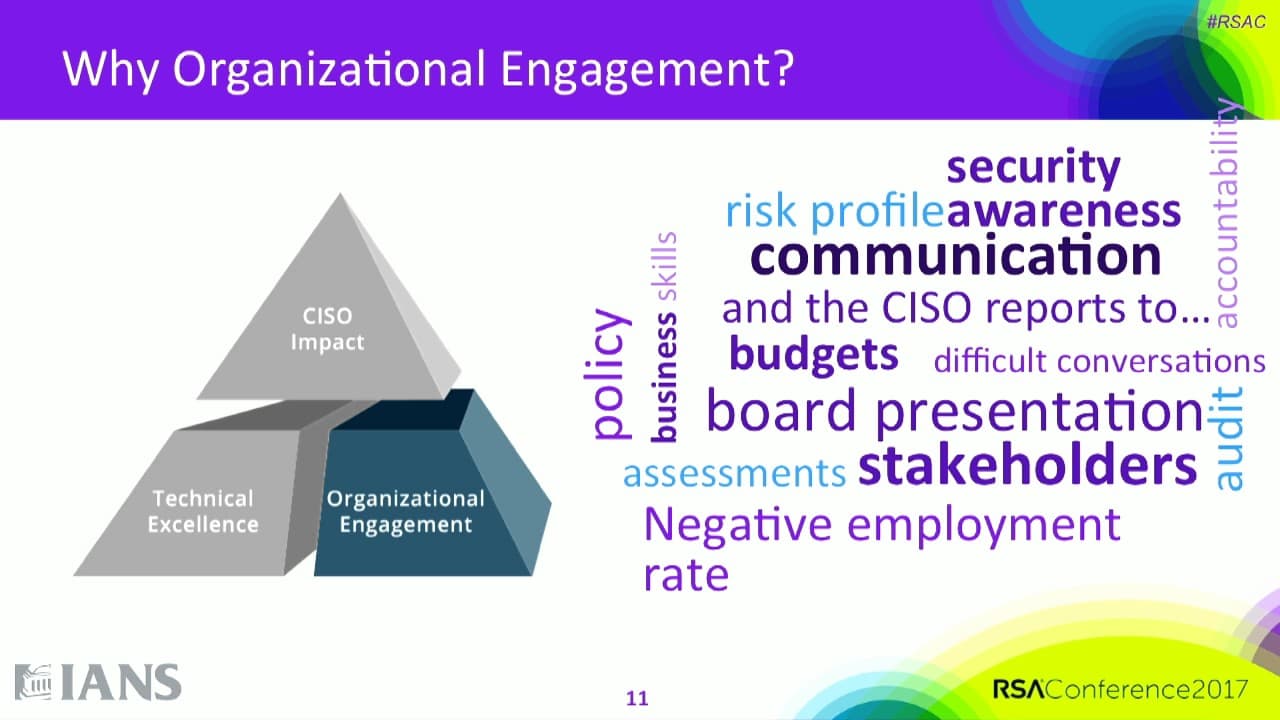
- CISO impact is built on two capabilities: technical excellence and proactive organizational engagement. IANS found that high-performing CISOs and their teams dedicated themselves to mastering both, rather than treating security as an exclusively technical responsibility.
- Technical excellence is the foundation of organizational credibility for a CISO. Strong technical capabilities provide the standing needed to get work done, but technical strength alone is insufficient to drive secure practices throughout the organization.
- Proactive organizational engagement brings information security thinking and best practices into the core of the business. It requires security leaders to leave the technology realm, understand business operations, and work directly with the people who control relevant decisions and resources.
- Command of the facts requires knowing the critical assets, their locations, their owners, the threats and risks surrounding them, the controls already operating, and the true exposure remaining after those controls have been evaluated.
- Business impact and future outlook are necessary parts of a CISO's factual picture. Answering whether the organization is adequately protected requires more than listing controls, because the CISO must describe the consequences of asset loss or compromise and provide a forecast.
- Direct conversations with individual business leaders are the starting point for better security decisions. These discussions reveal how each business operates, what leaders consider their crown jewels, and how much risk they accept, allowing security solutions to be tailored accordingly.
Install to Summarize YouTube Videos and Get Transcripts
Explore YouTube Video Summarizer or Get YouTube Transcript Extractor
Questions & Answers
Q: How can CISOs lead effectively without formal authority?
CISOs can lead without formal authority by using influence, persuasion, negotiation, conflict management, communication, and education. They generally do not control every function or resource needed to protect critical information assets, including application development and sales. Success therefore depends on persuading people throughout the organization to adopt safe practices, share relevant information, and participate in managing information security risk.
Q: What capabilities define a high-performing CISO?
A high-performing CISO combines technical excellence with proactive organizational engagement. Technical capabilities create credibility and are treated as essential, but they are not sufficient by themselves. The CISO and security team must also move beyond the technology realm, engage the wider organization, and drive information security thinking and best practices into the operations and decisions of the business.
Q: Why is technical excellence insufficient for CISO success?
Technical excellence is insufficient because security teams do not control all the people, processes, and resources that affect information risk. Technical strength gives a CISO credibility within the organization, but it cannot independently change business behavior. The CISO must use that credibility to engage business leaders, gather business-specific facts, influence decisions, and encourage safe practices across organizational boundaries.
Q: What facts should a CISO know about critical assets?
A CISO should know what the organization's critical assets are, where they are located, and who owns them. The CISO also needs to understand the risks and threats affecting those assets, evaluate the controls already in place, and determine the true remaining exposure. This factual foundation must include the business impact of loss or compromise and an outlook for future conditions.
Q: How should a CISO answer the board's question, "Are we okay?"
A CISO should answer by presenting a business-centered view of critical assets, risks, threats, controls, and remaining exposure. The response should identify asset ownership and explain the business impact if important information is lost or compromised. It should also provide an outlook for the future. Developing this answer requires obtaining facts from business leaders through persuasion, negotiation, communication, and education.
Q: How can CISOs understand the organization's risk appetite?
CISOs can understand risk appetite by holding direct conversations with individual business leaders about how their operations work and what they regard as their crown jewels. These discussions reveal both division-level priorities and the wider organization's willingness to accept risk. With that understanding, the security team can tailor its solutions more closely to actual business needs and operating conditions.
Q: Why should business leaders own information security risk?
Business leaders should own information security risk because ownership encourages more responsible behavior and creates genuine partners for the security team. The IANS dataset presented in the talk showed a sharp difference: one hundred percent of measured high performers had business leaders owning risk, compared with only three percent of low performers. This makes risk ownership a central example of successful leadership without authority.
Q: What is the IANS CISO Impact framework?
CISO Impact is an IANS framework for examining information security leadership and identifying practices associated with high-performing CISOs and their teams. It organizes performance around technical excellence and proactive organizational engagement. IANS further breaks these concepts into eight domains of technical excellence and seven factors of organizational engagement, creating discrete elements that can be defined, described, measured, and used to produce diagnostic data.
Summary & Key Takeaways
-
CISOs implicitly or explicitly promise to safeguard critical information assets, yet they rarely control all the resources needed to fulfill that promise. Application development, sales, and other business functions remain outside their authority. Effective security leadership therefore requires influence, persuasion, negotiation, conflict management, communication, and education across the organization.
-
IANS describes CISO impact through two complementary capabilities: technical excellence and proactive organizational engagement. Technical strength creates organizational credibility, but it cannot solve security problems by itself. High-performing CISOs move beyond the technology realm and embed security thinking and safe practices within business decisions, operations, and relationships.
-
Organizational engagement begins with commanding the facts and encouraging business ownership of risk. CISOs must identify critical assets, ownership, threats, controls, remaining exposure, business impact, and future outlook. They obtain this information through conversations with business leaders, which also reveal risk appetite and help security teams tailor solutions appropriately.
Read in Other Languages (beta)
Share This Summary 📚
Summarize YouTube Videos and Get Video Transcripts with 1-Click
Try YouTube Summary with ChatGPT & Claude or YouTube Transcript Generator
Explore More Summaries from RSAC Cybersecurity 📚



Summarize YouTube Videos and Get Video Transcripts with 1-Click
Try YouTube Summary with ChatGPT & Claude or YouTube Transcript Generator