The Mysterious Black Clouds of Birds: Murmurations Explained
TL;DR
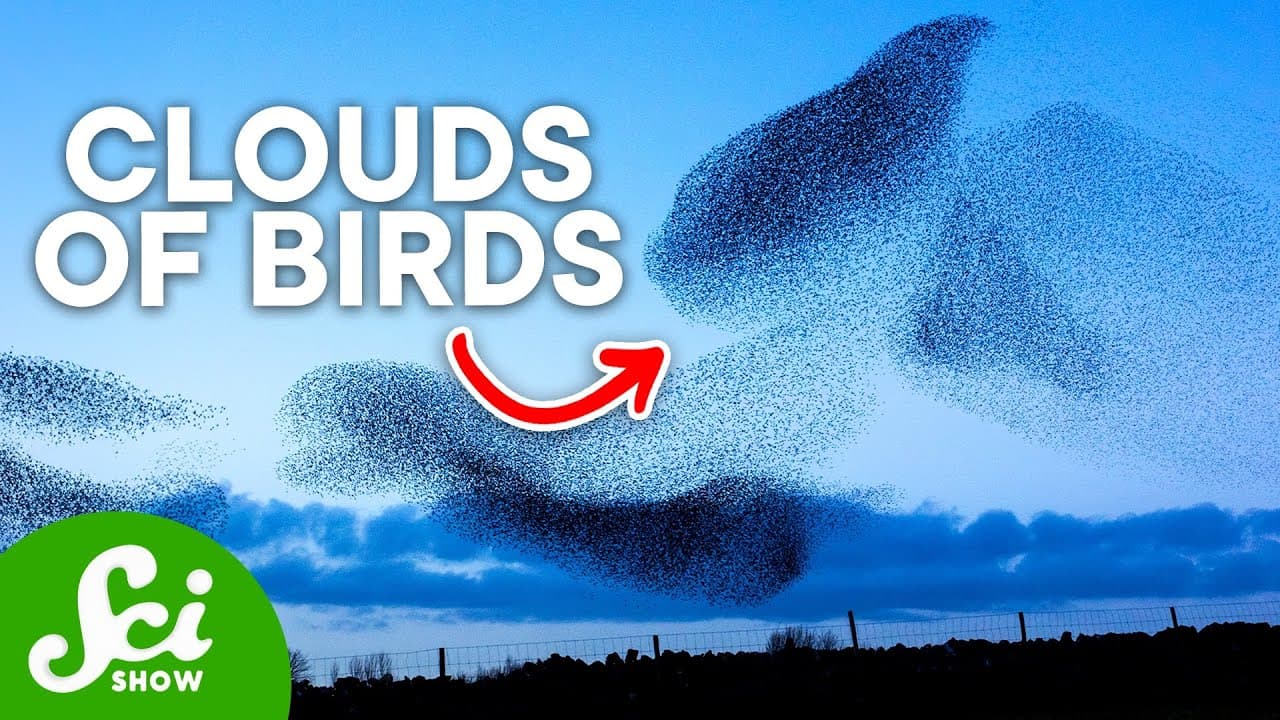
Starling murmurations are coordinated flock movements that help the birds detect and evade predators. Each starling responds to an average of six or seven nearby birds, allowing changes in direction and velocity to spread across the flock without a single leader. Larger groups react faster, while their rolling waves can confuse peregrine falcons and waste the predators’ energy. Read on to discover how simple local interactions create such complex motion, and what remains mysterious.
Transcript
[Intro] A bunch of goats is called a herd, whales travel in pods, baboons in troops, and owls in parliaments, but starlings may have the loveliest grouping of all: murmurations. Starlings are found all over the world including in North America where they were introduced in the late 1800s by a misguided Shakespeare fan who wanted to see every bird t... Read More
Key Insights
- 💨 Starlings form murmurations as a defense mechanism, responding faster to predators as the group size increases.
- 😕 Murmurations confuse and waste the energy of predators like peregrine falcons.
- 🐦 Each starling interacts with a fixed number of other birds, creating complex and dynamic movements.
- 🖐️ The shape of the flock, rather than its size, plays a significant role in the interactions between starlings.
- 🫨 The formation of murmurations is akin to a phase transition, where individuals become part of a cohesive unit.
- ❓ The senses and data used by starlings to interact with each other quickly and precisely are still a mystery to biologists.
- ❓ Murmurations are a beautiful and mesmerizing phenomenon in nature.
Install to Summarize YouTube Videos and Get Transcripts
Explore YouTube Video Summarizer or Get YouTube Transcript Extractor
Questions & Answers
Q: Why do starlings form murmurations?
Starlings form murmurations mainly for defense. Large groups reduce each bird’s odds of being caught, and research has found that larger flocks respond faster when predators such as falcons or foxes appear.
Q: How do starling murmurations move in coordination?
Each starling adjusts its direction and velocity in response to a fixed number of birds directly around it. Because those birds are simultaneously responding to their own neighbors, changes spread across the flock and create complex, coordinated movement.
Q: How many nearby birds does each starling follow in a murmuration?
Video analysis of murmurations in Rome found that each starling interacts with an average of six or seven other birds. Seven appears to be an optimal number for the tightly connected flocks associated with starlings.
Q: Do starling murmurations have a leader?
A murmuration does not rely on a single leader or a group of leaders. Instead, local interactions among neighboring birds allow the entire flock to respond as one.
Q: How do starlings avoid crashing into one another?
Starlings coordinate with the next birds around them in every direction rather than tracking the entire flock. Each bird’s movement is influenced by roughly six or seven neighbors, creating an organized system that helps explain how the flock moves together.
Q: How do murmurations protect starlings from peregrine falcons?
When attacked, murmurations often produce waves that roll away from the predator. Studies of peregrine falcons hunting starlings found that these undulations confuse the falcons, waste their energy, and make their hunts less successful.
Q: Does flock size determine how many birds each starling interacts with?
No; the flock’s shape has a greater effect on that number than its size. A starling connects with a fixed set of nearby birds regardless of whether those neighbors are relatively near or far.
Q: What remains unknown about starling murmurations?
Biologists still do not fully understand how murmurations first form or remain connected. They also have not determined exactly how starlings use their senses and other data to interact so quickly and precisely.
Summary & Key Takeaways
-
Starlings form murmurations, hypnotic group movements that can be seen across the world.
-
Murmurations serve as a defense mechanism, with larger groups allowing for faster response to predators.
-
Video analysis reveals that starlings interact with a fixed number of other birds around them to create complex, coordinated movements.
Read in Other Languages (beta)
Share This Summary 📚
Summarize YouTube Videos and Get Video Transcripts with 1-Click
Try YouTube Summary with ChatGPT & Claude or YouTube Transcript Generator
Explore More Summaries from SciShow 📚


Summarize YouTube Videos and Get Video Transcripts with 1-Click
Try YouTube Summary with ChatGPT & Claude or YouTube Transcript Generator