How to Find the PDF of a Linear Function of a Random Variable
TL;DR
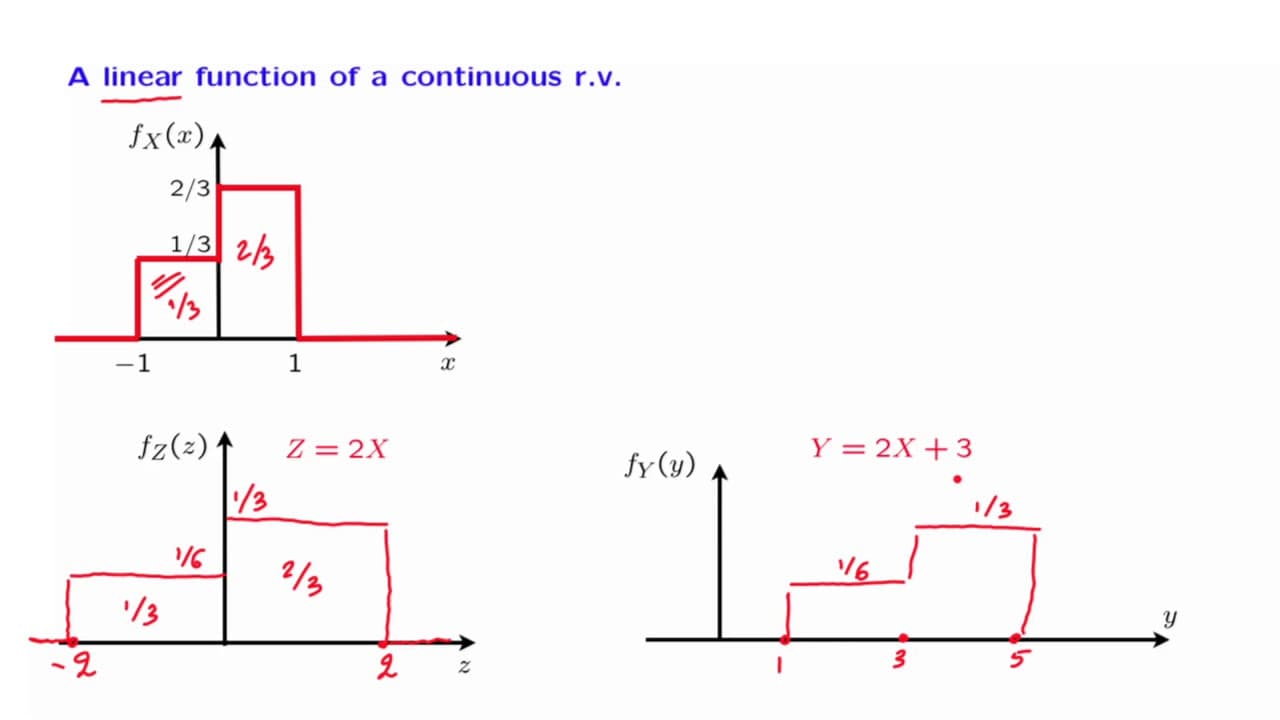
To find the PDF of a linear function of a continuous random variable, scale the original PDF horizontally by the multiplicative constant and shift it by the additive constant. Finally, vertically scale the PDF to ensure the total area under the curve equals 1. This process applies whether the scaling constant is positive or negative.
Transcript
We now move to the case of continuous random variables. We will start with a special case where we want to find the PDF of a linear function of a continuous random variable. We will start by considering a simple example, and study it using an intuitive argument. And afterwards, we will justify our conclusions mathematically. So we start with a rand... Read More
Key Insights
- ⚖️ Scaling and shifting the original PDF is necessary to find the PDF of a linear function of a continuous random variable.
- 🍉 The scaling factor is the constant term in the linear function, and the shift is the constant term as well.
- 🪡 The resulting PDF needs to be vertically scaled to ensure the total area under the curve is equal to 1.
Install to Summarize YouTube Videos and Get Transcripts
Explore YouTube Video Summarizer or Get YouTube Transcript Extractor
Questions & Answers
Q: How does the PDF of a linear function of a continuous random variable compare to the original PDF?
The PDF of a linear function is obtained by scaling and shifting the original PDF. The scaling factor is the constant term in the linear function and the shift is the constant term as well.
Q: Why is it necessary to vertically scale the resulting PDF?
The vertical scaling is necessary to ensure that the total area under the curve of the PDF is equal to 1. This scaling factor is determined by the absolute value of the constant term in the linear function.
Q: What happens to the PDF if the constant term in the linear function is negative?
If the constant term is negative, the direction of the inequality in the CDF formula gets reversed. The resulting PDF is equal to the negative of the original PDF, scaled and shifted accordingly.
Q: Are there any differences between the formulas for the PDF of a linear function for continuous and discrete random variables?
The formulas have the same appearance, but in the case of continuous random variables, a vertical scaling factor is present. In the discrete case, this scaling factor is not needed.
Summary & Key Takeaways
-
To find the PDF of a linear function of a continuous random variable, start with the original PDF and scale it horizontally by a factor of the constant in the linear function.
-
The PDF also gets shifted horizontally by the constant in the linear function.
-
The resulting PDF needs to be vertically scaled to ensure the total area under the curve is equal to 1.
Read in Other Languages (beta)
Share This Summary 📚
Summarize YouTube Videos and Get Video Transcripts with 1-Click
Try YouTube Summary with ChatGPT & Claude or YouTube Transcript Generator
Explore More Summaries from MIT OpenCourseWare 📚


Summarize YouTube Videos and Get Video Transcripts with 1-Click
Try YouTube Summary with ChatGPT & Claude or YouTube Transcript Generator