L04.9 Multinomial Probabilities
TL;DR
The multinomial model extends the binomial probabilities to situations where there are multiple colors or possibilities, and we repeat the experiment independently.
Transcript
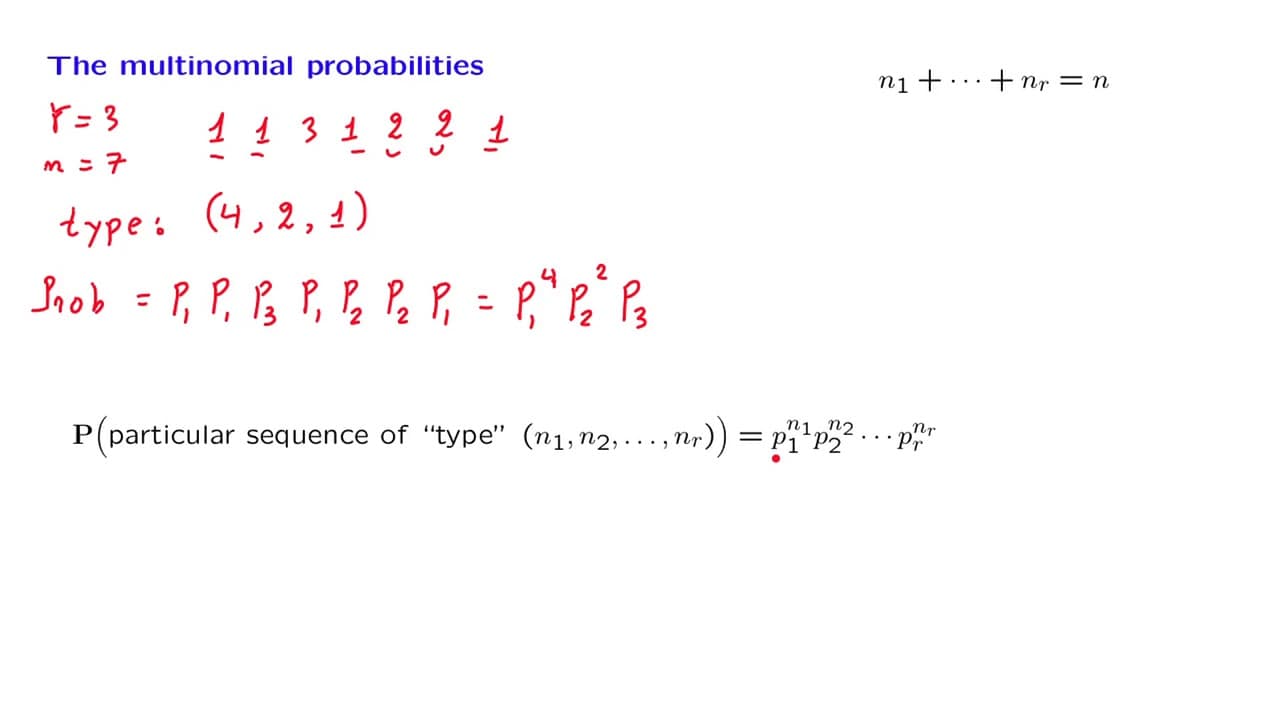
PROFESSOR: In this segment, we will discuss the multinomial model and the multinomial probabilities, which are a nice generalization of the binomial probabilities. The setting is as follows. We are dealing with balls and the balls come into different colors. There are r possible different colors. We pick a ball at random, and when we do that, there... Read More
Key Insights
- ❓ The multinomial model generalizes the binomial probabilities for situations with multiple colors or possibilities.
- 🤣 The model can be used for various experiments, including die rolls and coin tosses.
- ⌛ Specific outcomes in the multinomial model are represented by the number of times each color or possibility appears.
- ✖️ The probability of a specific outcome is calculated by multiplying the probabilities of each color/possibility and the number of sequences/outcomes of that type.
- 👻 The model allows for the analysis of repeated trials with multiple possible results.
- #️⃣ The number of sequences/outcomes of a specific type is equivalent to the number of partitions of the set of trials.
Install to Summarize YouTube Videos and Get Transcripts
Explore YouTube Video Summarizer or Get YouTube Transcript Extractor
Questions & Answers
Q: How does the multinomial model generalize the binomial probabilities?
The multinomial model extends the binomial probabilities by allowing for multiple colors or possibilities instead of just two. It calculates the probabilities of obtaining a specific number of each color or result in independent trials.
Q: Can the multinomial model be used for die rolls or coin tosses?
Yes, the model can be applied to these scenarios. For example, if we have two colors representing heads and tails, we can use the model to calculate the probability of obtaining a specific number of heads and tails in a given number of tosses.
Q: How is a specific outcome of the multinomial model represented?
A specific outcome is represented by stating the number of times each color or possibility appears. For example, if we have four balls of the first color, two balls of the second color, and one ball of the third color, the outcome would be represented as 4, 2, 1.
Q: How can the probability of a specific outcome be calculated in the multinomial model?
The probability of a specific outcome is calculated by multiplying the probabilities of each color or possibility (raised to the power of how many times it appears in the outcome) and the number of sequences/outcomes of that specific type.
Summary & Key Takeaways
-
The multinomial model is used when dealing with balls of different colors or other experiments with multiple possibilities.
-
The model calculates the probability of obtaining a specific number of balls of each color or result.
-
The model can also be extended to other scenarios, such as die rolls or coin tosses.
Read in Other Languages (beta)
Share This Summary 📚
Summarize YouTube Videos and Get Video Transcripts with 1-Click
Try YouTube Summary with ChatGPT & Claude or YouTube Transcript Generator
Explore More Summaries from MIT OpenCourseWare 📚


Summarize YouTube Videos and Get Video Transcripts with 1-Click
Try YouTube Summary with ChatGPT & Claude or YouTube Transcript Generator