7. Decision Problems for Automata and Grammars
TL;DR
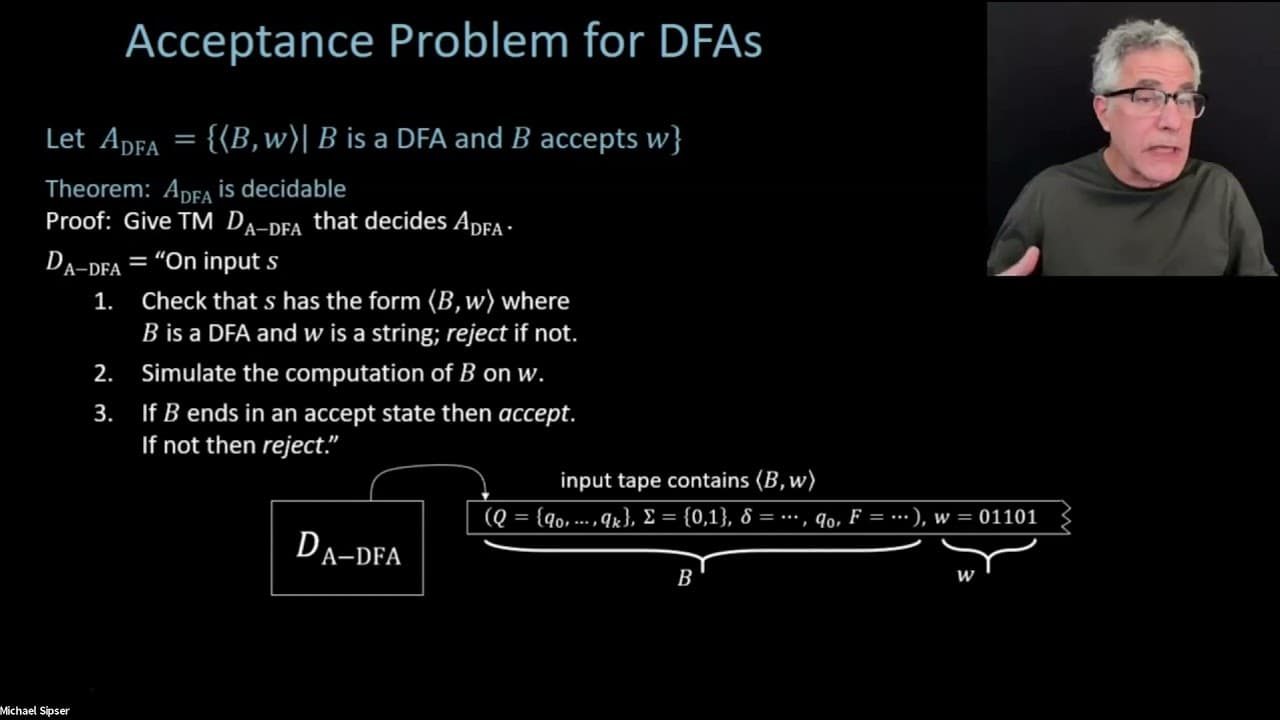
The lecture discusses the decidable and undecidable nature of various problems, including the acceptance problem for Turing machines, equivalence problem for context-free grammars, and emptiness problem for context-free grammars. The lecture highlights the importance of the universal Turing machine and its impact on computer science.
Transcript
[SQUEAKING] [RUSTLING] [CLICKING] MICHAEL SIPSER: All right, why don't we get started? It's 2:35, time to begin. So everyone, welcome back-- good to see you all. Well, at least a few of you-- glad that you're here. So let's see. Why don't I get a layout, as I usually do, where we have been, where we're going today. I'll talk a little tiny bit about... Read More
Key Insights
- 🤟 The acceptance problem for Turing machines is recognizable but not decidable.
- 🥶 Context-free grammars have their own set of undecidable problems, such as testing for ambiguity.
Install to Summarize YouTube Videos and Get Transcripts
Explore YouTube Video Summarizer or Get YouTube Transcript Extractor
Questions & Answers
Q: How is the acceptance problem different from the recognition problem?
The acceptance problem specifically asks if a given Turing machine accepts a specific input, while the recognition problem for a language asks if a Turing machine recognizes that language. The focus is on acceptance as opposed to general recognition.
Q: Why is the Turing machine simulation of the universal Turing machine recognizable but not decidable?
The universal Turing machine can simulate other Turing machines, which means it can process and recognize languages recognized by those other Turing machines. However, it cannot determine if an arbitrary Turing machine will halt on an arbitrary input, making it undecidable.
Q: Can you explain the concept of the universal Turing machine and its significance?
The universal Turing machine, introduced by Alan Turing, is a machine capable of simulating any other Turing machine. It was a groundbreaking concept as it led to the development of modern computer systems and laid the foundation for the von Neumann architecture. The universal Turing machine demonstrated that computers could be designed to execute any given algorithm by interpreting and processing instructions stored in memory, which influenced the development of stored-program computers.
Summary & Key Takeaways
-
The lecture introduces the acceptance problem for Turing machines, which asks if a given Turing machine accepts a specific input.
-
It explores the decidable and recognizable nature of the acceptance problem, using a Turing machine simulation to recognize Turing-recognizable languages.
-
The lecture addresses the equivalence problem for context-free grammars and the emptiness problem for context-free grammars, both of which have undecidable solutions.
Read in Other Languages (beta)
Share This Summary 📚
Summarize YouTube Videos and Get Video Transcripts with 1-Click
Try YouTube Summary with ChatGPT & Claude or YouTube Transcript Generator
Explore More Summaries from MIT OpenCourseWare 📚


Summarize YouTube Videos and Get Video Transcripts with 1-Click
Try YouTube Summary with ChatGPT & Claude or YouTube Transcript Generator