How Does AI Affect Founders' Judgment?
TL;DR
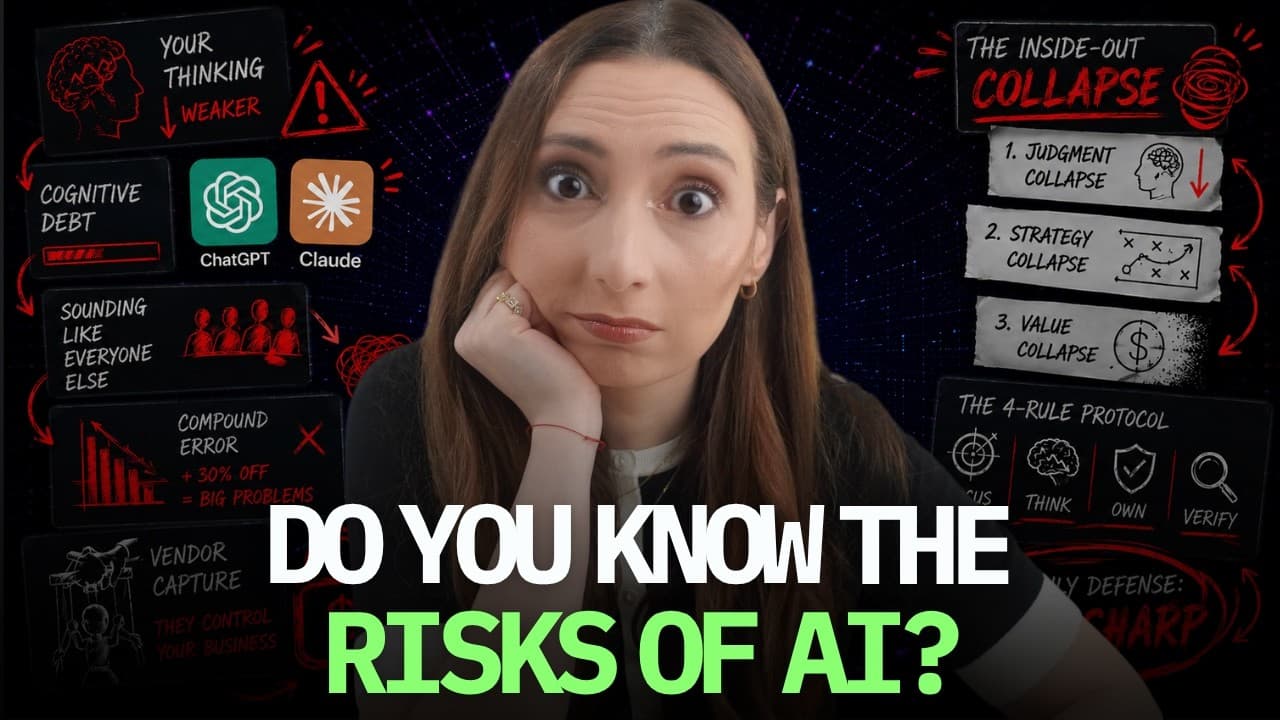
AI can weaken founders’ judgment when repeated reliance on models replaces the mental practice required for independent decisions. The speaker identifies three founder-specific risks, replaceability, compounding error, and vendor capture, and recommends a four-rule protocol led by “think first, prompt second.” Read on to understand how founders can preserve original thinking while still using AI every day.
Transcript
There's a specific kind of founder who I believe is going to lose the AI race. And what I think is the scariest part is that it's not the ones who ignore AI. It's the ones who use it every day. Actually, I've watched it happen around me. There are so many smart people with six or seven or eight figure businesses building with the best tools on the ... Read More
Key Insights
- AI is affecting founders' judgment and originality, leading to businesses becoming replaceable.
- Relying heavily on AI can cause cognitive atrophy, weakening decision-making skills.
- AI-generated content is becoming ubiquitous, reducing the uniqueness of business offerings.
- Founders should focus on maintaining their unique perspectives and judgment skills.
- AI should be used as a tool, not a crutch, to avoid dependency and maintain business uniqueness.
- Implementing protocols such as 'think first, prompt second' can help preserve judgment skills.
- The risk of 'vendor capture' arises when businesses rely too heavily on a single AI provider.
- Maintaining a distinct voice and unique perspective is crucial for premium pricing in a commoditized market.
Install to Summarize YouTube Videos and Get Transcripts
Explore YouTube Video Summarizer or Get YouTube Transcript Extractor
Questions & Answers
Q: How does AI affect founders’ judgment?
AI can weaken judgment when founders outsource decisions about what to write, how to price, what to build, and which ideas are good. Each outsourced decision skips a repetition that would otherwise strengthen independent thinking, potentially making founders less able to assess their own products.
Q: Why does the speaker describe AI as a prosthetic rather than a hammer?
A hammer does not change its user, but a prosthetic can allow the underlying muscle to weaken because something else is doing the work. The speaker argues that AI can affect thinking similarly when it repeatedly performs judgment tasks for a founder.
Q: What evidence does the speaker give for cognitive debt from AI use?
The speaker cites a June 2024 MIT Media Lab EEG study involving people writing essays with and without ChatGPT. According to the transcript, the AI group showed lower brain connectivity, weaker recall of what they had written, and a steady accumulation of cognitive debt.
Q: What are the three founder-specific risks of relying heavily on AI?
The three risks are replaceability, compounding error, and vendor capture. Together, they can erode a business’s distinct identity, magnify slightly flawed decisions over time, and create dependence on infrastructure the founder does not own.
Q: How can AI make a founder’s business replaceable?
A business becomes more replaceable when its strategy, writing, and offers begin to resemble those of other prompt-driven founders. Without a unique and defensible identity, the founder may be priced like a commodity.
Q: How do small AI-assisted judgment errors compound over time?
Early-stage founders make dozens of judgment calls every day. The speaker says that if even 30% are slightly wrong because synthesis was outsourced, the damage can become brutal over six months even if it was not visible in week two.
Q: What is vendor capture for an AI-driven business?
Vendor capture occurs when a business depends on AI infrastructure it does not own. The model, pricing, or policy can change overnight, creating a potentially expensive vulnerability for the founder.
Q: How can founders use AI without losing independent judgment?
The recommended approach is to treat AI as a tool rather than a replacement for thinking, beginning with “think first, prompt second.” The existing protocol also includes rewriting AI drafts, keeping one untouched input each day, and conducting quarterly cold audits to preserve judgment and a distinct voice.
Summary & Key Takeaways
-
AI's impact on founders can lead to a decline in judgment and originality, making businesses feel replaceable. Over-reliance on AI causes cognitive atrophy, weakening decision-making skills and reducing business uniqueness. Founders should focus on maintaining unique perspectives and judgment skills, using AI as a tool rather than a crutch.
-
The video discusses the risks of 'vendor capture' when businesses rely too heavily on a single AI provider. Maintaining a distinct voice and unique perspective is crucial for premium pricing in a commoditized market. Founders should implement protocols to preserve essential skills and ensure AI serves as a tool, not a replacement.
-
Founders are encouraged to implement specific protocols such as 'think first, prompt second' to preserve judgment skills. AI-generated content is becoming ubiquitous, reducing the uniqueness of business offerings. The video emphasizes the importance of maintaining a distinct voice and unique perspective to succeed in a competitive market.
Read in Other Languages (beta)
Share This Summary 📚
Summarize YouTube Videos and Get Video Transcripts with 1-Click
Try YouTube Summary with ChatGPT & Claude or YouTube Transcript Generator
Explore More Summaries from AI Founders 📚




Summarize YouTube Videos and Get Video Transcripts with 1-Click
Try YouTube Summary with ChatGPT & Claude or YouTube Transcript Generator