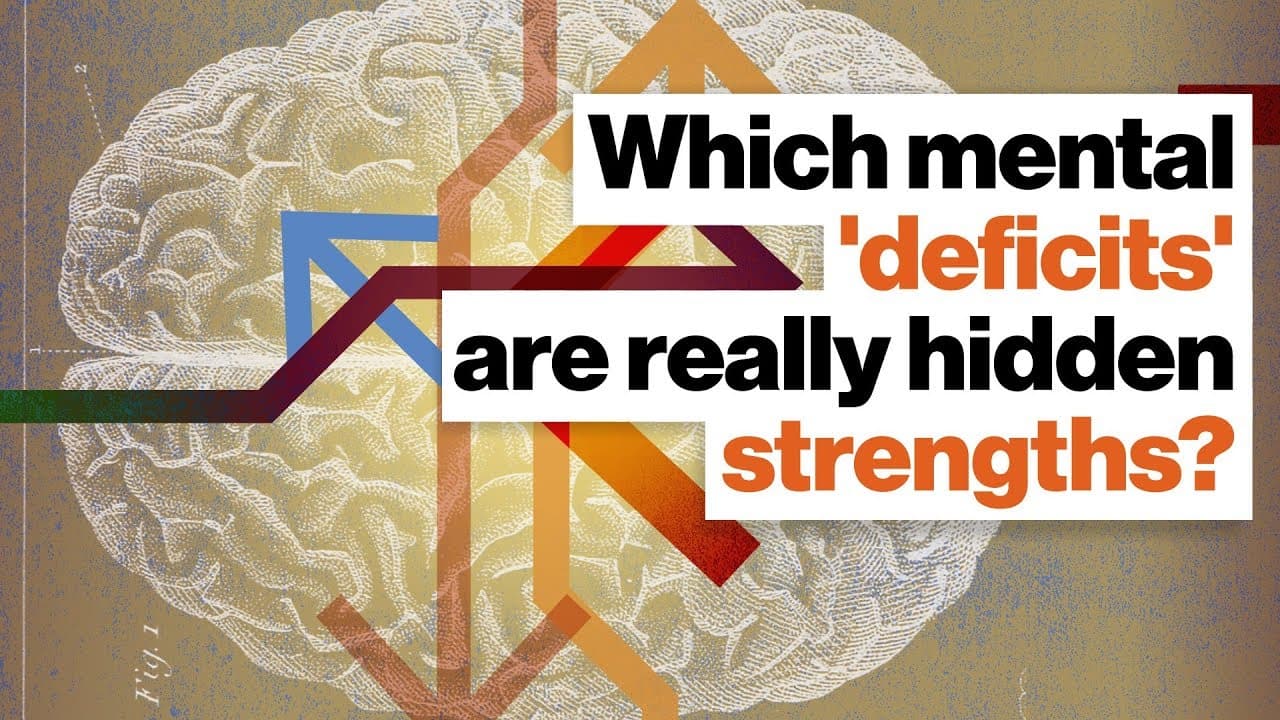
Which mental 'deficits' are really hidden strengths? | Heather Heying | Big Think
TL;DR
Mental traits labeled as deficits can be hidden strengths because different brain wiring creates tradeoffs in aptitudes, sensitivities, and capabilities. Heather Heying highlights autistic students’ analytical and observational skills, notes that about 10% of people across studied cultures are left-handed, and considers potential advantages associated with colorblindness and dyslexia. Read on to explore how each variation may support a distinct way of perceiving, communicating, or solving problems.
Transcript
'Neurodiversity' is a pretty new term and I'm very grateful for it it It gets to something that is absolutely real and has been harder to discuss before it existed That said I'm not sure I have a perfect definition it recognizes the fact That we are not Singular that we are not all identical that we have a variation of a brains of connectivity of a... Read More
Key Insights
- 🧠 Neurodiversity acknowledges the reality of individual differences in brain functioning, emphasizing that people are not identical.
- ❓ Autistic individuals often possess remarkable analytical skills and insightful observations of social interactions.
- 🗨️ Conditions like dyslexia, colorblindness, and left-handedness represent variations in brain functioning and offer advantages within specific social groups.
- ❓ Left-handedness, colorblindness, and dyslexia have evolutionary significance and may provide unique abilities and perspectives.
- 😯 The ability to process written symbols into meaning might be a tradeoff with enhanced real-time speech engagement.
Install to Summarize YouTube Videos and Get Transcripts
Explore YouTube Video Summarizer or Get YouTube Transcript Extractor
Questions & Answers
Q: Which mental “deficits” can actually be hidden strengths?
Heather Heying discusses autism, dyslexia, colorblindness, and left-handedness as variations that may combine apparent weaknesses with less obvious strengths. She argues that what the world calls a deficit will almost always exist in a tradeoff relationship with some hidden strength.
Q: What does neurodiversity mean?
Neurodiversity recognizes that people are not neurologically identical. Brains vary in connectivity, aptitudes, weaknesses, blind spots, sensitivities, and capabilities.
Q: What strengths can people on the autism spectrum have?
In Heying’s experience, highly functional people on the autism spectrum can have extraordinary analytical skills. They may also perceive social dynamics clearly when they are observing rather than participating.
Q: How did autistic students identify classroom dynamics?
Several autistic students pointed out emerging classroom dynamics that Heying had not yet noticed. Once the students identified those dynamics, she could see them too, even though the same students sometimes struggled to recognize when to speak, stand, or move through the classroom.
Q: Why can left-handedness be considered an adaptive trait?
About 10% of people across all cultures studied are left-handed, making it a persistent, stable, and rare phenotype. Heying says this pattern suggests that left-handedness is adaptive and provides benefits within social groups.
Q: What advantage might different left-handed brain wiring provide?
Heying suggests that a left-handed person may approach a physical problem differently from a right-handed person. The different brain wiring could therefore enable alternative approaches to problems that right-handed people may find harder to solve.
Q: Can colorblindness provide any strengths?
Colorblindness may help a person see beyond color and recognize patterns that are not color-based. Heying also suspects that its associated brain wiring may support other enhanced abilities, though she presents this as a possibility rather than a confirmed conclusion.
Q: What hidden strength might accompany dyslexia?
Dyslexia usually involves a reduced, rather than absent, ability to turn written symbols into meaning. Heying proposes that this may trade off with a stronger ability to engage in real-time speech, noting that language centered on sound long before writing appeared thousands of years ago.
Summary & Key Takeaways
-
Neurodiversity acknowledges the variation in brain connectivity, aptitudes, weaknesses, blind spots, sensitivities, and capabilities among individuals.
-
People on the autism spectrum often possess extraordinary analytical skills and insightful observations of social interactions when they are not directly involved.
-
Neurodiversity encompasses conditions like dyslexia, colorblindness, and left-handedness, all of which represent different wiring of the brain and provide unique benefits within social groups.
Read in Other Languages (beta)
Share This Summary 📚
Summarize YouTube Videos and Get Video Transcripts with 1-Click
Try YouTube Summary with ChatGPT & Claude or YouTube Transcript Generator
Explore More Summaries from Big Think 📚

Summarize YouTube Videos and Get Video Transcripts with 1-Click
Try YouTube Summary with ChatGPT & Claude or YouTube Transcript Generator