Google's AI Clones Your Voice After Listening for 5 Seconds! 🤐
TL;DR
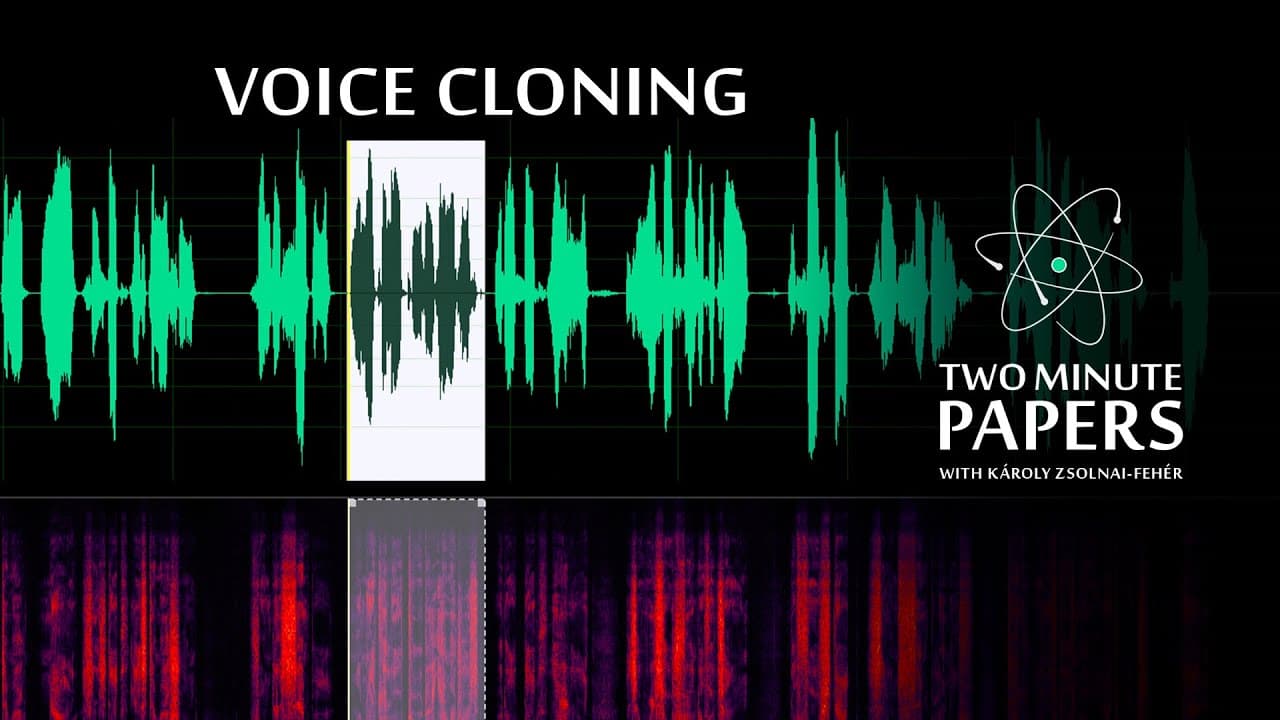
A new AI-based voice cloning technique has been developed that can clone someone's voice with just 5 seconds of speech data.
Transcript
Dear Fellow Scholars, this is Two Minute Papers with Károly Zsolnai-Fehér. Today we are going to listen to some amazing improvements in the area of AI-based voice cloning. For instance, if someone wanted to clone my voice, there are hours and hours of my voice recordings on Youtube and elsewhere, they could do it with previously existing techniques... Read More
Key Insights
- 😯 AI voice cloning can now be achieved with just 5 seconds of speech data.
- 🔇 The three components involved in the technique are the speaker encoder, synthesizer, and neural vocoder.
- 🌀 Evaluating the naturalness and similarity of the cloned voice is challenging and requires careful consideration of training data and the integration of the components.
- 💯 Mean opinion scores are used to measure the quality of the cloned voice.
- 🏮 The paper provides a detailed evaluation section to address the complexities of voice cloning.
- 🏮 Speaker verification is another aspect that the paper covers.
- 📽️ Weights & Biases is a company that supports this project and provides tools for tracking experiments in deep learning projects.
Install to Summarize YouTube Videos and Get Transcripts
Explore YouTube Video Summarizer or Get YouTube Transcript Extractor
Questions & Answers
Q: How much speech data is needed for AI voice cloning using this new technique?
Only 5 seconds of speech data is required for the AI system to clone someone's voice.
Q: What are the three components involved in this AI-based voice cloning technique?
The three components are the speaker encoder, which learns from thousands of speakers; the synthesizer, which converts text into a Mel Spectrogram; and the neural vocoder, which generates a waveform as an output.
Q: How is the naturalness and similarity of the cloned voice measured?
The paper discusses evaluating the naturalness and similarity using mean opinion scores, which assess how well the cloned voice passes as genuine human speech.
Q: What is the importance of data training and fitting the different puzzle pieces together?
The choice of training data and the way the three components are combined greatly affect the naturalness and similarity of the cloned voice, making them crucial factors in the voice cloning process.
Summary & Key Takeaways
-
Previously, voice cloning required hours of voice recordings, but this new technique can clone voices with just 5 seconds of speech data.
-
The system uses a speaker encoder, synthesizer, and neural vocoder to learn the essence of human speech and generate a waveform as an output.
-
Evaluating and measuring the naturalness and similarity of the cloned voice is a challenge, but the paper provides detailed explanations and evaluation methods.
Read in Other Languages (beta)
Share This Summary 📚
Summarize YouTube Videos and Get Video Transcripts with 1-Click
Try YouTube Summary with ChatGPT & Claude or YouTube Transcript Generator
Explore More Summaries from Two Minute Papers 📚



Summarize YouTube Videos and Get Video Transcripts with 1-Click
Try YouTube Summary with ChatGPT & Claude or YouTube Transcript Generator