What Was Christopher Wren's Impact on Mathematics and Architecture?
TL;DR
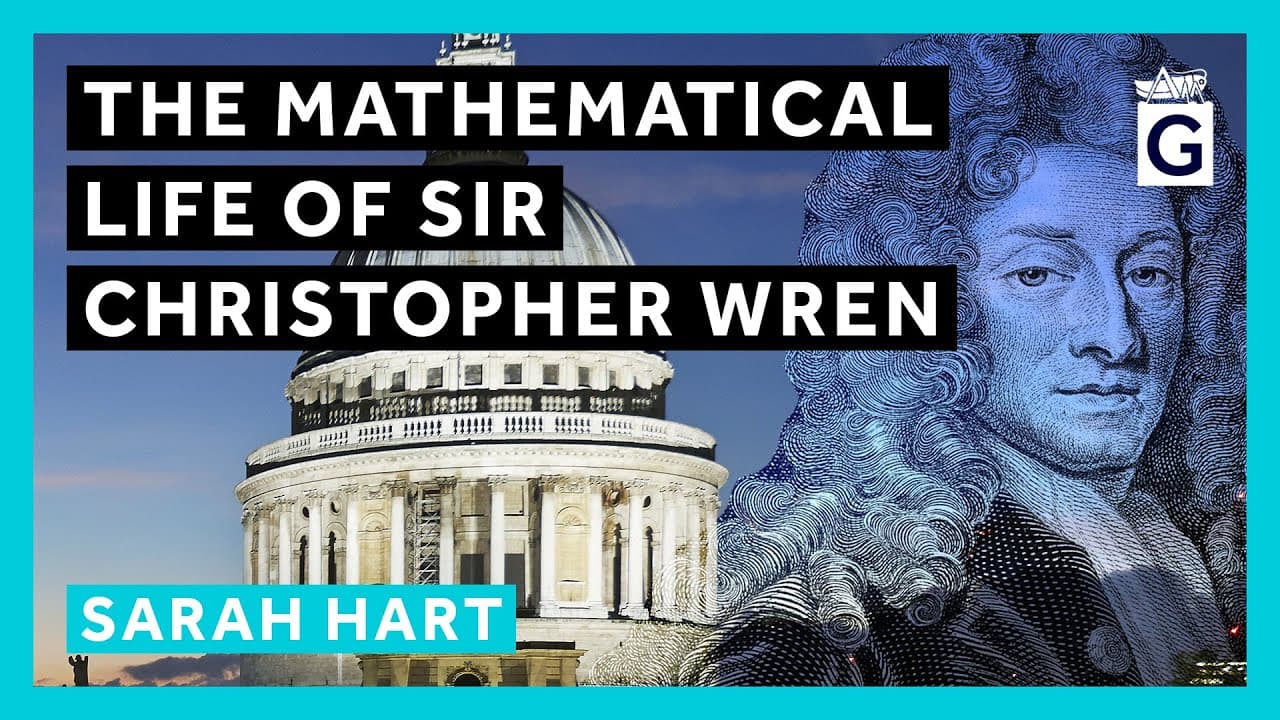
Christopher Wren significantly influenced both mathematics and architecture, considering geometry essential for architectural beauty. His mathematical explorations included solving problems related to catenaries and spiral shapes, and he integrated these principles into designs like the dome of St. Paul's Cathedral, which features a catenary structure for strength and aesthetic appeal.
Transcript
(air whooshing) - Welcome, everyone, today, I'm going to tell you about Christopher Wren. When we think of Sir Christopher Wren, we remember him as a great architect, but he's also a mathematician. And that's what I want to tell you about today. On the way, I'm going to share with you three mathematical gems that Christopher Wren played with and in... Read More
Key Insights
- 🧑🔬 Christopher Wren was a mathematician and scientist before becoming an architect, and he continued to contribute to the field of mathematics throughout his career.
- 🥰 Wren viewed architecture as a mathematical art and saw mathematics, particularly geometry, as essential to achieving architectural beauty.
- 👨🔬 Wren made important mathematical discoveries and innovations, including solving mathematical challenges and studying the properties of catenaries and arches.
- 👂 In his architectural designs, Wren applied mathematical principles and calculations to create visually pleasing and structurally sound buildings.
Install to Summarize YouTube Videos and Get Transcripts
Explore YouTube Video Summarizer or Get YouTube Transcript Extractor
Questions & Answers
Q: Why did Christopher Wren move from mathematics to architecture?
While Wren began his career as a mathematician and scientist, he later moved into architecture as he considered it to be one of the mathematical arts. He saw a strong connection between architecture and mathematics, particularly geometry, which he believed was the basis of architectural beauty.
Q: How did Christopher Wren contribute to the study of mathematics?
Wren made important contributions to various mathematical fields. He solved mathematical challenges, such as the elliptical cord problem and Kepler's problem of dividing an ellipse. He also investigated the properties of catenaries and developed an understanding of spiral shapes in nature. Wren's mathematical work had practical applications and helped shape his architectural designs.
Q: What mathematical principles did Christopher Wren incorporate into his architectural designs?
Wren believed in using mathematics as a foundation for architectural design. He emphasized the importance of geometry, proportion, and symmetry in creating visually pleasing buildings. In his designs, Wren incorporated mathematical principles such as the use of catenaries in the dome of St. Paul's Cathedral. He also considered the structural strength of arches and domes using mathematical calculations and approximations.
Q: How did Christopher Wren's mathematical work influence his architectural achievements?
Wren's mathematical background greatly influenced his architectural designs. He applied his knowledge of geometry, proportion, and structural principles to create visually stunning and structurally sound buildings. Wren's understanding of mathematical concepts, such as the properties of catenaries and the strength of arches, allowed him to design architectural features that were both aesthetically pleasing and functional.
Summary & Key Takeaways
-
Christopher Wren was a polymath, known for his architectural achievements as well as his contributions to mathematics and other scientific fields.
-
Wren emphasized the importance of mathematics in architecture, considering geometry and proportion to be crucial elements of beauty in architectural design.
-
Wren made mathematical discoveries and investigations, including solving mathematical challenges, studying the properties of catenaries, and developing an understanding of spiral shapes in nature.
-
In his architectural designs, Wren incorporated mathematical principles, such as the use of catenaries in the dome of St. Paul's Cathedral.
Read in Other Languages (beta)
Share This Summary 📚
Summarize YouTube Videos and Get Video Transcripts with 1-Click
Try YouTube Summary with ChatGPT & Claude or YouTube Transcript Generator
Explore More Summaries from Gresham College 📚

Summarize YouTube Videos and Get Video Transcripts with 1-Click
Try YouTube Summary with ChatGPT & Claude or YouTube Transcript Generator