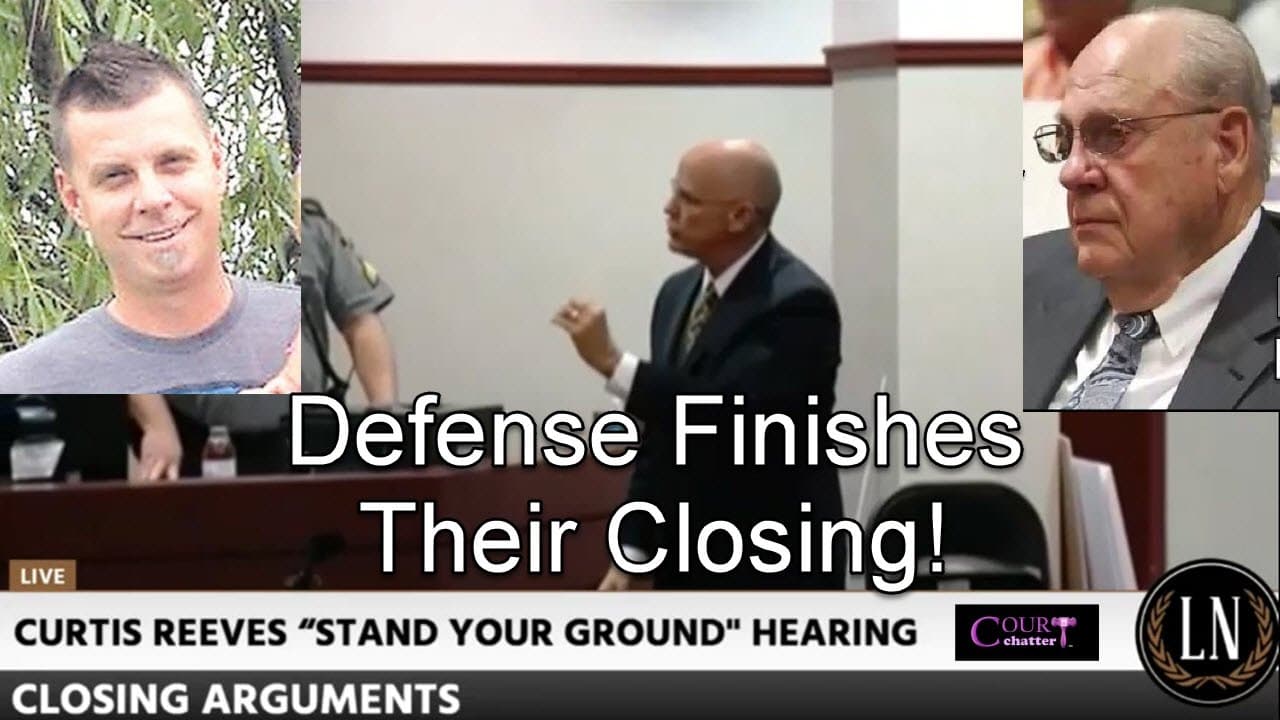
Why Did the Defense Say Curtis Reeves Acted Reasonably? Stand Your Ground Hearing Closing Arguments Part 3
TL;DR
The defense argued that Curtis Reeves reasonably feared imminent death or great bodily harm when he fired the fatal shot. It cited the danger of a punch to the head, perception distortion, tunnel vision, the darkened theater, and the disparity between the 71-year-old Reeves and the 43-year-old attacker. Read on to see how expert testimony and the timing of the popcorn incident supported that argument.
Transcript
e e for e e may be seated thank you ready Mr Escobar I your all right go ahead Vernard Adams why did we bring Mr Adams Dr Adams before this court human beings don't really want to know how vulnerable we are how vulnerable is our skeletal system how vulnerable is our head I think Dr Adams was able to explain to you how our skeletal system or head ho... Read More
Key Insights
- 🤕 The vulnerability of the head makes punches to the head a potentially deadly threat.
- 📺 Perception distortion can cause tunnel vision and make it difficult for individuals to accurately perceive threats.
- 😨 Fear of bodily harm can be justifiable, even without a weapon present.
- 😨 The attacker's perception and potential fears should also be considered when determining if the defendant's actions were reasonable.
- 😒 The defendant's experience, knowledge, and restraint in the use of force strengthen the argument for self-defense.
- 🤕 The booking photo and video evidence support the defense's claim of being struck in the head.
- ❓ Dr. Hayden's expert opinion supports the reasonableness of the defendant's actions.
Install to Summarize YouTube Videos and Get Transcripts
Explore YouTube Video Summarizer or Get YouTube Transcript Extractor
Questions & Answers
Q: Why did the defense argue that Curtis Reeves acted reasonably?
The defense said Reeves reasonably perceived a threat of imminent death or great bodily harm when he fired the fatal shot. It relied on testimony about the danger of head strikes, perception distortion, tunnel vision, the darkened theater, and the disparity in age between Reeves and the attacker.
Q: How dangerous can one punch to the head be?
Dr. Bernard Adams testified that the head is the most vulnerable part of the body and that one punch can cause great bodily harm or death. He explained that sufficient force can break orbital bones, the jaw, temporal bones, or the nose.
Q: Can a person reasonably fear great bodily harm when the attacker has no weapon?
Yes, according to the defense's argument. Citing Detective Aaron Smith, the defense said a person can reasonably fear a fist formed during an attack, even without a weapon being present.
Q: What is perception distortion in a deadly-force encounter?
Michael Knox described perception distortion as a phenomenon that occurs during deadly-force encounters. The defense said fear and anxiety can narrow a person's attention to the perceived threat and affect what the person notices while making a split-second decision.
Q: How did tunnel vision support the defense's argument?
Detective Aaron Smith testified that officers train to resist tunnel vision but that doing so is very difficult. The defense argued that Reeves focused strictly on the approaching threat and therefore did not perceive what was happening with the popcorn.
Q: Was Curtis Reeves's decision to use deadly force caused by the popcorn incident?
The defense argued that it was not. Based on timestamps and the perception-reaction times discussed by Michael Knox, it claimed Reeves made the decision before the popcorn was in hand, and it noted that Reeves later said he did not know what had happened to it.
Q: Why did the defense emphasize the ages and physical circumstances of the encounter?
The defense described Reeves as a 71-year-old man and the attacker as 43 years old and 6 feet 4 inches tall. It argued that the age disparity, the attacker coming over the chair, and the darkened theater supported Reeves's fear of death or great bodily harm.
Q: What did Dr. Hayden conclude about Curtis Reeves's actions?
Dr. Hayden described Reeves as a trapped man on January 13, 2014. He gave the opinion that Reeves acted reasonably when he fired the fatal shot because Reeves reasonably perceived imminent death or great bodily harm.
Summary & Key Takeaways
-
Dr. Adams explains the vulnerability of the human skeletal system, particularly the head, and how a punch can cause significant harm or death.
-
Detective Smith discusses perception distortion and tunnel vision experienced by police officers in dangerous encounters.
-
The defense argues that the elderly man involved in the case, as well as the attacker, had justifiable perceptions and fears.
Read in Other Languages (beta)
Share This Summary 📚
Summarize YouTube Videos and Get Video Transcripts with 1-Click
Try YouTube Summary with ChatGPT & Claude or YouTube Transcript Generator
Explore More Summaries from Law&Crime Network 📚



Summarize YouTube Videos and Get Video Transcripts with 1-Click
Try YouTube Summary with ChatGPT & Claude or YouTube Transcript Generator