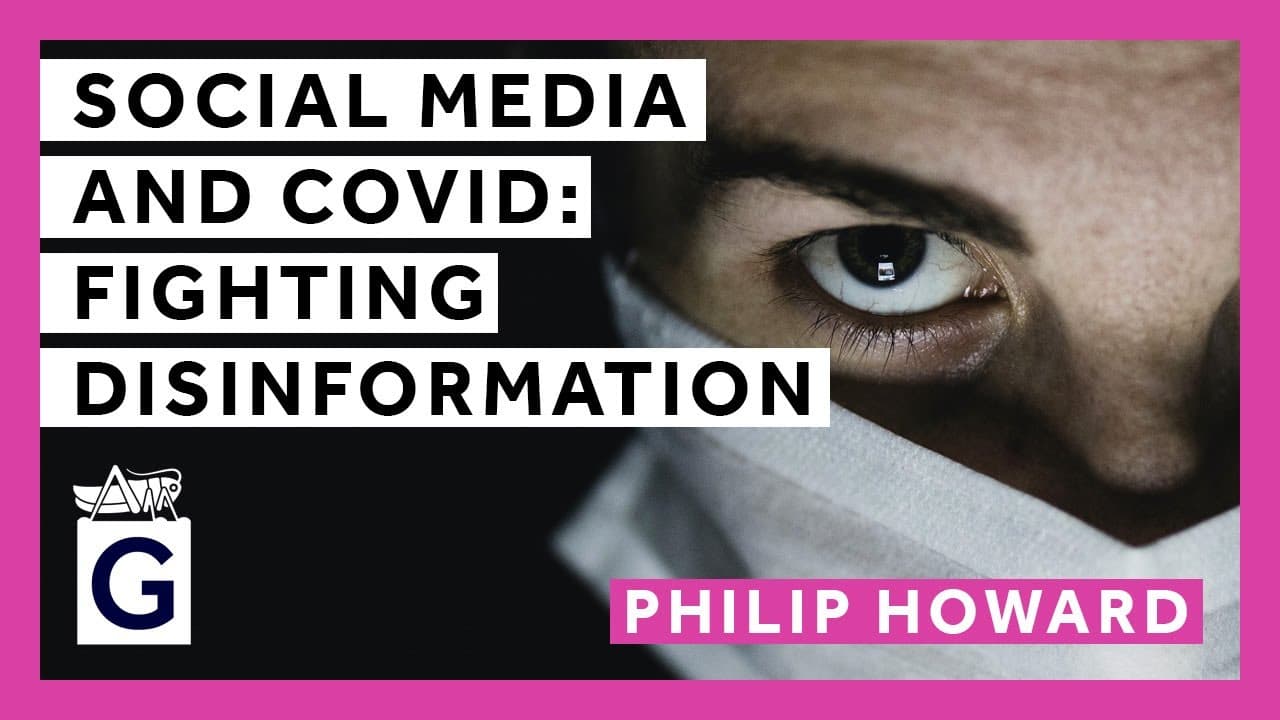
Social Media, COVID & Ukraine: Fighting Disinformation
TL;DR
Disinformation is fought by understanding it as an organized social and technical system that spreads multiple conflicting stories in service of political objectives. Drawing on COVID claims, the 2014 destruction of a Malaysian Airlines flight over Ukraine, and research across 45–50 countries, the speaker traces how these tactics moved from dictators to democratic politics while arguing that the information environment can still be fixed. Read on for the mechanisms, examples, and research approach behind that conclusion.
Transcript
- Now, the research story I want to lead with is actually about a career low, a career low I hit this fall. I've been spending a significant amount of time studying misinformation. And this fall I studied an information operation that blamed COVID on a shipment of bad lobster from Maine that had flown across and landed in Wuhan just before the heal... Read More
Key Insights
- 💗 Misinformation is a growing threat that undermines public trust, hampers democracy, and perpetuates division and polarisation.
- 😮 Global trends reveal a rise in misinformation operations, often run by mainstream communication firms.
- 🖐️ Social media platforms play a pivotal role in facilitating the spread of misinformation.
- ℹ️ Individuals can protect themselves by seeking information from reliable sources and developing critical thinking skills.
Install to Summarize YouTube Videos and Get Transcripts
Explore YouTube Video Summarizer or Get YouTube Transcript Extractor
Questions & Answers
Q: How do misinformation campaigns manipulate public opinion?
Their central tactic is to release multiple conflicting, and sometimes equally ridiculous, stories into public life. This can leave opponents unsure which claim to answer and make the public uncertain about what to believe.
Q: What is a “lie machine”?
A lie machine is defined as a complex social and technical mechanism whose two parts work together in service of an ideology. It takes an untrue claim and uses it to advance a higher political objective.
Q: Are lie machines usually lone-wolf operations?
No. The speaker describes them as significant, multi-person organizations with bosses, hiring plans, rent, performance bonuses, career paths, contracts, and financing.
Q: What COVID misinformation example does the speaker examine?
The speaker studied an operation claiming that COVID came to Wuhan through a shipment of bad lobster from Maine. The story required fake accounts across multiple platforms, images, and dissemination through major news media, and it lasted easily a month.
Q: What misinformation followed the destruction of a Malaysian Airlines flight over Ukraine in 2014?
The speaker’s Hungarian friends encountered several contradictory explanations, including claims involving Ukrainian democracy advocates, secret U.S. troops in Ukraine, and a lost World War II tank. The collection of competing stories revealed that the tactic was not merely to promote one narrative, but to overwhelm public discussion with many.
Q: How has the use of misinformation changed over time?
The speaker says the strategy moved from dictators manipulating their own populations to authoritarian rulers targeting voters in democracies. It then shifted again, becoming something politicians within democracies use on their own voters.
Q: What is computational propaganda?
Computational propaganda is described as a specialized form of propaganda customized and targeted using a person’s data trail. It is organizationally directed and emotive.
Q: How does Oxford’s Programme on Democracy and Technology study misinformation?
The program uses social data science and machine-learning techniques to address public problems, increase civic engagement, and make political life more transparent and efficient. It only works in a country when the team includes a student who knows its language, culture, and local nuances; its studies have covered 45–50 countries, with a team of about a dozen at the time described.
Summary & Key Takeaways
-
Misinformation is a complex social and technical mechanism used to spread false claims in service of a political objective. It has evolved from a tool used by dictators to manipulate their populations to a strategy employed by authoritarian rulers and even politicians in democracies.
-
Misinformation campaigns often involve the production of multiple conflicting stories, making it difficult for opponents to respond effectively and creating uncertainty among the public. These campaigns are disseminated through social media platforms, which serve as the primary conduit for misinformation.
-
Global trends show that misinformation operations are prevalent in many countries, with a rise in campaigns run by mainstream communication firms. Concerns about misinformation vary by region, with higher levels of concern in North America and Europe compared to East and South Asia.
Read in Other Languages (beta)
Share This Summary 📚
Summarize YouTube Videos and Get Video Transcripts with 1-Click
Try YouTube Summary with ChatGPT & Claude or YouTube Transcript Generator
Explore More Summaries from Gresham College 📚

Summarize YouTube Videos and Get Video Transcripts with 1-Click
Try YouTube Summary with ChatGPT & Claude or YouTube Transcript Generator