Sidgwick'S Electronic Theory
TL;DR
Civics Electronic Theory explains the formation of coordination bonds when ligands donate electron pairs to central metal ions.
Transcript
click the bell icon to get latest videos from akira hello friends in the previous topic we have discussed about the characteristic of the complex ions and now in this topic we are going to talk about the seed mix electronic theory so what is that let me talk about that in this topic so friends I'm going to talk about a new theory that is civics ele... Read More
Key Insights
- 💁 Civics Electronic Theory explains the formation of coordination bonds in coordination compounds.
- 😑 Ligands donate electron pairs to central metal ions in coordination complexes.
- 🍹 The charge of the coordination complex is determined by the sum of the ligand charges and the oxidation state of the metal ion.
Install to Summarize YouTube Videos and Get Transcripts
Explore YouTube Video Summarizer or Get YouTube Transcript Extractor
Questions & Answers
Q: What is Civics Electronic Theory?
Civics Electronic Theory is an extension of Lewis structures that explains the formation of coordination bonds when ligands donate electron pairs to central metal ions in coordination compounds.
Q: How is Civics Electronic Theory illustrated?
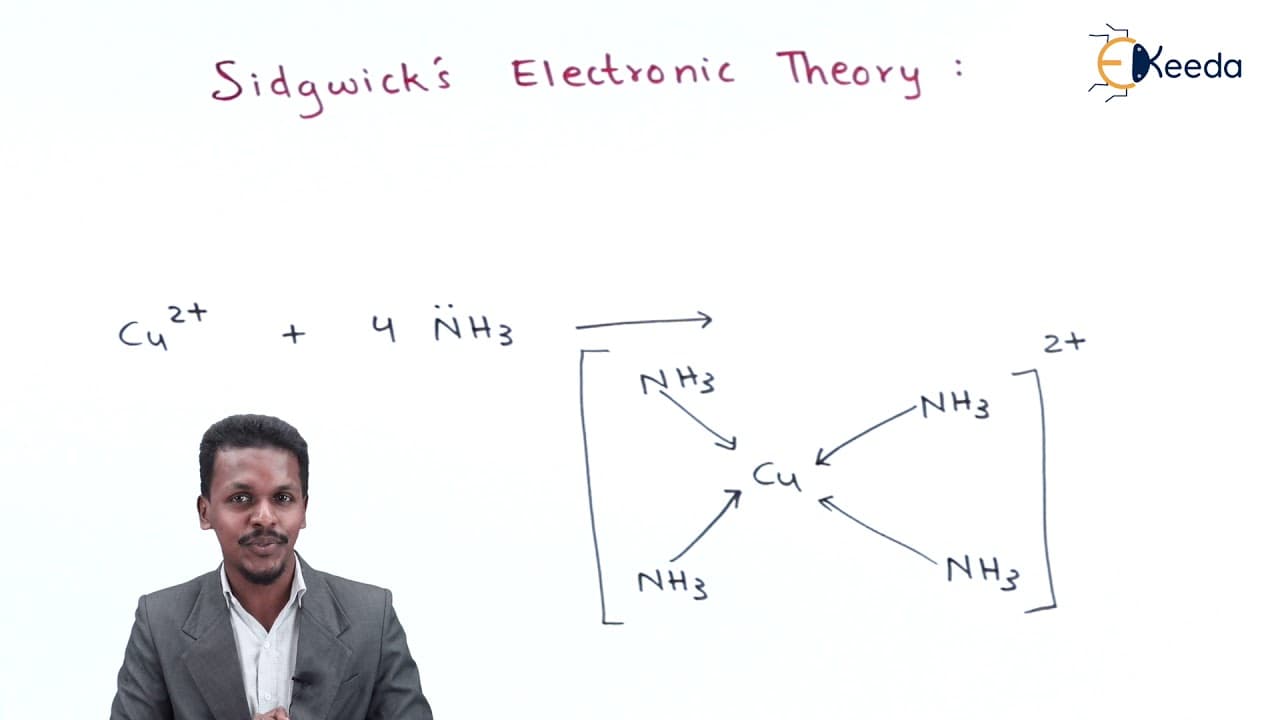
The theory can be illustrated using examples, such as the coordination complex of Cu2+ with NH3 and Fe(CN)6^2-. In Cu(NH3)4^2+, four NH3 ligands donate their electron pairs to Cu2+ to form coordination bonds. In Fe(CN)6^2-, six CN ligands occupy the space around Fe^2+ with each CN ligand donating its electron pair.
Q: What is the significance of the charges in coordination complexes?
In coordination complexes, the charge of the complex is determined by the overall charge of the ligands and the oxidation state of the central metal ion. The charge of the complex is equal to the sum of ligand charges and the oxidation state of the metal ion.
Q: How does Civics Electronic Theory contribute to our understanding of coordination compounds?
Civics Electronic Theory provides a framework for understanding how coordination bonds are formed in coordination compounds through the donation of electron pairs from ligands to central metal ions. It expands upon Lewis structures to explain the structure and bonding in coordination complexes.
Summary & Key Takeaways
-
Civics Electronic Theory is an extension of Lewis structures to explain the formation of coordination compounds.
-
The theory states that when ligands donate electron pairs to central metal ions, coordination bonds are formed.
-
The theory can be illustrated using examples, such as the coordination complex of Cu2+ with NH3 and Fe(CN)62-.
Read in Other Languages (beta)
Share This Summary 📚
Summarize YouTube Videos and Get Video Transcripts with 1-Click
Try YouTube Summary with ChatGPT & Claude or YouTube Transcript Generator
Explore More Summaries from Ekeeda 📚




Summarize YouTube Videos and Get Video Transcripts with 1-Click
Try YouTube Summary with ChatGPT & Claude or YouTube Transcript Generator