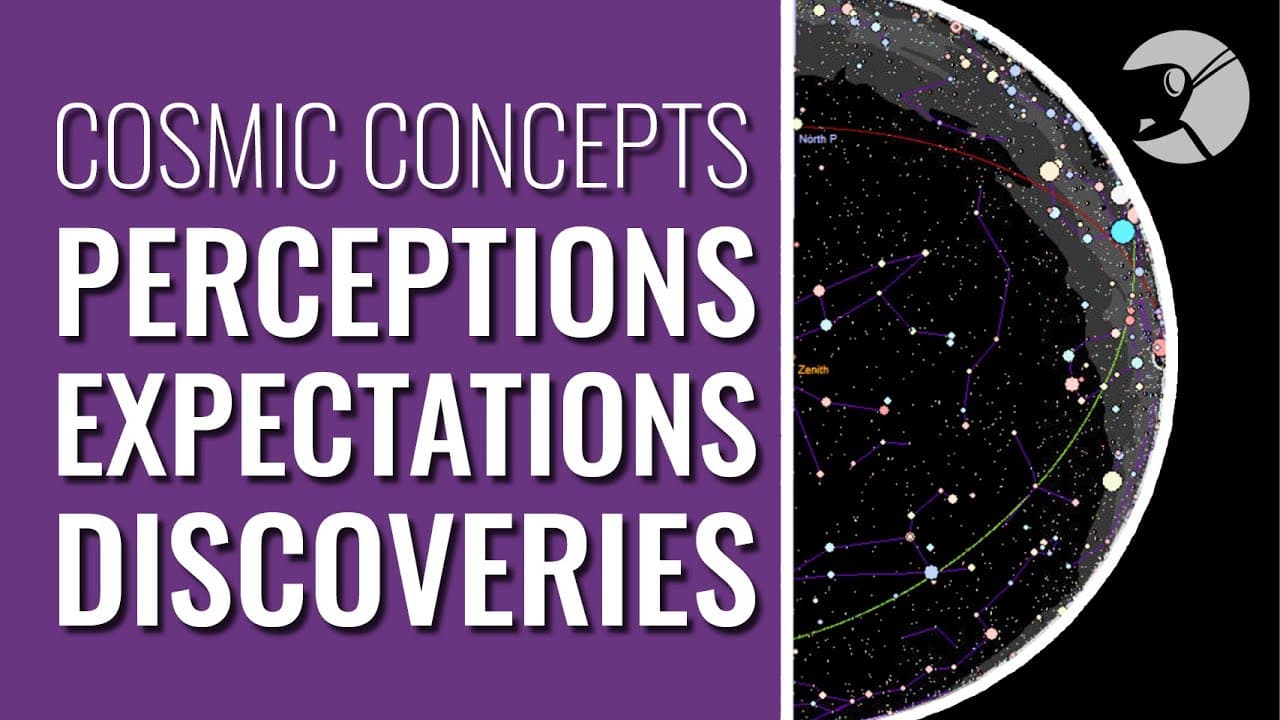
How Do Perceptions and Expectations Shape Scientific Discoveries?
TL;DR
Scientific discovery happens when a prepared mind asks the right questions, recognizes meaningful evidence, and patiently revises ideas as new information emerges. Catherine Blundell connects this process to astronomy, from observing Orion and the Pleiades to recording comets and supernovae, as well as to modern medicine. The Pleiades alone illustrate how tools transform perception: seven stars may be visible to keen eyes, while cameras reveal about 3,000. Read on for specific examples of observation driving discovery.
Transcript
hello and welcome I'm Catherine blunder Gresham professor of astronomy the title of my talk today is perceptions expectations and discoveries I want to talk about the business of Discovery in science How does Discovery happen in science the problem is how do we know what to discover until we've discovered it and how do we go about knowing how to di... Read More
Key Insights
- 🤯 Discovery in science requires a prepared mind, patience, and attention to detail.
- ❓ Ancient civilizations, such as the Chinese, made significant contributions to astronomy by observing and measuring celestial phenomena.
- 👶 Understanding the shape of the Earth, the movements of celestial bodies, and discovering new phenomena relied on careful observations, calculations, and the development of tools and models.
- 👋 Modern scientific discoveries, like gravitational waves and vaccines, also require perseverance and a thorough understanding of the subject matter.
- 🥺 Science self-corrects through the incorporation of new evidence, leading to a more accurate understanding of the world and its phenomena.
- 🌐 A scientifically literate society is crucial for advancing knowledge and addressing global challenges like climate change and pandemics.
Install to Summarize YouTube Videos and Get Transcripts
Explore YouTube Video Summarizer or Get YouTube Transcript Extractor
Questions & Answers
Q: How does scientific discovery happen?
Scientific discovery begins with asking the right questions, even though research provides neither preset questions nor answers. It also requires a prepared mind that can recognize and interpret evidence through patient, attentive observation.
Q: Why are perceptions and expectations important in scientific discovery?
Researchers must be familiar with expected patterns before they can recognize a meaningful change or anomaly. Expectations guide attention, while careful perception helps scientists distinguish potential evidence from ordinary variation.
Q: How did ancient civilizations contribute to astronomy?
Ancient observers developed strong skills for recognizing and measuring stars, rhythms, eclipses, and sudden changes in the night sky. Chinese records of comets, fuzzy stars, and new stars preserved valuable evidence about changing celestial phenomena.
Q: How can the Pleiades be found in the night sky?
Start with Orion and trace its belt upward to the right, passing Aldebaran, the bright star west of Orion. This route leads to the group of stars called the Pleiades.
Q: How were the Pleiades used before modern calendars?
In Latin America, the Pleiades’ return to the night sky during the final months of the calendar year served as a cue to begin planting crops in the Southern Hemisphere. Their recurring appearance connected celestial observation with the agricultural season.
Q: How were the Pleiades used to test eyesight?
Early observers used the number of Pleiades stars a person could distinguish as a measure of visual acuity. Many people with good eyesight can see seven, which explains the alternative name “Seven Sisters,” while people with exceptional eyesight may see more.
Q: How many stars are in the Pleiades, and how far away is the cluster?
Telescope and camera observations reveal about 3,000 stars in the Pleiades. The cluster is approximately 440 light years from Earth and spans about 13 light years from one side to the other.
Q: How does science correct its understanding over time?
Science self-corrects by incorporating new evidence and revising explanations to match it. Better observations, calculations, tools, and models can therefore replace earlier interpretations with more accurate ones.
Summary & Key Takeaways
-
Discovery in science is a complex process that involves asking the right questions and being able to recognize and interpret various signs and evidence.
-
Ancient civilizations, such as the Chinese, excelled in observing and measuring celestial phenomena, including the positions of stars, patterns, rhythms, eclipses, and sudden changes in the night sky.
-
The understanding of the shape of the Earth, the movements of the Moon and the Sun, and the discovery of comets, supernovae, and other celestial events were achieved through careful observations and calculations.
-
Modern scientific discoveries, such as gravitational waves and vaccines, also require a prepared mind, patience, and attention to detail.
-
Science self-corrects through the incorporation of new evidence, and a scientifically literate society is crucial for healthy advancements in various fields.
Read in Other Languages (beta)
Share This Summary 📚
Summarize YouTube Videos and Get Video Transcripts with 1-Click
Try YouTube Summary with ChatGPT & Claude or YouTube Transcript Generator
Explore More Summaries from Gresham College 📚

Summarize YouTube Videos and Get Video Transcripts with 1-Click
Try YouTube Summary with ChatGPT & Claude or YouTube Transcript Generator