What Are NMOS, CMOS, and BiCMOS Logic Gates?
TL;DR
NMOS, CMOS, and BiCMOS are types of logic gates used in digital circuits. NMOS logic uses only NMOS transistors and offers limited functionality, while CMOS combines NMOS and PMOS transistors for better performance and lower power consumption. BiCMOS technology integrates bipolar transistors with CMOS, enhancing configurations further.
Transcript
hi everyone in this video you are going to learn about gate logical gate logic in the previous video we have seen switch logic these two are used to construct a different logic functions like gatings or any type of logic now this video completely explains about what are the basic gate logic functions available with nmos and CMOS logic circuitry so ... Read More
Key Insights
- 🏛️ Logic gates serve as the foundational building blocks of digital circuits, performing basic operations on binary inputs.
- 😒 NMOS logic is characterized by the exclusive use of NMOS transistors, making it simpler yet limited in functionality compared to CMOS technology.
- 😘 CMOS technology efficiently combines PMOS and NMOS transistors, leading to lower power consumption and higher performance in logic designs.
- 🎨 BiCMOS technology incorporates bipolar junction transistors (BJTs) with CMOS technology, providing the advantages of both for robust circuit designs.
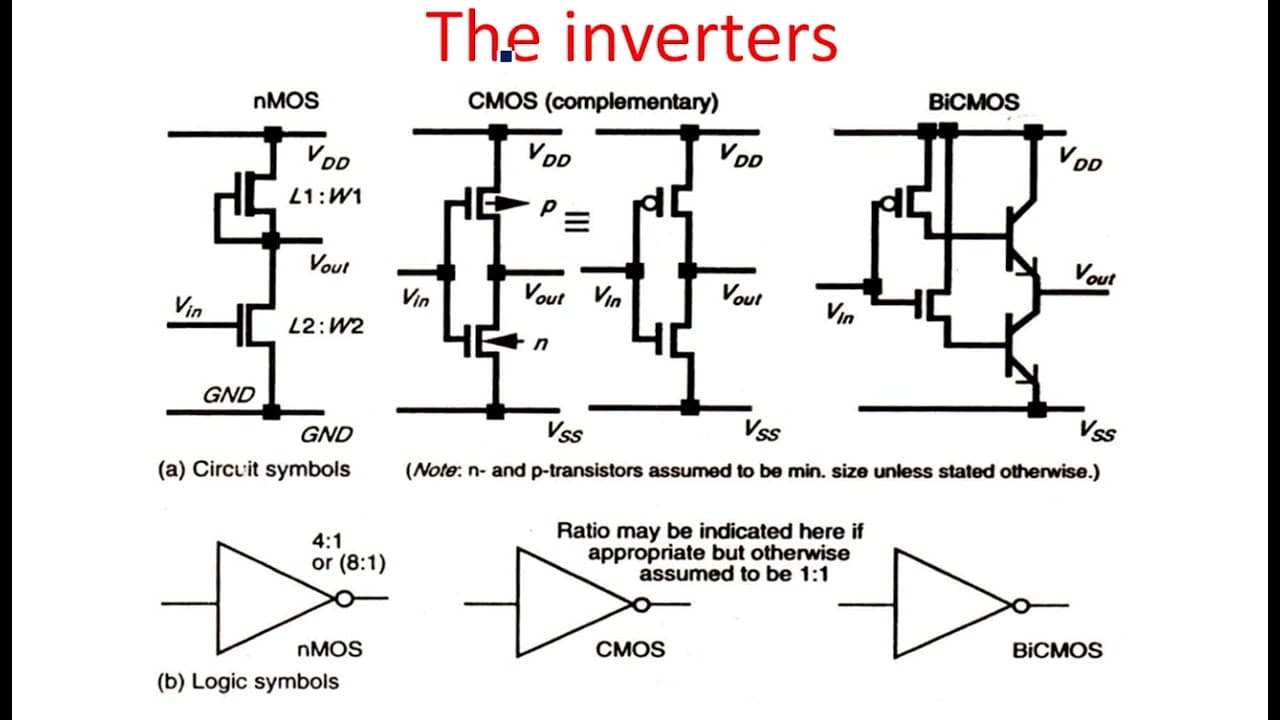
- 🧑🏭 Inverters are essential circuits that produce complemented outputs, acting as the basis for constructing more complex logic gates.
- 🎨 The design of NAND and NOR gates can vary significantly between NMOS, CMOS, and BiCMOS configurations, highlighting the intrinsic properties of the technology used.
- 🥠 The ability to modify threshold voltages via substrate terminals in MOS technology enhances design flexibility and performance tuning for transistors.
Install to Summarize YouTube Videos and Get Transcripts
Explore YouTube Video Summarizer or Get YouTube Transcript Extractor
Questions & Answers
Q: What are the primary types of logic gates discussed in the video?
The video primarily discusses inverters, NAND gates, and NOR gates, explaining their design and operation using NMOS, CMOS, and BiCMOS technologies. Each gate serves a unique function in logic circuits, making them fundamental in digital electronics.
Q: How does NMOS logic differ from CMOS logic?
NMOS logic uses only NMOS transistors for constructing logic circuits, whereas CMOS logic utilizes both NMOS and PMOS transistors. This combination in CMOS technology offers advantages such as lower power consumption and improved performance, especially in binary states.
Q: What role do depletion mode transistors play in NMOS inverters?
In NMOS inverters, depletion mode transistors enable high logic levels without needing an input to turn them on since they inherently conduct. This property ensures that the inverter can produce a reliable output when inputs are low, optimizing performance in digital circuits.
Q: Can you explain the push-pull configuration in BiCMOS technology?
The push-pull configuration in BiCMOS technology involves using NPN and PNP transistors to efficiently switch between high and low outputs. In this setup, one transistor conducts while the other remains off, providing a reliable output state while minimizing power loss during transitions.
Q: What are the advantages of using CMOS technology over NMOS?
CMOS technology offers several advantages over NMOS, including lower power consumption due to the complementary nature of PMOS and NMOS transistors, improved noise margins, and a higher threshold voltage, enabling better performance in various digital applications.
Q: How does the use of substrate terminals enhance transistor performance?
Substrate terminals in MOS technology allow for adjustments in threshold voltage through body biasing. This capability provides designers with increased flexibility in tuning transistor behavior, improving performance, and managing power consumption in digital circuits.
Q: What does "Universal Gates" refer to in the context of this video?
"Universal Gates" refers to gates like NAND and NOR, which can implement any logic function. The video highlights how these gates can be constructed using NMOS and CMOS technologies, demonstrating their vital roles in digital circuit design and flexibility in logic design.
Q: What will be covered in the next video, as mentioned?
In the next video, the speaker will explore different forms of CMOS logic functions, including pseudo-NMOS, dynamic logic, and clocked CMOS logic. This progression will enhance viewers' understanding of advanced logic designs and their applications in modern digital architectures.
Summary & Key Takeaways
-
The video introduces basic gate logic, including inverters and universal gates like NAND and NOR, using NMOS and CMOS technologies.
-
It explains how NMOS logic consists solely of NMOS transistors, while CMOS combines NMOS and PMOS transistors for enhanced functionality.
-
Different methods to design these gates are demonstrated, providing insights into their operation and application in digital circuits.
Read in Other Languages (beta)
Share This Summary 📚
Summarize YouTube Videos and Get Video Transcripts with 1-Click
Try YouTube Summary with ChatGPT & Claude or YouTube Transcript Generator