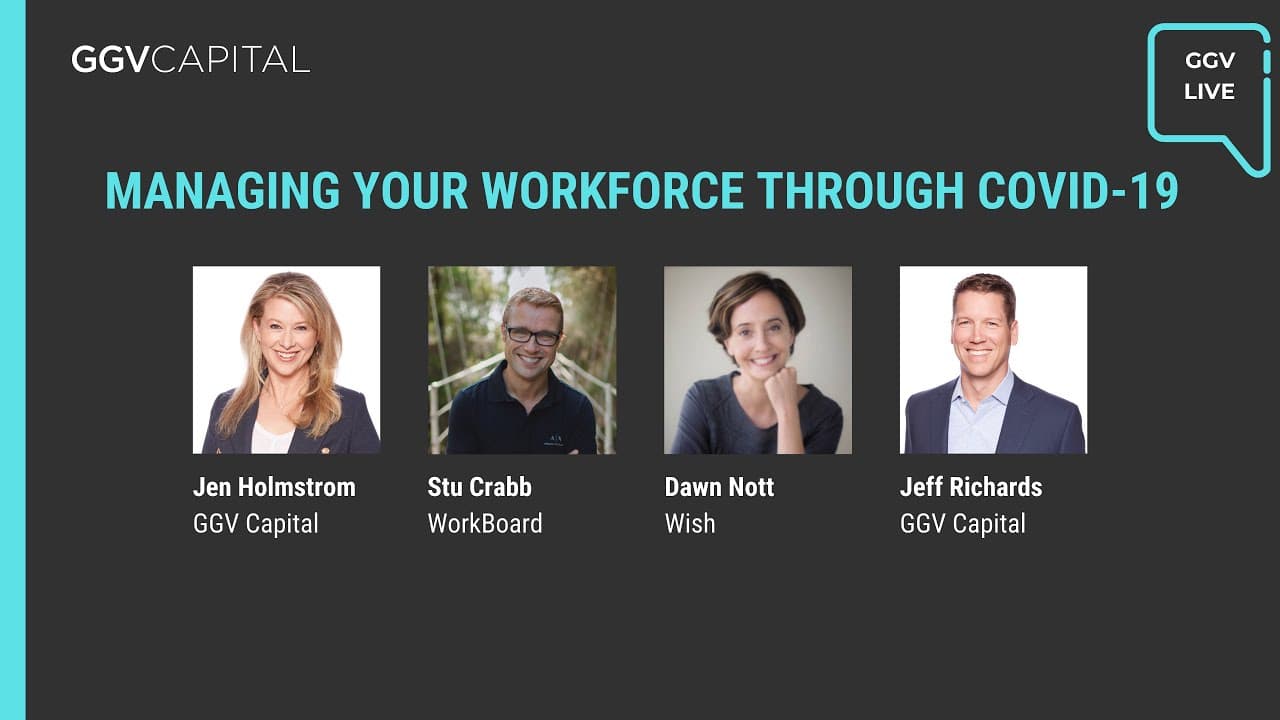
Managing Your Workforce Through COVID-19
TL;DR
Venture capital firm discusses the challenges of managing companies during the COVID-19 crisis and shares insights and best practices for remote work and employee well-being.
Transcript
Stu and dawn thank you guys for for joining this morning you know as you can imagine as a venture capital firm we've got well over 100 companies in the United States and 200 plus worldwide and this you know this crisis really hit everybody meets its unprecedented right I mean I was talking to a CEO last week about you know oh eight oh nine and oh w... Read More
Key Insights
- 💦 The crisis has accelerated the need for remote work and virtual connectivity, emphasizing the importance of effective communication and support for employees.
- 🪡 Managers need to focus on humanistic needs, including engagement, belonging, and personal accomplishment, while navigating the challenges of the crisis.
- 🧘 Mindfulness practices, such as meditation and deep breathing, can help manage anxiety and improve overall well-being during this time.
- 🥇 Companies should have strategies in place for digital-first interactions and adjust their priorities to meet evolving customer needs and expectations.
- 🪡 Layoffs and workforce management require empathy, transparency, and support for impacted employees, as well as a survivor strategy to address the needs of remaining employees.
- 😒 The use of video conferencing tools should be supplemented with deep listening and personal one-on-one connections to ensure effective communication and understanding.
- 🧑💼 The transition back to physical workspaces will require adaptation and reevaluation of office layouts, schedules, and employee concerns.
Install to Summarize YouTube Videos and Get Transcripts
Explore YouTube Video Summarizer or Get YouTube Transcript Extractor
Questions & Answers
Q: How are companies approaching remote work and employee engagement during the crisis?
Companies are prioritizing connectivity and creating a sense of community by increasing communication channels, implementing regular check-ins, and providing resources for mental health and well-being.
Q: How can managers support employees who are experiencing anxiety and stress?
Managers can create a safe and open environment for employees to express their concerns, offer resources for managing anxiety, encourage self-care practices, and provide flexibility in work schedules and responsibilities.
Q: What are some effective communication protocols and channels for organizations during this time?
Companies are leveraging video conferencing tools like Zoom, conducting regular check-ins and daily stand-ups, and utilizing platforms like Workboard to manage performance and communication. They are also encouraging direct communication through phone calls and utilizing digital platforms for sharing important updates.
Q: How can companies adapt their physical workspaces to ensure employee health and productivity?
Companies can consider implementing hot-desking or flexible workstations, reducing office space requirements, and reevaluating the need for in-person meetings and business travel. Prioritizing employee health and safety should guide decision-making.
Summary & Key Takeaways
-
The COVID-19 crisis has hit every sector in a short period of time, causing unprecedented challenges for executives and managers in companies of all sizes.
-
Webinars and discussions have become valuable resources for exchanging experiences and sharing best practices during these trying times.
-
Effective management strategies include understanding human behavior, prioritizing connectivity and support for employees, and helping managers navigate difficult conversations.
Read in Other Languages (beta)
Share This Summary 📚
Summarize YouTube Videos and Get Video Transcripts with 1-Click
Try YouTube Summary with ChatGPT & Claude or YouTube Transcript Generator
Explore More Summaries from GGV Capital U.S. 📚




Summarize YouTube Videos and Get Video Transcripts with 1-Click
Try YouTube Summary with ChatGPT & Claude or YouTube Transcript Generator