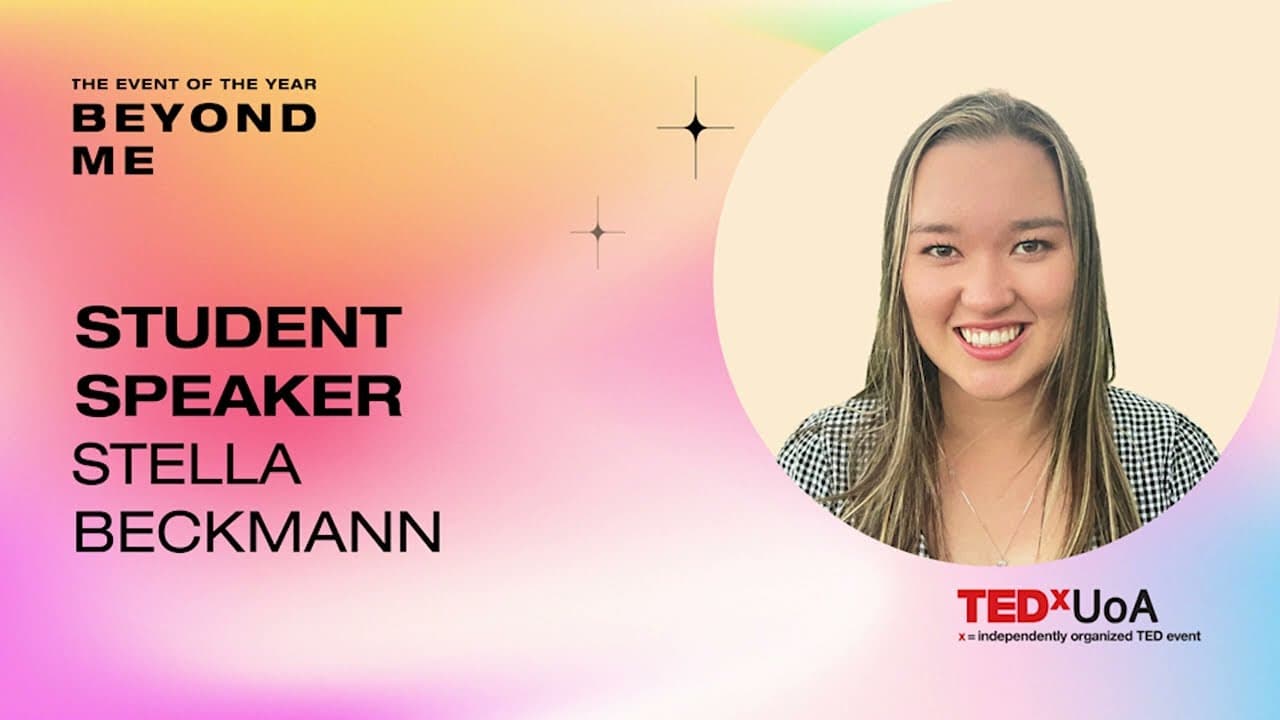
How Do the Stories We Tell Ourselves Shape Our Lives? | Stella Beckmann | TEDxUOA
TL;DR
The stories we tell ourselves shape our perceptions, identities, choices, and the trajectory of our lives. Stella Beckmann explains how egocentric bias, self-limiting beliefs, and upward social comparisons can pull personal narratives away from reality, while the CARE method offers a framework to clarify, activate, redesign, and rewire them. Read on to discover how changing your internal story can support a more fulfilling life.
Transcript
I thought I'd start off with a bad first date story this guy and I were meeting for the first time at the Museum everything was going well until out of nowhere I started to feel a little nauseous before I had time to do anything I vomited all over him and right in front of him all over the floor of the museum food poisoning definitely not the best ... Read More
Key Insights
- "our perception of the world is also a result of the stories that we've internalized" (1:30)
- "Life of Pi taught me that we all possess the ability to craft our own stories narratives that can Empower us to live more fulfilling lives" (2:53)
- "within ourselves we construct our own stories to make sense of the world and our place in it" (3:48)
- "we always believe that others are paying more attention to us than they actually are" (5:44)
- "I realized that I hadn't been limited by my abilities but by the story that I was telling myself about those abilities" (7:32)
Install to Summarize YouTube Videos and Get Transcripts
Explore YouTube Video Summarizer or Get YouTube Transcript Extractor
Questions & Answers
Q: How do the stories we tell ourselves shape our lives?
Internal stories help us make sense of the world and our place in it. Because biases, beliefs, and experiences influence these narratives, they can shape our perceptions, identities, choices, and the trajectory of our lives.
Q: Why does Stella Beckmann discuss her bad first date?
Beckmann describes vomiting on her date at a museum after getting food poisoning. She could treat the incident as defining the date or reinterpret it as a unique way to break the ice, and the two remain friends.
Q: What did Life of Pi teach Stella Beckmann about storytelling?
Life of Pi showed her how Pi uses storytelling to survive and cope after a shipwreck. It inspired her to reevaluate her own narrative and recognize that people can craft stories that empower them to live more fulfilling lives.
Q: What is egocentric bias?
Egocentric bias is the tendency to think the world revolves around us and that other people notice us more than they actually do. Recognizing this bias can help people care less about minor flaws, stay present, and express themselves more freely.
Q: What does the spotlight effect experiment demonstrate?
Participants wearing embarrassing Barry Manalo shirts estimated that more people noticed the shirts than actually did. Their focus on their own embarrassment caused them to overestimate how much attention others paid.
Q: How do self-limiting beliefs affect our abilities?
Self-limiting beliefs can make people treat a discouraging personal story as an actual limit on their ability. Beckmann realized this when she hit a difficult singing note after momentarily forgetting her belief that the song was beyond her range.
Q: What factors influence self-limiting beliefs?
These beliefs are heavily influenced by external factors such as friends, family, upbringing, culture, and religion. They can either empower people or limit them in personal and professional life.
Q: How can the CARE method help change internal narratives?
The CARE method provides a framework for changing internal narratives through four stages: Clarify, Activate, Redesign, and Rewire. Taking small steps and celebrating small victories can support long-term transformation.
Summary & Key Takeaways
-
The author shares a personal story about an embarrassing first date experience and how they chose to view it as an opportunity to break the ice.
-
They discuss the importance of storytelling in preserving culture and helping us make sense of the world.
-
Biases such as egocentric bias, self-limiting beliefs, and upward social comparisons can create narratives that hold us back.
Read in Other Languages (beta)
Share This Summary 📚
Summarize YouTube Videos and Get Video Transcripts with 1-Click
Try YouTube Summary with ChatGPT & Claude or YouTube Transcript Generator
Explore More Summaries from TEDx Talks 📚
Summarize YouTube Videos and Get Video Transcripts with 1-Click
Try YouTube Summary with ChatGPT & Claude or YouTube Transcript Generator