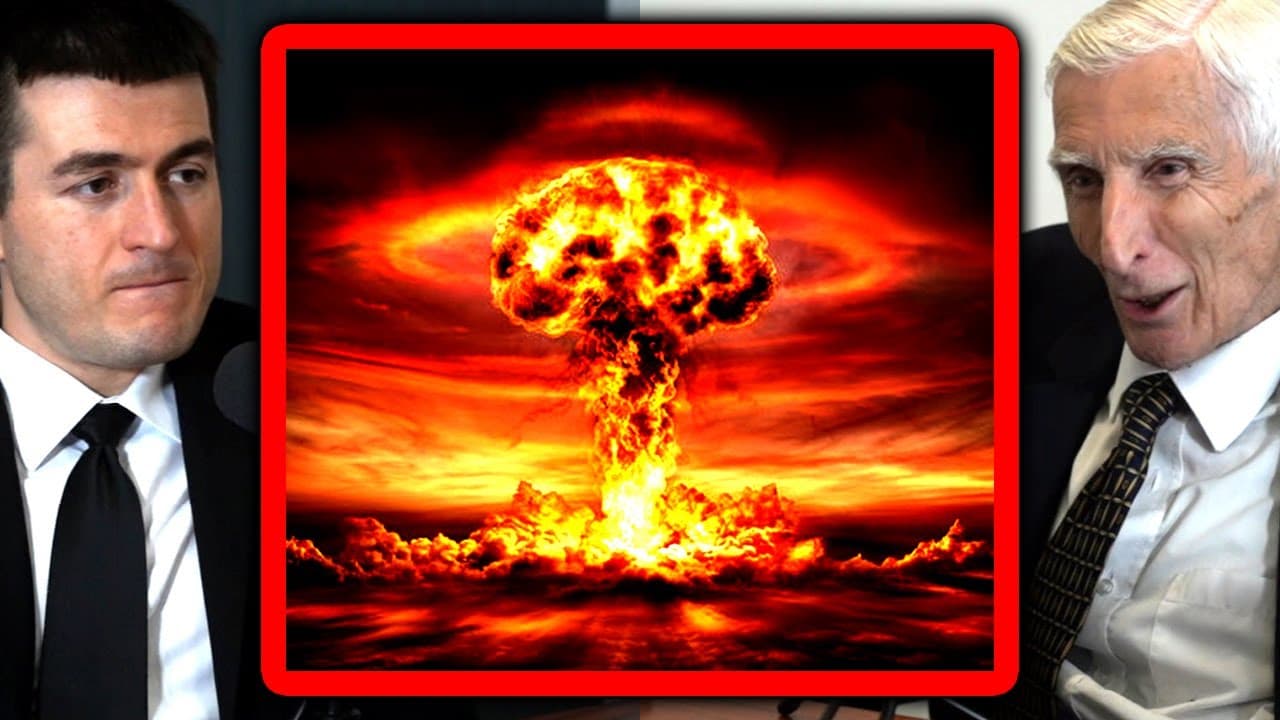
What will destroy human civilization? | Martin Rees and Lex Fridman
TL;DR
Human civilization is most threatened by climate change, biodiversity loss, and the misuse or breakdown of powerful technologies, especially biotechnology and cyber systems. Martin Rees warns that small groups could engineer more transmissible viruses, while AI-enabled attackers might disrupt critical infrastructure once targeted mainly by states. He also notes that the sun will die in about six billion years, though humans may be long gone. Read on for how these risks could cascade globally.
Transcript
what's the other thing on the horizon for humans uh in terms of the sun burning out all those kinds of interesting cosmological threats to our civilization well i think only cosmological time together because it won't be humans because uh something else even if evolution has gone no faster than darwinian and i would argue it will be thousands in th... Read More
Key Insights
- 😀 Humans face cosmological threats in the distant future, but the evolution of other entities could render us obsolete.
- 💋 The transition from flesh and blood to cyborgs may occur in this century, marking a significant shift in biology and complexity.
- 👊 The two major concerns for humanity are climate change and loss of biodiversity, and the threat of technology misuse through bioweapons and cyber attacks.
- 🌍 The world's interconnectedness brings both benefits and vulnerabilities, requiring a delicate balance between resilience and efficiency.
- 🌍 The size of the gap between the current state of the world and its potential highlights ethical shortcomings and the need for collective improvement.
- 💄 Social media can exacerbate polarization, making it harder to achieve a moderate consensus and govern effectively.
- 😌 The responsibility for addressing global challenges lies with charismatic leaders, scientists, politicians, and social media companies.
Install to Summarize YouTube Videos and Get Transcripts
Explore YouTube Video Summarizer or Get YouTube Transcript Extractor
Questions & Answers
Q: What could destroy human civilization according to Martin Rees and Lex Fridman?
Martin Rees identifies planetary damage and technological misuse as the central threats. He specifically highlights climate change, biodiversity loss, engineered pathogens, large-scale cyberattacks, and failures of increasingly complex systems; Lex Fridman also raises the danger of nuclear war.
Q: What are Martin Rees’s two main categories of threats to humanity?
The first is humanity’s growing impact on the planet through greater population, energy and resource demands, climate change, and biodiversity loss. The second is technological misuse, because even small malevolent or careless groups could trigger effects that cascade globally.
Q: Could an engineered virus cause a global catastrophe?
Rees describes this as his worst nightmare: a small group with biotechnology expertise might engineer a virus to be more virulent or transmissible than a natural virus. Because the world is interconnected, he argues that a disaster beginning in one region could spread globally.
Q: Why are large-scale cyberattacks a major threat to civilization?
Modern societies increasingly depend on interconnected systems, making disruptions more damaging and difficult to contain. Rees cites a 2012 American Pentagon report about a possible state-level cyberattack on the eastern United States electricity grid and suggests that AI might now empower a small group to attempt what once required a state actor.
Q: How could artificial intelligence increase technological risks?
Rees suggests that AI could empower small groups to conduct cyberattacks that previously would have required a state actor. He also warns that excessive dependence on AI and complex systems creates vulnerability to malicious attacks and innocent breakdowns that may be difficult to repair.
Q: How could failures in critical systems worsen a pandemic?
Rees asks readers to consider how much worse the pandemic would have been if the internet had failed during it. Communication and services depended heavily on the internet and Zoom, so losing those systems could have greatly intensified the disruption.
Q: Will the sun’s death destroy humanity?
Rees says the sun is expected to die in about six billion years, but he does not expect present-day humans to witness it. Any surviving entities might differ from humans as much as humans differ from slime mold, especially if they become electronic.
Q: Could humans transition from flesh-and-blood beings to cyborgs?
Rees says this century may see a transition from purely flesh-and-blood entities to cyborgs. He describes that possibility as an important transition in biology and complexity, although the transcript does not specify exactly how or when it would occur.
Summary & Key Takeaways
-
The sun burning out and other cosmological threats will have a significant impact on humanity in the distant future.
-
The transition from flesh and blood entities to cyborgs is a possibility in the near future, changing the nature of human existence.
-
The two major concerns for humanity are climate change and loss of biodiversity, and the threat of technology misuse, specifically bioweapons and cyber attacks.
Read in Other Languages (beta)
Share This Summary 📚
Summarize YouTube Videos and Get Video Transcripts with 1-Click
Try YouTube Summary with ChatGPT & Claude or YouTube Transcript Generator
Explore More Summaries from Lex Clips 📚





Summarize YouTube Videos and Get Video Transcripts with 1-Click
Try YouTube Summary with ChatGPT & Claude or YouTube Transcript Generator