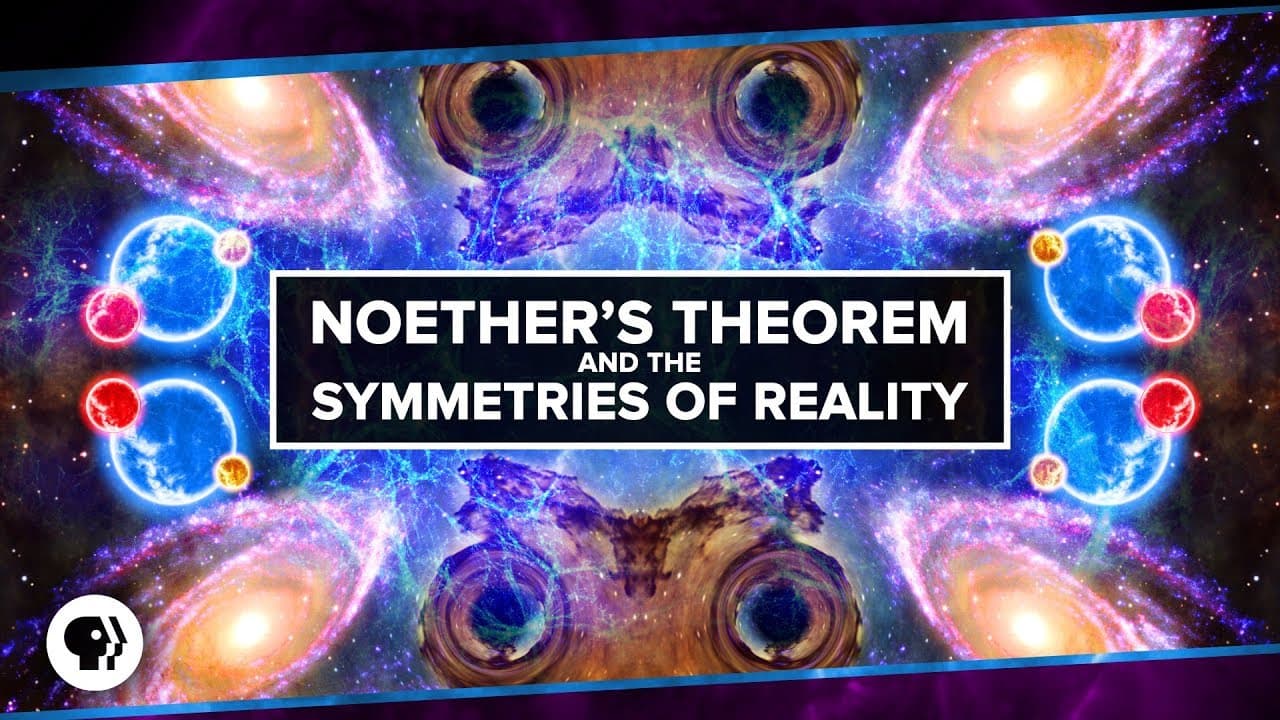
Noether's Theorem and The Symmetries of Reality
TL;DR
Noether's theorem links conservation laws to symmetries in physics.
Transcript
Thank you to Brilliant for supporting PBS Digital Studios. Conservation laws are among the most important tools in physics. They feel as fundamental as you can get. And yet they're wrong, or at least they're only right sometimes. These laws are consequences of a much deeper,... ...more fundamental principle, Noether's Theorem. Conservation laws ... Read More
Key Insights
- Noether's theorem establishes a profound connection between conservation laws and symmetries in the universe, revealing that every continuous symmetry corresponds to a conserved quantity.
- The theorem clarifies why conservation laws, such as energy conservation, can appear to break down under certain conditions, such as in general relativity.
- Continuous symmetries, unlike discrete ones, maintain their form under any size shift in a given coordinate, leading to conserved quantities like momentum and energy.
- In general relativity, the dynamic nature of space and time can break continuous time symmetry, explaining energy loss in phenomena like cosmological redshift.
- Noether's theorem is derived from the Principle of Least Action, a fundamental concept stating that systems evolve by minimizing action, a measure of effort over time.
- The theorem applies to quantum physics, where symmetries in quantum fields lead to conserved charges like electric charge, based on phase symmetry.
- Gauge symmetries in quantum fields, predicted by Noether's theorem, underpin the standard model of particle physics, describing interactions between fundamental particles.
- Emmy Noether's contributions to mathematics and physics were groundbreaking, yet her recognition was limited due to gender biases during her time.
Install to Summarize YouTube Videos and Get Transcripts
Explore YouTube Video Summarizer or Get YouTube Transcript Extractor
Questions & Answers
Q: What is the main idea behind Noether's theorem?
Noether's theorem fundamentally links conservation laws to symmetries in the universe. For every continuous symmetry in nature, there exists a corresponding conserved quantity. This profound insight helps explain why certain conservation laws, like energy conservation, can appear to break down under specific conditions, such as in the context of general relativity.
Q: How does Noether's theorem explain the breakdown of energy conservation in general relativity?
In general relativity, the dynamic and changeable nature of space and time can lead to the breaking of continuous time symmetry. This results in the apparent breakdown of energy conservation, as seen in phenomena like cosmological redshift. Noether's theorem helps clarify this by showing that energy conservation is only a special case in parts of the universe where space can be approximated as unchanging over time.
Q: What role does the Principle of Least Action play in Noether's theorem?
The Principle of Least Action is a foundational concept that underlies Noether's theorem. It states that systems evolve by minimizing action, a measure of effort over time. This principle is used to derive laws of motion in classical and quantum mechanics. Noether's theorem extends this principle to identify conserved quantities based on the symmetries of a system, highlighting its broad applicability across physics.
Q: How is Noether's theorem applicable to quantum physics?
In quantum physics, Noether's theorem applies to the symmetries of quantum fields, leading to conserved charges like electric charge. These symmetries, known as gauge symmetries, are fundamental to the standard model of particle physics, describing interactions between particles. The theorem's general nature allows it to be applied to various symmetries beyond just space and time, making it crucial for understanding quantum interactions.
Q: What is the significance of gauge symmetries in the standard model of particle physics?
Gauge symmetries, predicted by Noether's theorem, are essential to the standard model of particle physics. They describe the fundamental interactions between particles, such as the strong interaction between quarks and gluons. These symmetries lead to a family of conserved charges, governing the behavior of particles within the standard model, making them crucial for understanding the fundamental forces and particles in the universe.
Q: Who was Emmy Noether, and what were her contributions to physics?
Emmy Noether was a pioneering mathematician whose work revolutionized our understanding of conservation laws and symmetries in physics. Her theorem linked these concepts, providing a foundational framework for modern physics. Despite her groundbreaking contributions, she faced significant gender discrimination during her time, receiving limited recognition. Her work continues to influence fields from cosmology to quantum physics.
Q: Why are conservation laws considered 'cheat codes' in physics?
Conservation laws are often referred to as 'cheat codes' in physics because they simplify the process of solving complex problems. By identifying conserved quantities based on symmetries, these laws provide shortcuts to understanding and predicting the behavior of physical systems. This makes otherwise difficult or impossible problems more manageable, highlighting their fundamental importance in the field.
Q: How does Noether's theorem relate to the concept of symmetries in nature?
Noether's theorem establishes a direct relationship between symmetries in nature and conservation laws. It states that for every continuous symmetry, there is a corresponding conserved quantity. This connection reveals the underlying structure of physical laws, showing that symmetries are not just aesthetic features but fundamental aspects that dictate the conservation of physical properties like energy and momentum.
Summary & Key Takeaways
-
Noether's theorem provides a foundational understanding of conservation laws by linking them to continuous symmetries in nature. This principle explains why energy conservation appears to break down in certain scenarios, such as general relativity, due to the dynamic nature of space and time.
-
The Principle of Least Action, a fundamental concept in physics, underlies Noether's theorem. It states that systems evolve by minimizing action, which can derive laws of motion across classical mechanics and quantum mechanics, highlighting the theorem's broad applicability.
-
Emmy Noether's work revolutionized our understanding of conservation laws and symmetries in physics, yet her contributions were undervalued during her lifetime due to gender discrimination. Her theorem continues to influence fields ranging from cosmology to quantum physics.
Read in Other Languages (beta)
Share This Summary 📚
Summarize YouTube Videos and Get Video Transcripts with 1-Click
Try YouTube Summary with ChatGPT & Claude or YouTube Transcript Generator
Explore More Summaries from PBS Space Time 📚





Summarize YouTube Videos and Get Video Transcripts with 1-Click
Try YouTube Summary with ChatGPT & Claude or YouTube Transcript Generator