Why Did SR-71 Tires Deform While Parked?
TL;DR
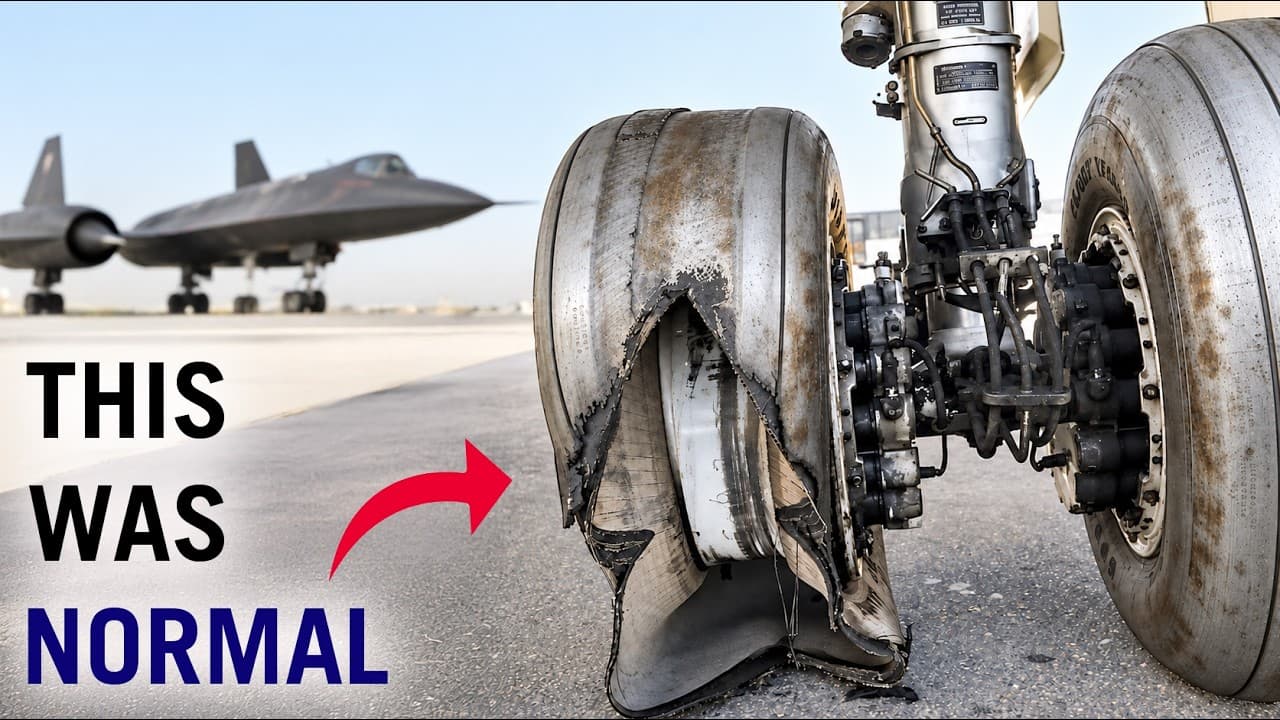
SR-71 tires permanently deformed while parked because aluminum made their rubber exceptionally stiff under the aircraft's weight. The aluminum reflected radiant heat from the hot airframe, while pure nitrogen at 415 PSI removed oxygen that could ignite inside the tires. This heat-resistant design came with a short service life of only 15 to 20 landings.
Transcript
On August 31st, 1974, a crew of two suited up in full pressure space suits at Beale Air Force Base in California with a simple mission on their mind. To shatter the transatlantic speed record [music] from New York to London. It sounds like an ambitious goal, but not when your aircraft is the freaking SR-71, the fastest, the hardest, and the hottest... Read More
Key Insights
- The SR-71's tires permanently deformed while parked because aluminum made them extremely stiff, allowing the aircraft's weight to create lasting flat spots. This was an accepted consequence of designing tires that could survive the intense radiant heat produced during Mach 3 flight.
- The SR-71's tires contained aluminum that gave them a distinctive silver color and reflected radiant heat from the hot airframe. Regular rubber tires could have melted or exploded from trapped heat, so Goodrich developed these specialized tires for the Blackbird and the XB-70 Valkyrie.
- The SR-71's tires were inflated with pure nitrogen at 415 PSI to eliminate oxygen that could ignite inside them. Even with their specialized construction and inflation, the tires had a limited service life and lasted for only 15 to 20 landings.
- The SR-71's airframe was 92% titanium because the metal offered the strength of steel at half the weight. Since the United States lacked the necessary domestic ore supplies, the CIA used dummy corporations and shell companies to procure titanium originating in the Soviet Union.
- Trace chlorine in Burbank tap water caused stress corrosion in titanium panels washed during summer, when the city added more chlorine to prevent reservoir algae. Skunk Works solved the seasonal cracking problem by washing the SR-71's titanium panels exclusively with distilled water.
- Cadmium-plated aerospace tools could deposit traces of cadmium on titanium bolts during tightening. When heated beyond 600 degrees Fahrenheit, the contaminated titanium could weaken until bolt heads fell off, forcing Skunk Works to replace ordinary tools with newly manufactured titanium tools.
- The SR-71 was designed to leak fuel while parked because rubber seals and fuel bladders could not withstand its operating heat. After takeoff, thermal expansion closed the gaps between titanium panels, stopping the ground leakage as the airframe heated during high-speed flight.
- The SR-71's astro-inertial navigation system combined precise inertial sensors with an automated optical tracker and a catalog of 61 stars. At 80,000 feet, it could identify stars even during daylight and continuously correct drift without relying on radio beacons that hostile nations could jam.
Install to Summarize YouTube Videos and Get Transcripts
Explore YouTube Video Summarizer or Get YouTube Transcript Extractor
Questions & Answers
Q: Why did SR-71 tires deform while parked?
SR-71 tires permanently deformed under the aircraft's weight because aluminum made their rubber construction exceptionally stiff. The aluminum was necessary because it reflected radiant heat from the extremely hot airframe and helped prevent the tires from melting. The resulting stiffness produced lasting deformation on the ground, and each tire survived only about 15 to 20 landings.
Q: How were SR-71 tires protected from extreme heat?
Goodrich infused the SR-71's custom rubber tires with aluminum, which gave them a distinctive silver appearance and reflected radiant heat coming from the airframe. The tires were also inflated to 415 PSI with pure nitrogen, leaving no oxygen inside to ignite. These protections addressed heat that could have melted or exploded conventional rubber tires.
Q: Why did the SR-71 intentionally leak fuel on the ground?
The SR-71 had no rubber seals or fuel bladders because those components would have melted under the aircraft's extreme operating heat. Engineers instead left gaps between titanium panels, causing fuel to leak while the aircraft was cold and parked. Shortly after takeoff, heat expanded the panels and closed those gaps, making the fuel system suitable for Mach 3 flight.
Q: How did chlorine damage the SR-71's titanium panels?
Titanium panels welded during summer cracked because Burbank added extra chlorine to its tap water during that season to control algae in reservoirs. Lockheed used the same water to wash the panels. Even microscopic chlorine traces caused stress corrosion and weakened titanium at the molecular level. Skunk Works prevented further damage by switching exclusively to distilled water.
Q: Why did Skunk Works manufacture titanium tools?
Standard aerospace wrenches often had cadmium plating to resist corrosion, but tightening titanium bolts could leave cadmium traces behind. When contaminated bolts reached temperatures above 600 degrees Fahrenheit, their titanium could weaken so severely that the bolt heads fell off. Skunk Works therefore removed hundreds of ordinary tools and manufactured replacement tools from titanium.
Q: How did the United States obtain titanium for the SR-71?
The United States lacked the domestic ore supplies needed to manufacture enough titanium when the SR-71 program was being developed. The Soviet Union possessed the required material, so the CIA established a global network of dummy corporations and shell companies in other countries to procure it covertly. The resulting Blackbird airframes were 92% titanium.
Q: How did the SR-71 navigate before GPS?
The SR-71 used an astro-inertial navigation system that paired high-precision inertial sensors with an automated optical tracker beneath a circular quartz window. A ground computer prepared navigation tapes and the crew's route map before flight. Using a catalog of 61 stars, the tracker repeatedly corrected inertial drift without depending on ground radio beacons that enemies could jam.
Q: How could the SR-71 navigate by stars during daylight?
At the SR-71's operating altitude of 80,000 feet, the atmosphere was thin enough for its optical tracker to observe celestial bodies even in broad daylight. The astro-inertial system compared those observations with its catalog of 61 stars to correct navigational drift. Its precise coordinates kept reconnaissance sensors aligned with narrow target areas far below the aircraft.
Summary & Key Takeaways
-
The SR-71 crossed from New York to London in 1 hour, 55 minutes, and 32 seconds on August 31, 1974, breaking the previous 4-hour, 46-minute record. No Blackbird was ever shot down despite thousands of missiles being fired at the aircraft during its operational lifespan.
-
Sustained flight above Mach 3 heated the aircraft's skin beyond 600 degrees Fahrenheit, forcing engineers to redesign its materials and components. The airframe was 92% titanium, its tires contained aluminum, its fuel system intentionally leaked while cold, and its crew wore full pressure suits for high-altitude operations.
-
Skunk Works overcame unusual manufacturing and operational problems caused by titanium, heat, and extreme speed. Distilled water prevented chlorine contamination, titanium tools avoided cadmium damage, and an astro-inertial navigation system tracked a catalog of 61 stars, including during daylight at 80,000 feet, to correct navigational drift.
Read in Other Languages (beta)
Share This Summary 📚
Summarize YouTube Videos and Get Video Transcripts with 1-Click
Try YouTube Summary with ChatGPT & Claude or YouTube Transcript Generator
Explore More Summaries from Not What You Think 📚



Summarize YouTube Videos and Get Video Transcripts with 1-Click
Try YouTube Summary with ChatGPT & Claude or YouTube Transcript Generator