How to Calculate the Center of Mass for Three Objects
TL;DR
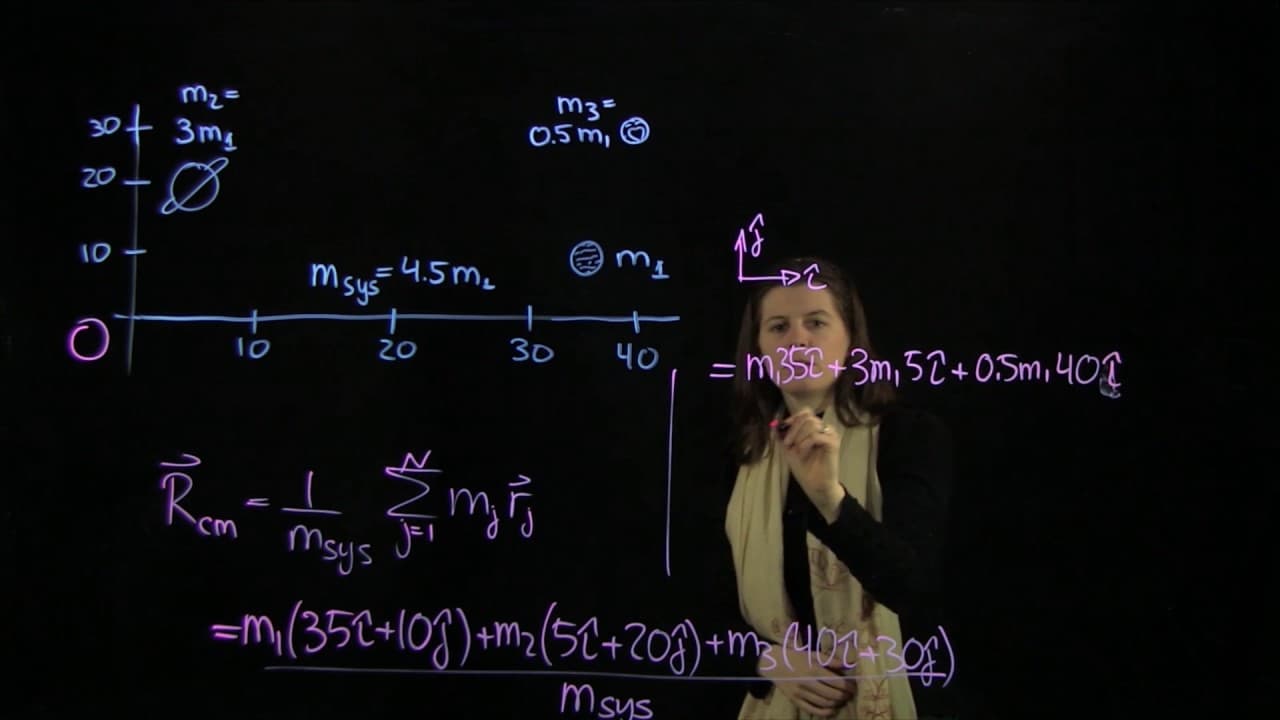
To calculate the center of mass for three objects, sum the products of each object's mass and its position, and then divide by the total mass of the system. For example, with masses of 3, 1.5, and 4 Earth masses, the center of mass would be derived from their weighted positions, revealing it to be closer to the heaviest object.
Transcript
The little prince is sitting on his little planet, and he's watching the planets go by. And so suddenly, he's seeing three of them. One, two, three. And he wonders, hmm, what would the center of mass of these three planets be? So let's calculate it. We have one planet here that's three times the mass of this guy. And then this one has half of m1. A... Read More
Key Insights
- 💆 The center of mass is a useful concept in physics for analyzing the motion of systems of objects.
- 💆 The position of the center of mass depends on the masses and distances of the objects in the system.
- 💆 The total mass of the system is an important factor in calculating the position of the center of mass.
- 💆 The center of mass can be used to simplify calculations and make predictions about the motion of the system.
- 😚 In the example given, the center of mass is closer to the heaviest planet, Saturn, indicating that it holds more of the system's weight.
- 💆 The calculation of the center of mass can be done using approximate math, but more accurate results can be obtained by using actual masses.
- 💆 The position of the center of mass can vary depending on the arrangement of the objects in the system.
Install to Summarize YouTube Videos and Get Transcripts
Explore YouTube Video Summarizer or Get YouTube Transcript Extractor
Questions & Answers
Q: What is the center of mass?
The center of mass is a point in a system where the total mass can be considered to be concentrated. It is the average position of the masses in the system.
Q: How is the total mass of the system calculated?
The total mass of the system is calculated by adding up the masses of all the objects in the system. In this case, it is the sum of the masses of the three planets.
Q: How are the distances between the planets and the center of mass calculated?
The distances between the planets and the center of mass are calculated by measuring the distances from each planet to the center of the coordinate system.
Q: What factors affect the position of the center of mass?
The position of the center of mass is determined by the masses of the objects and their respective distances from the origin of the coordinate system. Changing any of these factors will affect the position of the center of mass.
Summary & Key Takeaways
-
The video demonstrates how to calculate the center of mass for a system of three planets.
-
The total mass of the system is determined by adding up the masses of each planet.
-
Using the sum of the masses and their respective distances, the position of the center of mass can be calculated.
Read in Other Languages (beta)
Share This Summary 📚
Summarize YouTube Videos and Get Video Transcripts with 1-Click
Try YouTube Summary with ChatGPT & Claude or YouTube Transcript Generator
Explore More Summaries from MIT OpenCourseWare 📚


Summarize YouTube Videos and Get Video Transcripts with 1-Click
Try YouTube Summary with ChatGPT & Claude or YouTube Transcript Generator