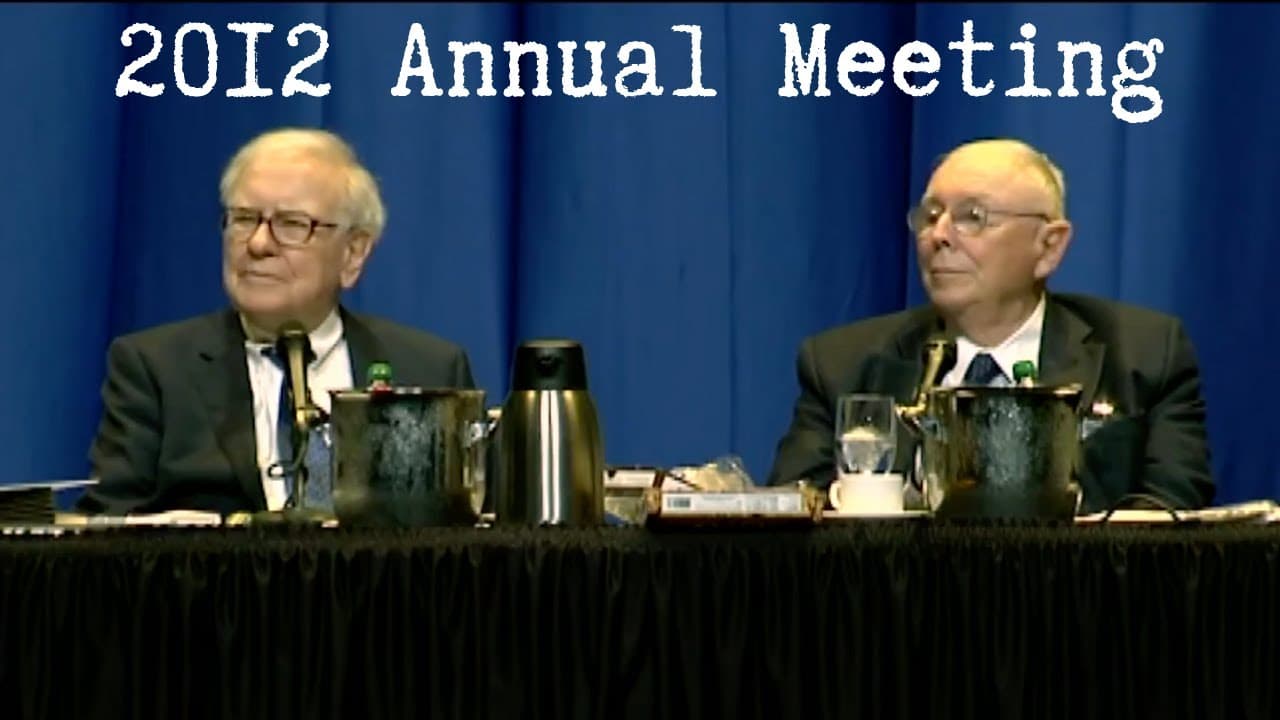
2012 Berkshire Hathaway Annual Meeting (Full Version)
TL;DR
The CEO of Berkshire must act as the chief risk officer, a role the pair argues is essential for large financial firms. The successor will need the same risk responsibility, and Berkshire can act quickly on deals when the other party is aligned. Not all negotiated deals define Berkshire, as core value comes from long term investments like Coca Cola and IBM.
Transcript
[Applause] good morning i'm more and then this hyperkinetic fellow is charlie and and we're going to uh conduct this pretty much as we have in the past we'll uh take your questions uh alternated among uh the media and analysts in the audience um until 3 30 with a break around noon uh for an hour and then we'll have the regular meeting of the uh of ... Read More
Key Insights
- The chief risk officer role is essential at Berkshire and cannot be delegated.
- The successor to Warren Buffett will also carry the chief risk officer responsibility.
- Berkshire can act with speed and finality in large transactions when the other party is willing.
- Value at risk concepts were criticized for relying on gaussian models and misapplying risk metrics.
- The Bank of America, Goldman Sachs, and GE deals were negotiated based on current circumstances and Berkshire’s capital strength.
- Large, complex deals are less important to Berkshire’s long term value than core investments.
- The current leadership believes the risk framework must account for leverage and insurance risk across units.
- The future leadership will bring different strengths and may negotiate differently while maintaining Berkshire’s risk discipline.
Install to Summarize YouTube Videos and Get Transcripts
Explore YouTube Video Summarizer or Get YouTube Transcript Extractor
Questions & Answers
Q: What is the role of the chief risk officer at Berkshire according to Buffett and Munger?
Buffett states that the CEO must be the chief risk officer, a responsibility that should not be delegated. This role involves understanding major risks that could hit Berkshire and ensuring all operations assess and manage those risks, including leverage, insurance risk, and how risks accumulate across units. Munger adds that relying on simplistic risk models has led to mistakes, emphasizing real world risk judgment over theoretical Gaussian models.
Q: How does Berkshire view the importance of negotiated deals like those with Goldman Sachs and Bank of America?
The discussion suggests that while negotiated deals can be valuable, they are not central to Berkshire’s long term value. Buffett notes that deals with major partners were possible due to Berkshire’s ability to commit and act quickly, but the core value is derived from ongoing investments and businesses like Coca Cola and IBM bought over time in the market rather than through a single negotiated transaction.
Q: What qualities make a good successor for Berkshire according to the meeting?
The successor should possess the ability to understand and manage risk across the organization, similar to Buffett’s role as chief risk officer. In addition, the successor should bring energy and capability in exploring transactions, potentially compensating for a reduced emphasis on negotiated deals while preserving Berkshire’s risk discipline and focus on long term value.
Q: What critique do Buffett and Munger offer about risk models used in finance?
They argue that risk models like value at risk based on Gaussian curves are often misapplied and can mislead even highly intelligent analysts. The implication is that real market behavior is not perfectly Gaussian and that executives must rely on practical, experience-based judgment rather than overreliance on mathematical curves.
Q: What was Berkshire’s approach to identifying and pursuing deals with large financial institutions?
Berkshire leverages its ability to act with speed and finality when there is a willing counterparty. Buffett described initiating contact with potential partners, like Bank of America, and presenting terms that could be agreed upon. The key is the counterparty’s belief in Berkshire’s commitment and financial strength, enabling negotiations that are not solely dependent on Berkshire’s size.
Q: Why does Buffett say some deals are not as important as core investments?
Buffett explains that while some deals are interesting, the value Berkshire gains most from core, long term holdings such as Coca Cola and IBM, which are built up gradually in the market. These investments demonstrate Berkshire’s ability to generate returns over time, rather than relying heavily on a few large negotiated transactions.
Q: How does the meeting describe the management structure and director involvement at Berkshire?
The meeting outlines a structure where directors and leadership participate in meetings and provide oversight. Buffett notes he would introduce directors, and the board would ensure that risk and governance are aligned with Berkshire’s long term objectives. The emphasis is on strong governance, quick decision making, and clear accountability within a disciplined framework.
Q: What does Buffett say about the successor’s potential to handle future opportunities differently?
Buffett suggests that a capable successor may handle opportunities differently, bringing new strengths and possibly focusing less on negotiated deals. However, they would still be expected to maintain Berkshire’s risk discipline and capital allocation standards, ensuring that long term value continues to be the primary objective while adapting to changing market conditions.
Summary
In this video, Warren Buffett and Charlie Munger hold their annual shareholder meeting. They discuss various topics, including the performance and outlook of Berkshire Hathaway, the importance of risk management, the impact of accounting changes on GEICO's earnings, the company's approach to share buybacks, their views on European and American banks, the role of coal and natural gas in the energy industry, GEICO's competitive advantages in pricing, and their thoughts on business school education.
Questions & Answers
Q: Can you explain the role of risk management in Berkshire Hathaway?
Warren Buffett explains that risk management is a crucial responsibility for the CEO of any large financial organization. He believes that risk management should not be delegated and that he, as the CEO of Berkshire Hathaway, is the chief risk officer. The company closely monitors risks like excessive leverage and insurance risk. They also ensure that the leaders of their insurance businesses correctly assess risks.
Q: Can you discuss the impact of accounting changes on GEICO's earnings?
Warren Buffett mentions that an accounting change called deferred policy acquisition cost (DPAC) affected GEICO's earnings negatively by about $250 million in the first quarter. However, this change does not affect the operations or cash of the company. Despite the accounting change, GEICO had a strong first quarter and remains a profitable business with good growth potential.
Q: How does Berkshire Hathaway approach share buybacks?
Warren Buffett explains that Berkshire Hathaway prefers to buy back shares when they are significantly undervalued. The company sets a threshold of 1.1 times book value for buybacks but would consider buying more if the stock is even more undervalued. Buffett emphasizes that the decision to buy back shares is made with the intention of increasing the per-share value for remaining shareholders. Berkshire Hathaway would only buy back shares if they believe it is a good investment for the company.
Q: What are your views on European and American banks?
Warren Buffett states that American banks are in a much better position compared to European banks. American banks have improved their capital positions, strengthened their balance sheets, and have more liquidity. On the other hand, European banks have struggled and needed liquidity support from the European Central Bank. Buffett believes that the difference is due to the structure and regulations of the banking systems in the two regions.
Q: How does Berkshire Hathaway view coal and natural gas as investments?
Warren Buffett points out that MidAmerican, a subsidiary of Berkshire Hathaway, is a regulated public utility that is not significantly impacted by the price of coal. They pass on the costs or benefits of coal prices to their customers. As for natural gas, Buffett believes it is a valuable resource that should be preserved rather than quickly consumed. He expresses concern about using up natural gas at very low prices, as it is a precious resource that should be conserved.
Q: How does GEICO maintain its competitive advantage in pricing?
Warren Buffett says that GEICO continually evaluates various factors related to accident propensity to determine pricing. While they have not implemented technology like telematics for pricing, they are open to adopting such innovations if they provide better predictive value for accident likelihood. GEICO focuses on risk selection, retention, and marketing to maintain its competitive edge.
Q: What changes would you suggest for business school education?
Warren Buffett acknowledges that some business schools have taught students a lot of nonsense about investments. However, he does not believe that business schools are primarily responsible for societal problems. Charlie Munger adds that business school education is improving and believes that the understanding of investing is getting better. Overall, they do not consider business schools to be the cause of major issues in the economy.
Takeaways
In this meeting, Warren Buffett and Charlie Munger discuss various topics related to Berkshire Hathaway and the economy. They emphasize the importance of risk management, the performance of their investments, and the specific challenges in the banking and energy sectors. They also comment on GEICO's competitive advantages and share their thoughts on business school education.
Summary & Key Takeaways
-
The meeting emphasizes that the CEO of Berkshire must be the chief risk officer, a role that cannot be delegated, especially for large financial firms.
-
The speakers note that Berkshire benefits from speed and commitment in negotiating deals, which helps when aligning with the other party and securing favorable terms.
-
The discussion downplays the primacy of large negotiated deals, asserting that fundamental value often comes from core holdings and steady investments over time.
Read in Other Languages (beta)
Share This Summary 📚
Summarize YouTube Videos and Get Video Transcripts with 1-Click
Try YouTube Summary with ChatGPT & Claude or YouTube Transcript Generator
Explore More Summaries from Investor Archive 📚



Summarize YouTube Videos and Get Video Transcripts with 1-Click
Try YouTube Summary with ChatGPT & Claude or YouTube Transcript Generator